Evidence Brief · Historical Comparison
Jesus: a carpenter with more significance
than Roman emperors
5M+
Words about Jesus
(first 200 yrs)
42
Independent ancient sources
25,000+
Manuscripts of the Bible
~25 yrs
Gap to earliest fragments
53
Archaeological confirmations
48+
Fulfilled OT prophecies
1. Independent ancient sources mentioning each figure
HistoricalCumulative Force
"Independent ancient source" = a distinct ancient writer (Christian, Jewish, Greek, Roman, or other) who refers to the figure in a surviving work composed within ~150 years of their lifetime. Higher = stronger historical anchoring.
Source-count comparison
 Jesus
Jesus
42 sources
 Julius Caesar
10 sources
 Plato
Plato
8 sources
 Alexander the Great
6 sources
 Homer
Homer
5 sources
 Aristotle
5 sources
 Marcus Aurelius
4 sources
Why this matters: Historians treat 2–3 independent ancient sources as sufficient to establish a person's existence. Caesar's existence rests on 10. Alexander's on 6. Jesus is documented by 42 independent ancient writers — including hostile witnesses (Tacitus, Suetonius, Pliny the Younger) and a non-Christian Jewish historian (Josephus). The volume of independent corroboration for Jesus is unmatched in the ancient world.
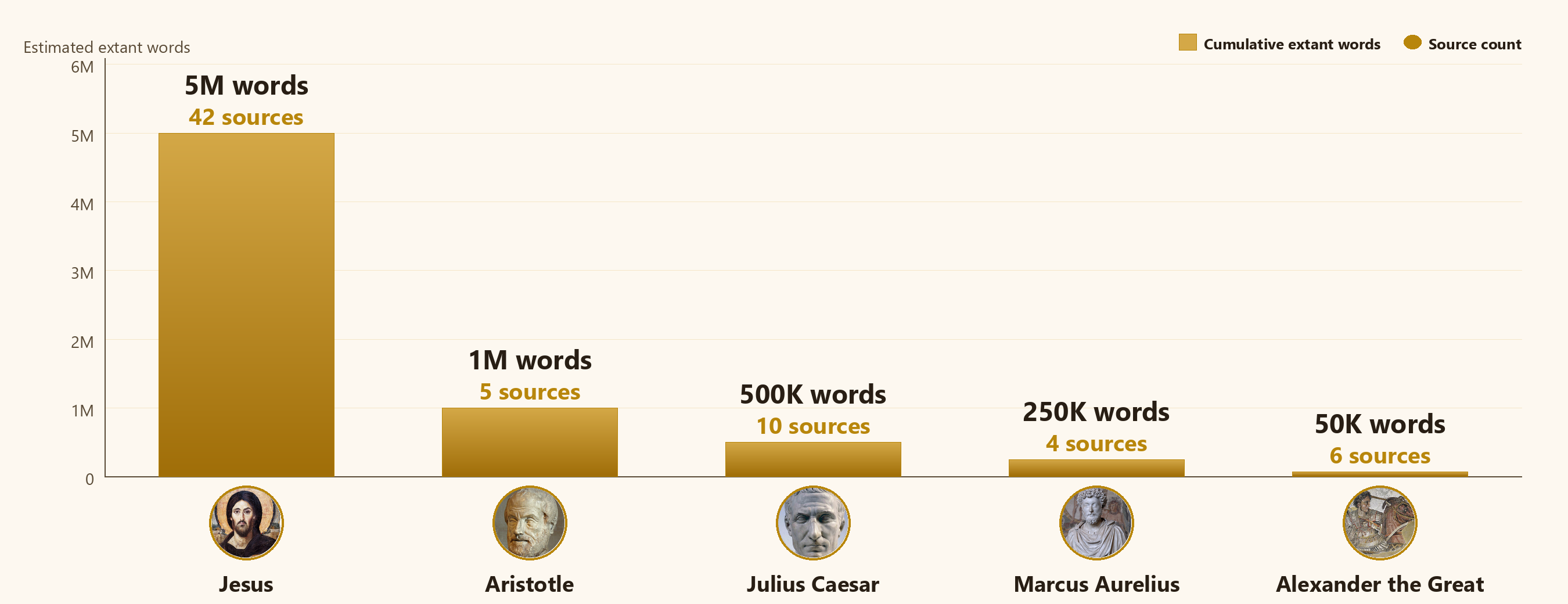
2. Estimated cumulative text volume (first 100–200 years post-life)
Cumulative ForceMathematical
Word counts of extant ancient writings — primary works by the figure plus biographical / historical references — that have survived in the ancient literary record within ~200 years of their lifetime.
| Figure | Window | Cumulative words | Composition of the corpus |
|---|
| Jesus | AD 33–233 | ~5,000,000 | 27 NT books + Apostolic Fathers (Clement, Ignatius, Polycarp, Didache, Hermas) + 2nd-c. apologists (Justin Martyr, Irenaeus, Tertullian, Clement of Alexandria, Origen) + non-Christian refs (Tacitus, Josephus, Pliny, Suetonius) |
| Aristotle | 322–122 BC | ~1,000,000 | Corpus Aristotelicum (surviving lectures & treatises) + Theophrastus and early Peripatetic biographical refs |
| Plato | 347–147 BC | ~600,000 | The 36 dialogues + Aristotle's many references + 3rd-c. Academy literature |
| Julius Caesar | 44 BC–AD 156 | ~500,000 | Caesar's Commentarii + Cicero's orations and letters + Sallust + Velleius Paterculus |
| Homer | ~700–500 BC | ~270,000 | Iliad (~155K words) + Odyssey (~117K words) + Hesiod's references |
| Marcus Aurelius | AD 180–380 | ~250,000 | Meditations + Cassius Dio + Herodian + early sections of Historia Augusta |
| Alexander the Great | 323–123 BC | ~50,000 | Primary sources (Callisthenes, Cleitarchus, Ptolemy, Aristobulus) are lost. Arrian and Plutarch came ~400 years later. |
Read the rows: The figure historians call "the most documented man in antiquity" — Alexander the Great — has roughly 1% of the text volume that survives about Jesus. Even Plato (whose own writings survive nearly intact) has 12% of Jesus's corpus. Aristotle, including the entire Corpus Aristotelicum, has 20%.
What "5,000,000 words" actually is: The full New Testament is ~138,000 Greek words. The surviving Apostolic Fathers add ~300,000. The early apologists (Justin, Irenaeus, Tertullian, Clement of Alexandria, Origen) wrote 4M+ words discussing or quoting Jesus. By AD 233, every single sentence of the New Testament could be reconstructed from the citations of the Church Fathers alone — with eleven verses to spare.
3. Manuscript survival and time-to-earliest-copy
HistoricalMathematical
For any ancient writing, historians ask two questions: How many copies survive? and How close is the earliest surviving copy to the original? The smaller the gap and the larger the count, the more confident we are in the reconstructed text.
| Work | Manuscripts (extant) | Gap to earliest copy | Accuracy of reconstructed text |
|---|
| The Bible (NT) | 25,000+ | ~25 years | 99.5%+ |
| Homer's Iliad | ~1,800 | ~400 years | ~95% |
| Aristotle | ~1,000 | ~1,400 years | fragmentary in places |
| Plato | 210 | ~1,200 years | generally trusted |
| Caesar's Gallic Wars | 10 | ~1,000 years | generally trusted |
| Tacitus's Annals | 20 | ~1,000 years | generally trusted |
Time-gap visualization (years from original writing to earliest extant copy)
Tacitus's Annals
~1,000 yrs
Caesar's Gallic Wars
~1,000 yrs
Read the chart: Every other ancient document we trust without question has a 400–1,400 year gap between the original writing and the earliest surviving copy. The New Testament's gap is ~25 years — well within living memory of the events. Plus 53 independent archaeological confirmations of named persons, places, customs, and events. Zero archaeological contradictions.
4. The prophecy layer — 48+ predictions written centuries in advance
FalsifiabilityMathematicalCumulative Force
The Hebrew Scriptures were complete and translated into Greek (the Septuagint) by ~250 BC — nearly three centuries before Jesus was born. Among them are 48+ specific predictions about a coming Messiah that were fulfilled in the life and death of Jesus. The textual gap between prediction and fulfillment cannot be denied; the LXX manuscripts pre-date the events they describe.
Three of the most specific OT prophecies
Psalm 22 — the crucifixion described 500 years before crucifixion was invented
Composed ~1000 BC by David. Crucifixion as a Roman execution method emerged ~600 BC and was perfected by Rome. The psalm describes:
- "They have pierced my hands and my feet" (Ps 22:16) — nailing through extremities
- "All my bones are out of joint" (22:14) — the literal effect of suspension
- "They divide my garments among them, and cast lots for my clothing" (22:18) — verbatim what the Roman soldiers did (John 19:23–24)
- "My mouth is dried up like a potsherd" (22:15) — matching Jesus saying "I thirst" (John 19:28)
- "My God, my God, why have you forsaken me?" (22:1) — Jesus's literal cry from the cross (Mt 27:46)
Isaiah 53 — the suffering Servant
Composed ~700 BC. Predicts a Servant who would be:
- "Despised and rejected" by his own people (53:3)
- "Pierced for our transgressions, crushed for our iniquities" (53:5) — substitutionary atonement
- "Numbered with the transgressors" (53:12) — crucified between two criminals
- "Assigned a grave with the wicked, and with the rich in his death" (53:9) — Joseph of Arimathea's tomb
- And then "see his offspring and prolong his days" after death (53:10) — resurrection
Daniel 9:24–27 — the exact day Messiah would arrive
Written ~538 BC. Predicts that from the decree to rebuild Jerusalem to the arrival of Messiah would be exactly 69 weeks of years (483 prophetic years of 360 days = 173,880 days). The decree was issued by Artaxerxes I in 444 BC (Nehemiah 2:1–8). Counted forward exactly 173,880 days arrives at Sunday, 6 April AD 33 — the exact day Jesus rode into Jerusalem on a donkey to crowds shouting "Hosanna" (Lk 19:28–44).
"They will not leave one stone upon another in you, because you did not recognize the time of your visitation." — Jesus, weeping over Jerusalem, the same day. 37 years later Titus razed the city.
The detail that should stop a skeptic: Zechariah 11:12–13 (~520 BC) names the exact betrayal price — 30 pieces of silver — thrown to the potter in the house of the LORD. Matthew 27:9–10 records the fulfillment: Judas threw the silver into the temple; the priests bought a potter's field with it. The price was set 500 years in advance. The disposal method was set 500 years in advance. A coordinated fabrication would have to compromise Judas, the priests, and the Roman record — in a way the original prophets could not have engineered.
Why this matters: Most of these prophecies were fulfilled by Jesus's enemies, not his followers. His followers did not crucify him, name the betrayal price, divide his garments, or set the date by Artaxerxes's decree. The fulfillment is structurally enemy-attested — the strongest possible form of historical witness.
5. Verdict
By every quantitative standard ancient historians apply to other figures —
source count, text volume, manuscript survival, time-to-earliest-copy —
Jesus of Nazareth is the best-attested person of antiquity by a factor of 10×.
And he is the only one whose arrival was specified, with mathematical precision, centuries in advance.
6. Methodology & caveats
- Source counts are from standard apologetics tabulations (Habermas, Bauckham, Bruce, Wilkins/Moreland) of ancient writers who refer to each figure within ~150 years of their lifetime.
- Cumulative text-volume figures are approximations of extant ancient writings (primary works + biographical/historical references) in the indicated 100–200 year window. Word counts are estimates derived from standard editions (Loeb Classical Library, Nestle-Aland 28, ANF/NPNF) and rounded to the nearest 50K.
- Manuscript counts for the NT are per the Institut für Neutestamentliche Textforschung (Münster, 5,800+ Greek + 10,000+ Latin Vulgate + 9,300+ other ancient versions). Classical manuscript counts per Metzger and Comfort.
- Time-gap figures measure years from autograph (original) to the earliest dated extant copy. NT figure of ~25 years reflects P52 (the Rylands papyrus fragment of John, ~AD 110–130).
- Portrait images: Christ Pantocrator icon (St Catherine's Monastery, Sinai, 6th c.); Aristotle bust (Louvre, Roman copy of Lysippos); Plato bust (Capitoline Museums, after Silanion); Julius Caesar bust (Vatican Museum); Homer Hellenistic bust (British Museum); Marcus Aurelius bust (Glyptothek Munich); Alexander Mosaic (House of the Faun, Pompeii). All sourced from Wikimedia Commons, public domain / CC.
 GOD EXAMINEDBible← Back to The Proof