Scripture Analysis · Who was where, when — and what physically survives
Jesus, the Apostles & the Manuscripts
Four linked timelines. Jesus' life and ministry; the Twelve (plus Paul & James) tracked
by location through time — with every book they wrote and every martyrdom marked; when the 27 books of the
New Testament were composed; and every early manuscript we have found and dated — from the little scrap
P52 to the great 4th-century codices. Claims are graded honestly: HistoricalTraditionDisputed.
Drawn roughly to scale. Birth before Herod's death (4 BC); a public ministry of about three years (John's Gospel
counts three Passovers) beginning at his baptism ~AD 27; crucifixion on Nisan 14 in either AD 30 or AD 33
— the two dates astronomy allows. The cluster on the right is Passion Week.
⇠scroll sideways⇢
② The Apostles — Where & When
AD 27 → AD 100
One lane per apostle. Colored bars = where they were; dashed bars = locations known only from
church tradition. Markers on the bars show when each wrote a book (✍), attended the
Jerusalem Council (⚖, AD 49), or was martyred (✝). The band on top is who ruled Rome.
⇠scroll sideways — names stay pinned on the left⇢
③ When the New Testament Was Written
AD 48 → AD 100
All 27 books. The solid core of each bar is the mainstream/traditional date; the faded extension is how
far the later ("critical") dating pushes it. Color = author group. The whole New Testament was finished inside
one lifetime of the events — the earliest book (1 Thessalonians, ~AD 50) within ~20 years of the crucifixion.
⇠scroll sideways⇢
④ The Manuscripts — What Physically Survives
AD 125 → AD 450
Every major early witness plotted at the date scholars now assign it (with its uncertainty bar). Gold dots =
papyri; blue dots = the great parchment codices. ★ = landmark copies. The famous P52 — a
credit-card-sized scrap of John 18 — is the earliest of all.
⇠scroll sideways⇢
How short is the gap?
Each bar runs from when a book was written (the green line) to our earliest surviving copy
of it. For most of classical antiquity that gap is 400–1,400 years. For the New Testament it is decades. John's
Gospel to P52 is about the length of one human life.
The four Gospels, one at a time — written vs. first copy
For each Gospel: when it was composed, the earliest surviving scrap of it, and the earliest
near-complete copy — with the gap in years, and the same gap for a famous pagan work for scale. Dates are
palaeographic ranges; the single years shown are mid-estimates.
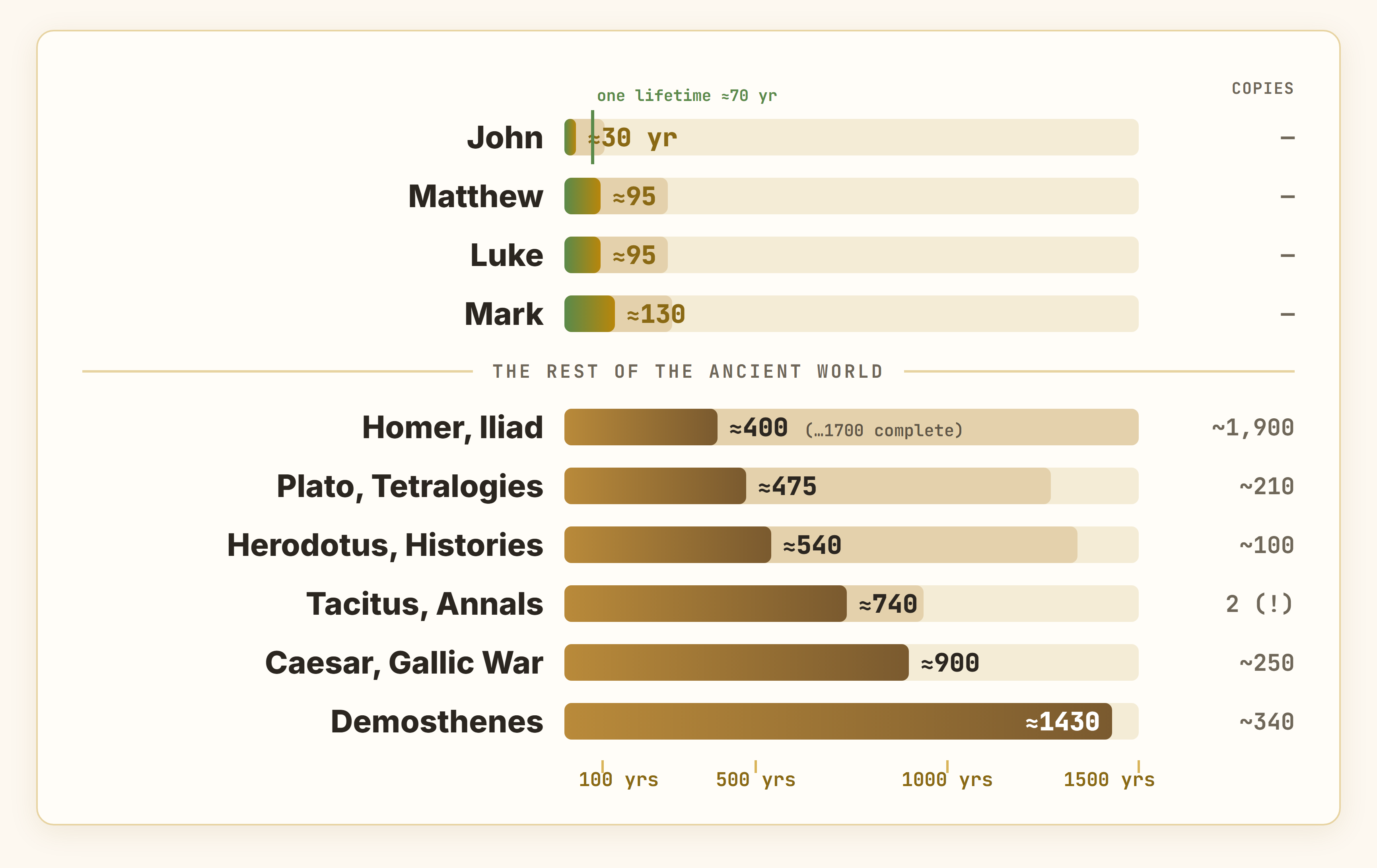
Fig. — at a glanceWriting → earliest surviving copy, one scale for all.
The four Gospels (≈30–130 yrs) against eleven classical works (≈340–1,430 yrs). The interactive, sortable version with
fragment-vs-complete detail is below.
The same gap, for the Gospels and for the rest of antiquity
One bar per work = the years between composition and its earliest surviving witness
(solid) extended to its earliest near-complete copy (faded). Applied honestly: the same yard-stick
for Scripture and for Homer. The four Gospels (green→gold) cluster at the far left; everything else in the ancient
world sits hundreds to fourteen hundred years out.
Read honestly — the real apples-to-apples comparison. Popular apologetics charts cheat a little: they time the
New Testament from its earliest scrap (P52) but time the classics from their earliest complete copy
(a medieval codex), which flatters the contrast. This chart applies one yard-stick to all. Even so the Gospels
win on both measures: by earliest fragment (John→P52 ≈ 30 yrs vs Homer ≈ 400, Tacitus has none) and by
earliest near-complete copy (the whole NT by ≈ AD 350, Sinaiticus — while Caesar, Tacitus, Herodotus and Plato
wait 700–1,400 years). Two further honesties: (1) papyrus finds shorten several classical gaps too — Herodotus,
Thucydides and Plato all survive in Roman-era scraps — so the fragment bars for the classics are their real earliest
witnesses, not the medieval codices; (2) the copy counts marked * are the commonly-cited figures and are being
revised upward as new papyri surface — treat them as order-of-magnitude. The durable, defensible claim is the one the
numbers actually support: no other work of antiquity is attested so early, by so many hands, as the Gospels.
Manuscript
Date
Contains
Found
Kept today
Why it matters
Two cautionary tales in the table: the "First-Century Mark" (P137) was hyped for years as a first-century
find — when finally published in 2018 it was dated ~AD 150–250. The "Magdalen Papyrus" (P64) was claimed
by Carsten Thiede to be a first-century Matthew; palaeographers rejected it and date it ~AD 150–200. And 7Q5,
a Dead Sea scrap once argued to be Mark (~AD 50), is Disputed and rejected by almost all
papyrologists. Honest dating means not claiming these. The real earliest witness is P52, ~AD 125.
⑤ Apostle Dossiers
For each: the arc of where they went, what they wrote, how they died, and how well-attested
it is. Peter, Paul, John and James-the-Just are anchored in Acts, Paul's own letters and Josephus; the far-flung
missions of Thomas, Andrew, Bartholomew and the rest rest on early-but-later church tradition — labeled as such.
How to read this honestly. Three things are hard history nearly everyone grants: Jesus was crucified under Pilate
(~AD 30/33); the movement exploded out of Jerusalem within a few years; and Paul's undisputed letters were written in the
50s AD — within two decades of the events, by a named eyewitness-generation author. The locations and deaths of the
Twelve range from well-documented (James beheaded AD 44, Acts 12; James-the-Just stoned AD 62, Josephus) to
Tradition (Thomas in India, Andrew in Greece) — genuine, early, but not court-proof.
The manuscript dates are palaeographic estimates with real error bars, shown here, not certainties. What is not in
dispute: no other work of antiquity is attested so early, so often, or by so many copies.
 GOD EXAMINEDBible← Back to The Proof