 GOD EXAMINEDBible← Back to The Proof
Honestly assessed: the earliest and unbroken tradition — from Papias (c. 125) through Irenaeus, Pantaenus, and Origen, and across every manuscript title — names the apostle Matthew, an eyewitness member of the Twelve, as author, with no competing claimant anywhere in antiquity; the Gospel's Jewish and tax-collector fingerprint fits him well. What we cannot claim with certainty is that our Greek Matthew is that apostle's own unaided composition, since it demonstrably uses Mark and stands in real tension with Papias's 'Hebrew dialect.' The honest position is that the First Gospel rests on genuine apostolic (Matthean) testimony — very plausibly with his sayings-material at its core — even if its final Greek form drew on Mark and possibly a later editorial hand. Grade: Mixed.
Film stills are copyrighted, so these are listed as references rather than reproduced here.

Click any ▸ Scripture reference to expand the verse (World English Bible).
| The point | The telling detail | Reference |
|---|---|---|
| The call at the tax booth is told from the inside, under the author's own apostolic name. | Matthew 9:9 says Jesus 'saw a man called Matthew sitting at the tax booth (telōnion)' and called him — using the honorable apostolic name. The parallel accounts in Mark 2:14 and Luke 5:27 call the very same man 'Levi son of Alphaeus.' The First Gospel alone identifies itself with the despised tax-collector name rather than distancing from it. | Matt 9:9As Jesus passed by from there, he saw a man called Matthew sitting at the tax collection office. He said to him, “Follow me.” He got up and followed him. (WEB) Mark 2:14As he passed by, he saw Levi, the son of Alphaeus, sitting at the tax office, and he said to him, “Follow me.” And he arose and followed him. (WEB) Luke 5:27After these things he went out, and saw a tax collector named Levi sitting at the tax office, and said to him, “Follow me!” (WEB) |
| Only Matthew records the temple-tax episode, with exact first-century coinage. | Matt 17:24-27 has the collectors ask whether Jesus pays the 'two-drachma tax' (didrachma = the half-shekel temple tax), and Jesus tells Peter he will find a 'stater' (a four-drachma coin) in a fish's mouth — precisely enough to cover two people. This numismatic detail (a stater equals exactly two didrachmas) is preserved in no other Gospel and reads like a tax man's instinct for currency. | Matt 17:24-27When they had come to Capernaum, those who collected the didrachma coins came to Peter, and said, “Doesn’t your teacher pay the didrachma?” He said, “Yes.” When he came into the house, Jesus anticipated him, saying, “What do you think, Simon? From whom do the kings of the earth receive toll or tribute? From their children, or from strangers?” Peter said to him, “From strangers.” Jesus said to him, “Therefore the children are exempt. But, lest we cause them to stumble, go to the sea, cast a hook, and take up the first fish that comes up. When you have opened its mouth, you will find a stater coin. Take that, and give it to them for me and you.” (WEB) |
| Matthew alone labels himself 'the tax collector' in the list of the Twelve. | In Matthew's apostle list (Matt 10:3) he is 'Matthew the tax collector' — the occupational tag attached to no one else and dropped from the parallel lists in Mark 3:18 and Luke 6:15. A self-effacing, self-implicating note about a socially reviled profession is the opposite of what a flattering pseudonymous author would invent. | Matt 10:3Philip; Bartholomew; Thomas; Matthew the tax collector; James the son of Alphaeus; Lebbaeus, who was also called Thaddaeus; (WEB) Mark 3:18Andrew; Philip; Bartholomew; Matthew; Thomas; James, the son of Alphaeus; Thaddaeus; Simon the Zealot; (WEB) Luke 6:15Matthew; Thomas; James, the son of Alphaeus; Simon, who was called the Zealot; (WEB) |
| A distinctive money vocabulary and outsized sums run through the Gospel. | Matthew handles the largest denominations and the most financial parables: the Unforgiving Servant owes 'ten thousand talents' against a fellow servant's hundred denarii (Matt 18:24), and the Parable of the Talents turns on entrusted 'talents' (Matt 25:14-30). In the tribute scene he alone uses the technical word 'nomisma' — legal coinage/currency — for 'the coin of the tax' (Matt 22:19), where Mark 12:15 and Luke 20:24 simply say 'denarius.' | Matt 18:24When he had begun to reconcile, one was brought to him who owed him ten thousand talents. (WEB) |
| An undesigned coincidence marks the author as the host who quietly omits himself. | Matt 9:10 places Jesus at dinner 'in the house' with many tax collectors and sinners, without saying whose house it was. Luke 5:29, writing independently, supplies that Levi 'made a great feast for him in his own house.' Matthew's modest silence about hosting the party, filled in from the outside by Luke, is exactly the fingerprint of a self-effacing insider. | Matt 9:10As he sat in the house, behold, many tax collectors and sinners came and sat down with Jesus and his disciples. (WEB) Luke 5:29Levi made a great feast for him in his house. There was a great crowd of tax collectors and others who were reclining with them. (WEB) |
| The passion narrative names the officials by their correct titles and persons. | Matthew names Caiaphas the high priest at whose house the council gathered (Matt 26:3, 57) and 'Pontius Pilate the governor' (hēgemōn, the correct term for a Roman prefect of Judea, Matt 27:2) — the two historical authorities in Jerusalem at the time, both independently confirmed by archaeology (see below). | Matt 26:3Then the chief priests, the scribes, and the elders of the people were gathered together in the court of the high priest, who was called Caiaphas. (WEB) |
| Find / site | What it confirms | Reference |
|---|---|---|
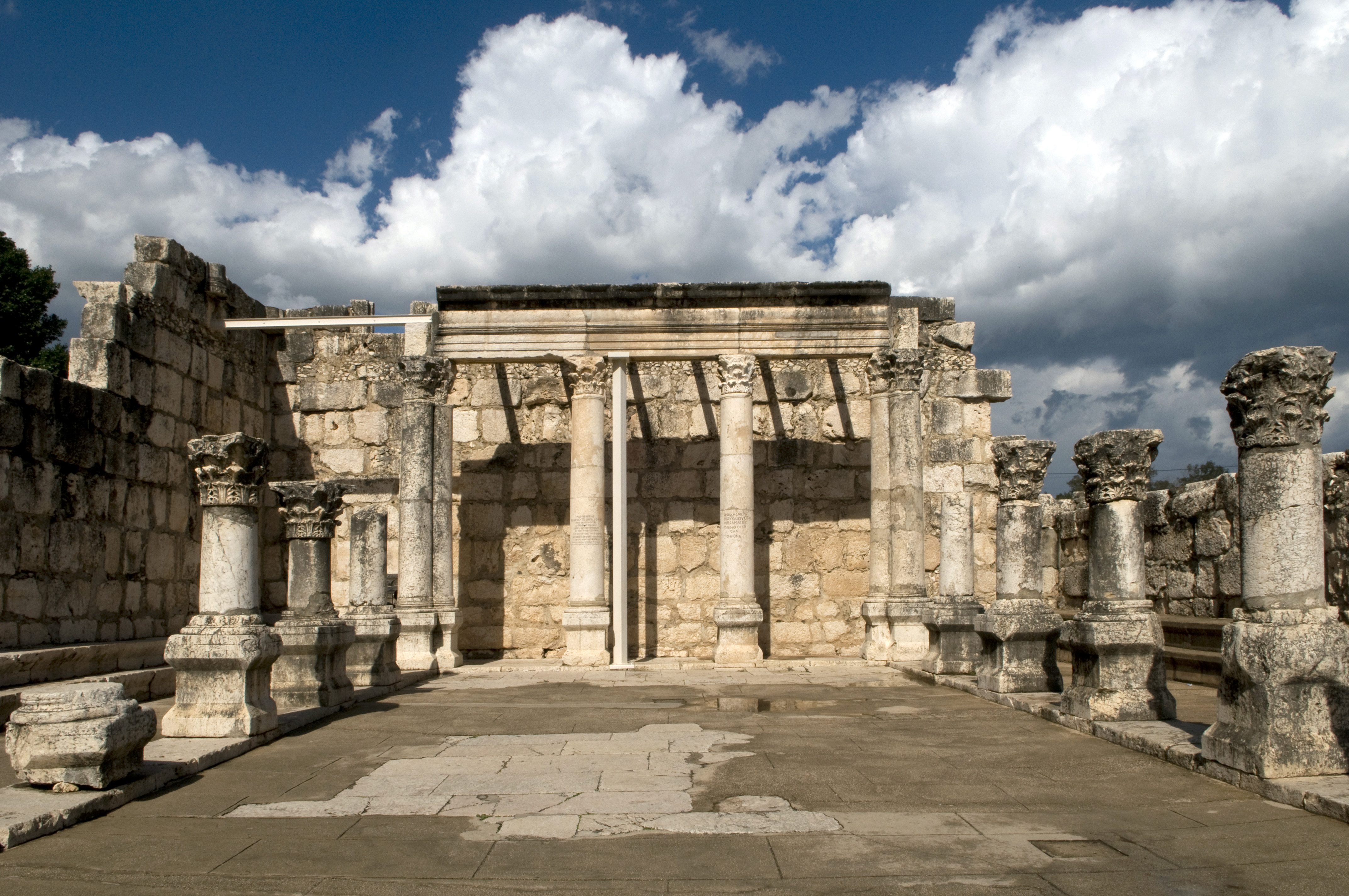
| Capernaum excavations (Franciscan digs from 1968) — the basalt fishing village, the first-century 'House of Peter,' and the synagogue built over first-century foundations. | That Matthew's home base and tax-booth town was a real, modest first-century lakeside settlement on the north shore of Galilee, with domestic and worship structures matching the Gospel's setting. | Capernaum excavations, V. Corbo & S. Loffreda (Franciscan Custody of the Holy Land)Franciscan excavations led by Virgilio Corbo and Stanislao Loffreda (from 1968) uncovered a basalt-built fishing village on the north shore of the Sea of Galilee. The dig exposed a first-century domestic insula venerated early as the 'House of Peter' (later enclosed by an octagonal church) and a white-limestone synagogue (4th-5th c.) built directly over black-basalt first-century foundations. The remains match the modest lakeside town the Gospel gives as Matthew's tax-booth home base. Capernaum (Kefar Nahum) excavations, Studium Biblicum Franciscanum / Franciscan Custody of the Holy Land; published by V. Corbo and S. Loffreda. |
| The Magdala Stone and first-century synagogue at Magdala, discovered 2009, a few miles from Capernaum. | That functioning synagogues existed in Galilee during Jesus' lifetime — directly supporting Matthew's many synagogue-teaching scenes (e.g. Matt 4:23, 9:35, 13:54), which earlier skeptics doubted for the pre-70 period. | Magdala synagogue & Magdala Stone, excavation dir. Marcela Zapata-Meza / Israel Antiquities Authority, 2009In 2009 the Israel Antiquities Authority uncovered a first-century synagogue at Magdala (Migdal) on the western shore of the Sea of Galilee, in use before 70 AD. At its center lay the carved limestone 'Magdala Stone,' whose relief depicts a seven-branched menorah flanked by amphorae and columns — the earliest known menorah image from a Second Temple-era synagogue. The find demonstrates that functioning Galilean synagogues existed in Jesus' lifetime, supporting Matthew's synagogue-teaching scenes. Magdala synagogue and Magdala Stone, excavated 2009; Israel Antiquities Authority with subsequent work directed by Marcela Zapata-Meza (Universidad Anáhuac México). |
| The route of the international highway (the Via Maris) past Capernaum, on the frontier between Herod Antipas's Galilee and Philip's tetrarchy. | Exactly why a customs/toll station (telōnion, Matt 9:9) would sit at Capernaum — a border crossing on a major trade road is the natural place for a tax collector to work. The geography matches the profession the Gospel assigns its author. | Via Maris / Herodian border geography of Capernaum (standard historical geography of Galilee)The Via Maris ('Way of the Sea') was the major international trade road linking Egypt with Damascus and Mesopotamia, a branch of which ran through Galilee past Capernaum. Capernaum sat on the frontier between Herod Antipas's Galilee and Philip the Tetrarch's territory, making it a natural customs/toll crossing. A tax station (telōnion, Matt 9:9) at such a border on a major road is exactly where a tax collector would be posted, matching the profession the Gospel assigns its author. Standard historical geography of Galilee / Herodian administrative borders (general scholarly reconstruction). |
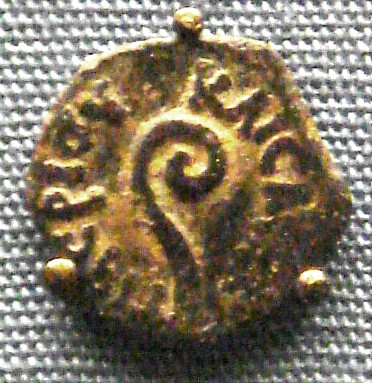
| The Tyrian half-shekel currency for the temple tax, corroborated by 4Q159 (Ordinances) from Qumran, Mishnah Shekalim, and hoards of Tyrian shekels. | The accuracy of Matt 17:24's 'two-drachma' (didrachma = half-shekel) temple tax and the fixed rate it presupposes — a real, well-documented first-century Jewish institution. | 4Q159 (Ordinances); m. Shekalim; Tyrian shekel coin hoards4Q159 ('Ordinances,' from Qumran Cave 4) interprets the half-shekel payment of Exodus 30:11-16, documenting first-century Jewish debate over the temple tax. The Mishnah tractate Shekalim (m. Shekalim) codifies the annual half-shekel temple tax, its fixed rate, and its collection. Large hoards of silver Tyrian shekels and half-shekels — the specie accepted for the tax — confirm the real currency standard behind Matt 17:24's 'two-drachma' (didrachma = half-shekel) payment. 4Q159 (Qumran Cave 4, Discoveries in the Judaean Desert series); Mishnah, tractate Shekalim; numismatic evidence from Tyrian shekel/half-shekel hoards. |
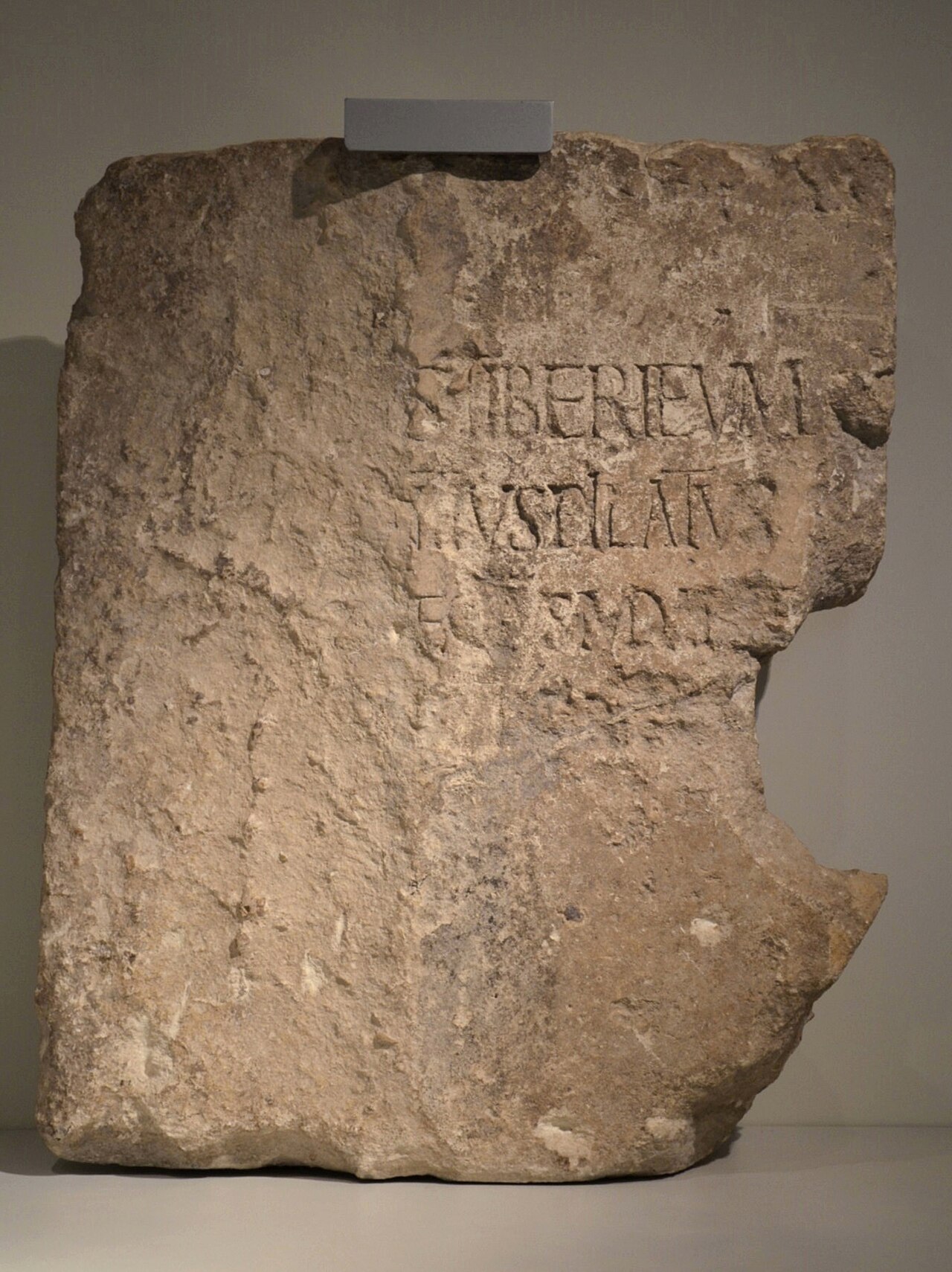
| The Pilate Stone, Caesarea Maritima, 1961 — a dedicatory inscription naming '[Po]ntius Pilatus, [praef]ectus Iuda[ea]e.' | The historical existence and office of Pontius Pilate, the governor of Matthew's trial narrative (Matt 27), against the older claim that Pilate might be legendary. | Pilate Stone, Caesarea 1961 (excavation dir. Antonio Frova)A damaged limestone block found reused in the theater at Caesarea Maritima in 1961 by Antonio Frova's Italian expedition. Its fragmentary Latin dedicatory inscription names '[Po]ntius Pilatus, [praef]ectus Iuda[ea]e' (Pontius Pilate, prefect of Judea) and records his dedication of a 'Tiberieum' honoring the emperor Tiberius. It is the only known contemporary inscription naming Pilate, confirming both his historicity and his exact office (praefectus), the governor of Matthew's trial narrative. Pilate Stone, Caesarea Maritima, discovered 1961 (excavation dir. Antonio Frova); now in the Israel Museum, Jerusalem. |
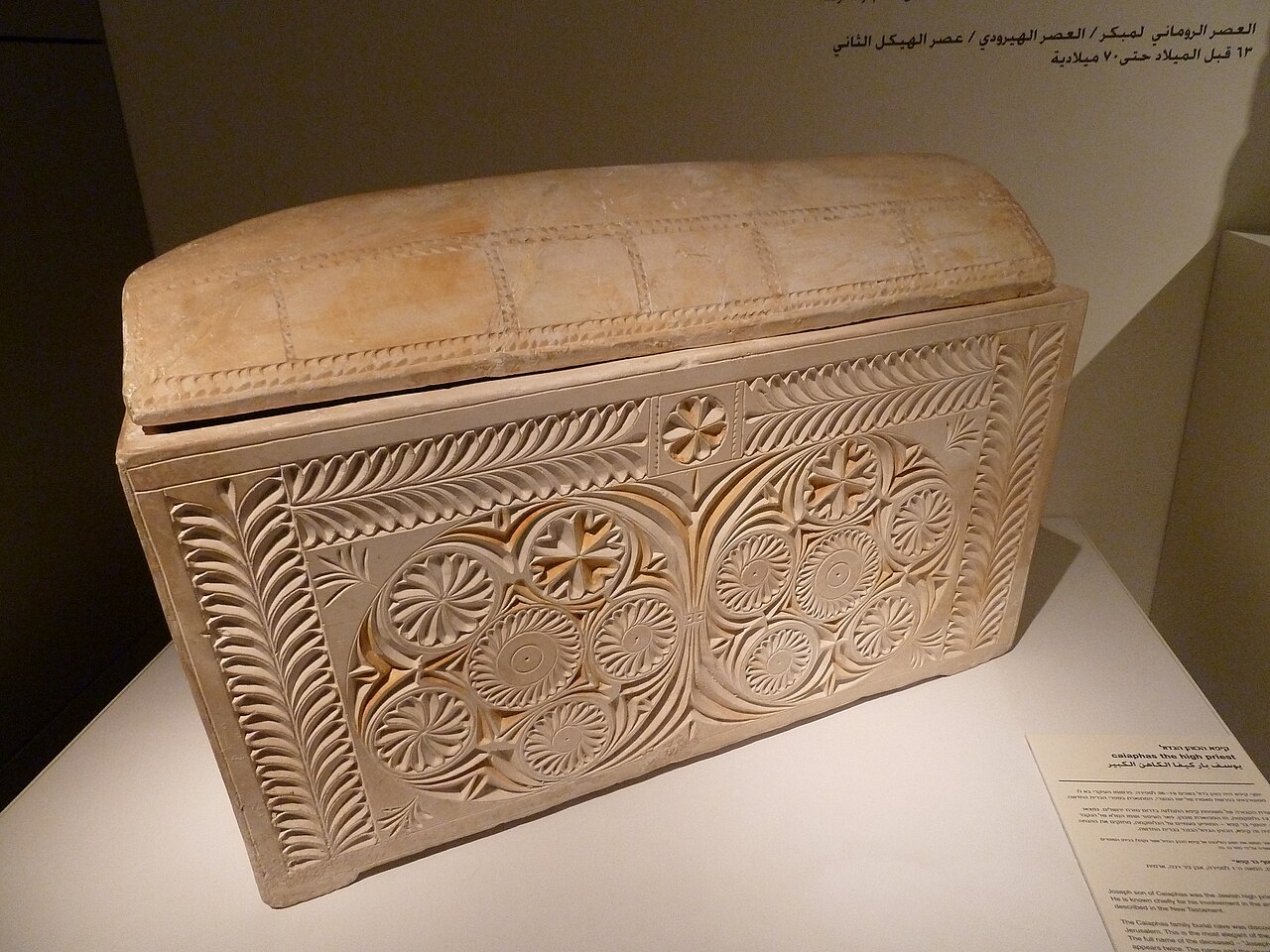
| The Caiaphas ossuary, Jerusalem (Peace Forest), 1990 — an ornate bone-box inscribed 'Yehosef bar Qayafa' (Joseph son of Caiaphas). | The historical high priest Caiaphas whom Matthew names at Jesus' trial (Matt 26:3, 57) — a specific personal name verified by a first-century inscription. | Caiaphas ossuary, Jerusalem 1990 (Israel Antiquities Authority)An ornately carved first-century limestone bone-box (ossuary) discovered in 1990 in a burial cave in Jerusalem's Peace Forest. It is twice inscribed in Aramaic 'Yehosef bar Qayafa' (Joseph son of Caiaphas) and held the bones of several individuals, including a man of about sixty. It is widely identified with the high priest Caiaphas whom Matthew names as presiding at Jesus' trial (Matt 26:3, 57). Caiaphas ossuary, Jerusalem (Peace Forest), 1990; Israel Antiquities Authority; now in the Israel Museum, Jerusalem. |
| Ancient witness | What they say | Reference |
|---|---|---|
| Papias of Hierapolis, c. 125-130 (preserved by Eusebius) | 'Matthew compiled/arranged the oracles (ta logia) in the Hebrew dialect (Hebraidi dialektō), and each interpreted (or translated) them as he was able.' The earliest surviving statement linking the apostle Matthew to a written record. | Papias via Eusebius, Historia Ecclesiastica 3.39.16"So then Matthew wrote the oracles in the Hebrew language, and every one interpreted them as he was able." This sentence, which Eusebius quotes from Papias, is the earliest surviving statement linking the apostle Matthew to a written record. Eusebius, *Church History (Historia Ecclesiastica)* 3.39.16, quoting Papias — tr. A. C. McGiffert, NPNF2 (public domain). |
| Irenaeus of Lyons, c. 180 | 'Matthew also issued a written Gospel among the Hebrews in their own dialect, while Peter and Paul were preaching at Rome and laying the foundations of the Church.' He places Matthew first of the four and ties it to the apostolic era. | Irenaeus, Adversus Haereses 3.1.1 (also in Eusebius, HE 5.8.2)"Matthew also issued a written Gospel among the Hebrews in their own dialect, while Peter and Paul were preaching at Rome, and laying the foundations of the Church." Irenaeus places Matthew first of the four Gospels and ties its composition to the apostolic era. Irenaeus, *Against Heresies (Adversus Haereses)* 3.1.1 — tr. Roberts-Donaldson, ANF (public domain); also preserved in Eusebius, HE 5.8.2. |
| Pantaenus of Alexandria, c. 180-190 (reported by Eusebius) | On a mission as far as 'India,' Pantaenus is said to have found a copy of Matthew's Gospel in Hebrew letters, left there by the apostle Bartholomew — an independent line corroborating the tradition of a Semitic Matthew. | Pantaenus via Eusebius, Historia Ecclesiastica 5.10.3Eusebius reports that Pantaenus of Alexandria, on a mission as far as 'India,' found there the Gospel according to Matthew already present: "For Bartholomew, one of the apostles, had preached to them, and left with them the writing of Matthew in the Hebrew language, which they had preserved till that time." This is an independent line corroborating the tradition of a Semitic Matthew. Eusebius, *Church History (Historia Ecclesiastica)* 5.10.3 — tr. A. C. McGiffert, NPNF2 (public domain). |
| Origen of Alexandria, c. 230-250 (preserved by Eusebius) | 'The first [Gospel] was written by Matthew, once a tax collector but afterwards an apostle of Jesus Christ, who published it for those who came to faith from Judaism, composed in Hebrew letters.' Names the tax-collector apostle explicitly as author. | Origen via Eusebius, Historia Ecclesiastica 6.25.4Eusebius preserves Origen's statement that of the four Gospels "the first was written by Matthew, who was once a publican, but afterwards an apostle of Jesus Christ, and it was prepared for the converts from Judaism, and published in the Hebrew language." Origen names the tax-collector apostle explicitly as author. Eusebius, *Church History (Historia Ecclesiastica)* 6.25.4, quoting Origen — tr. A. C. McGiffert, NPNF2 (public domain). |
| The Muratorian Fragment, c. 170-200 (damaged) | The surviving text begins mid-sentence and names Luke as the 'third' Gospel and John as the 'fourth' — thereby presupposing Matthew and Mark as the first two. The lines that directly described Matthew are lost at the torn top of the manuscript, so the Fragment attests Matthew's place only implicitly, not in words. | Muratorian Fragment, lines 1-9 (opening lacuna)The Muratorian Fragment is a damaged 7th-century Latin manuscript (discovered by L. A. Muratori in Milan, published 1740) preserving the oldest known list of accepted New Testament books, its original Greek text usually dated c. 170-200. Its surviving text begins mid-sentence while discussing Mark, then explicitly numbers Luke the 'third' Gospel and John the 'fourth' — a sequence that presupposes Matthew and Mark as the first two. The lines that would have named Matthew are lost in the torn opening lacuna, so the Fragment attests Matthew's primacy only implicitly, by the numbering of the Gospels that follow. Muratorian Fragment (Codex Muratorianus, Biblioteca Ambrosiana, Milan), c. 170-200 original; English rendering of the surviving lines after S. P. Tregelles, 1867 (public domain). |
| The manuscript titles (inscriptio) and Martin Hengel's analysis | Every Greek manuscript that preserves a heading carries 'KATA MATTHAION' — 'According to Matthew' (Codex Sinaiticus and Vaticanus, 4th c., and onward). No manuscript, and no ancient writer, ever ascribes the First Gospel to any rival author. Hengel argued these titles were affixed very early, as the Gospels began to circulate together. | Gospel inscriptions 'KATA MATTHAION'; M. Hengel, 'The Four Gospels and the One Gospel of Jesus Christ' (2000)Every Greek manuscript of the First Gospel that preserves a heading carries the title ΚΑΤΑ ΜΑΘΘΑΙΟΝ ('According to Matthew'), including the great fourth-century codices Sinaiticus and Vaticanus, and continuing through the later tradition. No surviving manuscript, and no ancient writer, ever ascribes this Gospel to any rival author. Gospel inscriptions/titles in the Greek NT manuscript tradition (Codex Sinaiticus and Vaticanus, 4th c., and later). — Martin Hengel, *The Four Gospels and the One Gospel of Jesus Christ* (2000): argues (in his own copyrighted work, not reproduced here) that the Gospel titles were attached very early, as the four Gospels began to circulate together as a collection. |
The strongest critical case rests on Markan priority. On the two-source hypothesis (B. H. Streeter, 'The Four Gospels,' 1924; more recently Bart Ehrman), Matthew reproduces roughly 90% of Mark's verses, frequently word-for-word in Greek and largely in Mark's order. The objection is pointed: why would an eyewitness apostle who personally walked with Jesus copy the account of Mark, who was not an eyewitness? An apostle should draw on his own memory, not lean on a companion of Peter. Three further problems compound it: (1) the Gospel is formally anonymous — the autograph contains no 'I, Matthew,' and the title 'According to Matthew' was attached later; (2) Papias says Matthew wrote in 'the Hebrew dialect,' yet our Matthew is fluent, idiomatic Koine Greek with no marks of being a translation and often quotes the Greek Septuagint — suggesting Papias described a different work (perhaps a lost sayings-collection) or was simply mistaken; (3) the developed church language ('ekklēsia,' Matt 16:18; 18:17) and other features point many scholars to a post-70 Jewish-Christian community around 80-90, making eyewitness apostolic authorship improbable.
Concede what is fair: Markan priority is the majority view, the anonymity of the autograph is real, and the Greek-versus-'Hebrew dialect' tension is genuine — this is why the entry is graded Mixed, not Solid. But the traditional case is not thereby overturned. First, on copying Mark: the same early tradition (Papias, HE 3.39.15) holds that Mark faithfully recorded Peter's eyewitness preaching, so 'using Mark' means preserving authoritative Petrine testimony — a sound reason for any evangelist to keep the received apostolic narrative rather than reinvent it, and ancient authors used written sources without embarrassment. Matthew's substantial unique material (the 'M' source: the temple-tax coin, the five discourses, distinctive parables) is exactly where his own hand shows. Second, on Papias's 'Hebrew dialect' (Hebraidi dialektō): the phrase may denote a Hebrew/Aramaic rhetorical style rather than language, or may attest an earlier Semitic sayings-collection (the logia) that was later expanded into the Greek Gospel — either way Papias independently ties the apostle Matthew to this Gospel. Third, on anonymity: all four Gospels are formally anonymous, yet the titles are early and, decisively, unanimous — no manuscript and no Father ever ascribes the First Gospel to anyone but Matthew, and there is no rival claimant. A forger or an unknown community would far more likely have credited a prominent apostle (Peter, James, or Thomas) than a minor, socially despised tax collector; the very unattractiveness of choosing Matthew is itself evidence the attribution rests on memory, not invention. Finally, 'ekklēsia' and a post-70 date are inferences, not proofs, and a pre-70 composition remains defensible.
See also: the directory · the full roster · verified by outsiders · how we verify the NT.