How to train a God-ward heart posture, carry less of the self, and
do God’s will more — with a concrete method for prayer (asking to be happy and fulfilled
within His will) and for dying to self by retraining the vocabulary of “mine,” “me,” and “I.”
Compiled 2026-10-30 · Scripture + peer-reviewed psychology & neuroscience, each claim graded · A practical, honest training manual
⚛ The arc of the heart — where the weight sits
A conceptual map (not measured data): the same life can be lived with the self at the center or with Christ at the center. Training moves the fulcrum rightward — and the research markers underneath are honest, cited effect-sizes, not the proof of the theology.
The oldest instruction in the wisdom literature is a training order: “Keep your heart with all
vigilance, for from it flow the springs of life” (Proverbs 4:23). This paper treats the heart’s
posture — its default lean toward or away from God — as something that can be trained, and it
reads two records side by side. Scripture says the heart is the governing center of a person, that the self must
be displaced from its throne (“not I, but Christ” — Galatians 2:20), and that joy is found by
seeking it in God rather than in circumstance. Modern psychology and neuroscience independently find that chronic
self-reference — measurable right down to how often a person says “I,” “me,” and
“mine” — travels with anxiety and low mood, that the same self-referential loop has a physical
home in the brain, and that specific, teachable practices (distanced self-talk, if–then plans, gratitude, giving,
relational prayer) reliably move a person out of it. The two records converge, and the convergence is the useful
thing — Scripture states the why and carries the authority; the studies describe a how and carry
none of the doctrine. Below: what heart posture is, why the grasping self hurts, the biblical mechanic of dying to
self, a concrete method for retraining the “mine / me / I” vocabulary, how to pray to be happy
within His will, and a daily program. Every section is collapsed — the header previews its three
takeaways; click to open.
⚡ Skim it in one chain — the whole argument as a single thread
Every section is collapsed; click any line to jump to it and open it. Each point hands off to the next.
sections are collapsed by default — click any header to open
0How to read the grades
Five tiers kept strictly apart — Scripture (Established) is never dressed up with a rodent study (Model); every claim below wears its honest weight.
Scripture carries the doctrine.Established = read directly off the text
Human trials are the ceiling for science.Strong = RCT / meta-analysis in people
The prettiest brain claims are only Model.“Prayer rewires X” = mechanism, not proof
Every claim in this paper carries a badge so you always know how much weight it can bear. The most
common dishonesty in popular “Christian self-help” is to flatten a plain verse, a randomized human trial, and a
mouse experiment into one confident paragraph. Here they are kept apart.
Established — Scripture states it plainly. The claim is read directly off the
biblical text, not inferred or imported. These carry doctrinal weight on their own terms; the science neither adds to nor
subtracts from them. “He must increase, but I must decrease” (John 3:30) is Established because the Gospel says
it, full stop — no study makes it truer, and none could make it false.
Strong — robust human evidence. A well-powered randomized controlled
trial, or a meta-analysis pooling many of them, in human beings. This is the highest tier the science can reach, and
even here effect sizes are usually modest. The gratitude and implementation-intention results earn this badge; most
“prayer changes the brain” headlines do not.
Moderate — human, but limited. Real human data from small samples, short
durations, single-arm designs, or self-report. Directionally trustworthy, not settled. The distanced-self-talk and the
gray-matter-from-practice findings live here — genuine, replicated in part, but not yet bedrock.
Model — mechanism or map only. A biochemical pathway, an animal result, or
a conceptual diagram (like the arc at the top of this page). It illuminates the shape of what may be happening —
it is never, by itself, evidence that it does happen in a praying human. Saying so is not pessimism; it is honesty.
Emerging — observational or preliminary. Large cohorts where religious people
differ from the irreligious in a hundred uncontrolled ways, or early pilot data. Suggestive, worth watching, not
load-bearing. Nearly all “religion predicts better health” evidence is here, and its confounds are discussed in
§7.
The governing ruleScripture states the why; the studies describe a how. When the
two converge — and on the self, they converge remarkably — that convergence is corroboration, a second witness,
never the proof of the doctrine. The doctrine stands on the text.
1What “heart posture” is — and that it is trainable
The biblical “heart” (Heb. lev, Gk. kardia) is the control room — thought, will, and affection together; its default lean is a posture, and postures can be retrained.
The heart is the whole inner command center.&~850 OT uses: mind + will + affection
Posture = the heart’s resting lean.what it defaults to when unwatched
It is plastic — trainable like a muscle.gray-matter changes in ~8 weeks of practice
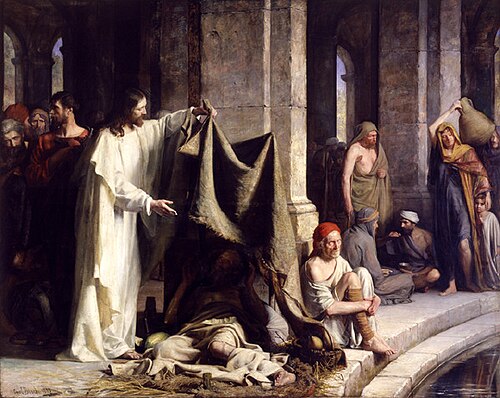
Fig. 1 — “A new heart I will give you” (Ezekiel 36:26). Carl Bloch, Christ healing the sick at Bethesda (19th c.). Public domain, Wikimedia Commons.
Before you can train a heart posture you have to know what the word heart is doing in the Bible —
because it does not mean what a Valentine means by it.
In Scripture the “heart” is the entire inner command center, not the feelings alone. The Hebrew
lev / levav appears over 850 times, and in the great majority of them it names what we would call the mind and
the will as much as the emotions: people “say in their heart,” “devise in their heart,”
“set their heart” on a course. The Greek kardia carries the same freight in the New Testament. So when
Proverbs 4:23 says the springs of life flow from the heart, it is making an engineering claim about the control room of the
person — govern the source and you govern the stream. “Heart posture,” then, is not a mood; it is the
resting orientation of your thinking, wanting, and loving — what the whole apparatus leans toward when no one is
watching.
Jesus makes the heart the hinge of the entire moral life. Asked for the greatest commandment, he answers with the
heart first: “You shall love the Lord your God with all your heart” (Matthew 22:37). And he locates both good and
evil at that same source: “out of the abundance of the heart the mouth speaks” (Luke 6:45), and “out of the
heart come evil thoughts” (Matthew 15:19). This is why the project of this paper is not behavior-management but
posture-training: Jesus consistently treats outward words and acts as the overflow of an inner state, so durable
change has to be made upstream, at the spring, not downstream at the faucet. A person who only polices the faucet is doing
what he called cleaning “the outside of the cup” (Matthew 23:25).
A “posture” is a default, and defaults are exactly what the Bible says God wants to reset. The deepest
promise in this whole territory is Ezekiel 36:26: “I will give you a new heart… and I will remove the heart of
stone… and give you a heart of flesh.” David prays the same in Psalm 51:10 — “Create in me a clean
heart, O God.” Notice the grammar: the decisive act is God’s (“I will give,” “create in
me”). That keeps this honest and keeps it from becoming mere willpower religion — the training below is not how you
manufacture a new heart; it is how you cooperate with the One who gives it, the way a patient cooperates with the
medicine. Grace is the surgeon; the disciplines are the physical therapy.
And the modern finding that makes “training” literal: the brain that hosts your inner life is physically
plastic. This matters because a skeptic will say a “posture” is just a fixed personality. It is not. In an
eight-week mindfulness program, Hölzel, Lazar and colleagues (2011) found measurable increases in gray-matter density
in regions tied to learning, memory, and emotion regulation — the organ of the inner life remodels itself in response to
sustained practice. The claim here is modest and honestly graded (small sample, no claim that “prayer”
specifically did it), but it establishes the principle: dispositions are not destiny. What you repeatedly attend to, you
become. Scripture had already said as much — “as he thinks in his heart, so is he” (Proverbs 23:7).
1.1The inner life physically remodels with practiceModerate
8-week MBSR → increased gray-matter density in hippocampus & other regions; n = 16 + controls (MRI, pre/post)
Establishes the principle behind “training”: the organ of thought and affection is plastic, not fixed.
Honest limits: small sample, a mindfulness protocol (not prayer), density ≠ function. Graded Moderate, not Strong.
It does not prove prayer rewires the brain — only that sustained inner practice can change brain structure at all.
Scripture — Romans 12:2: “be transformed by the renewing of your mind” — a process word, not a one-time switch.
Analogy · Logic · Plain EnglishAnalogy: a heart posture is like the tilt of a sunflower — the flower is always leaning somewhere; training
is turning the stem so the lean is toward the sun rather than toward the self. Logic: (1) words and acts overflow from
the heart; (2) the heart’s lean is a trainable default, not a fixed fate; (3) therefore durable change is made at the
lean, by repeated practice under grace — not by willpower at the surface. Plain English: your heart is always
pointed at something; this paper is about gently, repeatedly re-pointing it at God until that becomes the resting position.
If the heart always leans somewhere, the first job is to see honestly where it leans by default — and the research on that is uncomfortably specific.
2The gravity of self: the “I / me / mine” problem
Chronic self-reference is measurable — how often you say “I” tracks negative mood — it has a physical home in the brain’s default-mode network, and it is exactly what Scripture calls the self on the throne.
“I-talk” tracks suffering.r≈.10, n≈4,700 across 6 labs
Self-reference has a brain address.default-mode network: PCC + mPFC
The cure Scripture names: displace the self.Luke 18:9–14, the two prayers
Fig. 2 — Two men, two prayers. The Pharisee’s prayer is a list of “I”; the tax collector’s is “God, be merciful to me, a sinner.” Only one “went down justified” (Luke 18:14). John Everett Millais, The Pharisee and the Publican. Public domain, Wikimedia Commons.
Before the cure, the diagnosis. The striking thing is that the Bible’s oldest warning about pride and the
newest data from language psychology point at the same symptom — the volume of the self in a person’s
speech and attention.
How often a person says “I,” “me,” and “my” is a measurable marker of distress.
This sounds like a sermon illustration, but it is a replicated finding in quantitative text analysis. The largest synthesis
to date — Tackman, Mehl, Pennebaker and colleagues (2019), pooling roughly 4,700 participants across six independent
labs — found that first-person-singular pronoun use (“I-talk”) reliably tracks a person’s general
negative emotionality, and more loosely, depression. The effect is small (on the order of r ≈ .10), and the
authors are careful: I-talk indexes the broad tendency to feel distress more than clinical depression specifically. But the
direction is robust, and an earlier meta-analysis (Edwards & Holtzman, 2017) and the classic essay study (Rude, Gortner
& Pennebaker, 2004, where currently- and formerly-depressed students used measurably more first-person singulars) point
the same way. The self, when it is suffering, talks about itself — constantly.
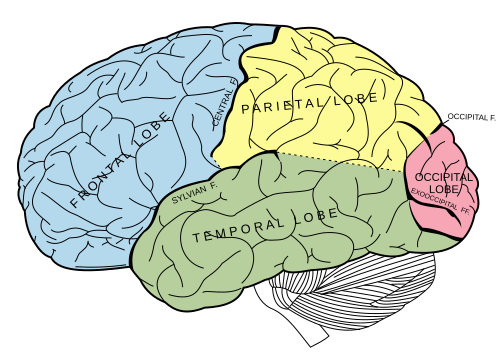
This self-referential loop is not a metaphor; it has a physical home in the brain.Fig. 2b — Medial surface of the cortex. Self-referential thought localizes to the midline structures here — medial prefrontal cortex and posterior cingulate — the core of the “default-mode network.” Gray’s Anatomy plate (rev. Mysid). Public domain, Wikimedia Commons. Converging imaging work
identifies a network — Raichle and colleagues’ (2001) “default-mode network,” anchored in the
posterior cingulate (PCC) and medial prefrontal cortex (mPFC) — that activates when the mind is not doing a task:
idling, mind-wandering, and above all reflecting on oneself. Northoff’s (2006) meta-analysis of self-referential
processing localizes “self” tasks to these same cortical midline structures. In other words, there is a default
idling mode of the human mind, and its favorite subject is me — my past, my grievances, my plans, my standing.
This is not yet a moral claim; it is simply where the untrained mind goes when released.
And the loop can be quieted — which is the hinge of hope in this whole section. Brewer and colleagues (2011)
scanned experienced meditators and novices and found that the experienced practitioners showed relatively reduced
activity in the main default-mode nodes (mPFC and PCC) during meditation, across different techniques. Read carefully: this
is a correlational, cross-sectional finding about meditators, not a randomized proof that any one practice “turns off
the self” — but it demonstrates that the self-referential network is modifiable by trained attention. The
grasping self is not a life sentence. Something can be done, and it is learnable.
Scripture diagnosed the same disease two millennia early — and dramatized it in a single parable. In Luke
18:9–14 two men pray. The Pharisee’s prayer is, almost comically, a monologue of the first person: “I
thank you that I am not like other men… I fast… I give.” The tax collector cannot
even lift his eyes: “God, be merciful to me, a sinner.” Jesus’ verdict is that the second man, not
the first, “went down to his house justified.” Count the pronouns and you have, in narrative form, the exact
distinction the language data describes: the self curved in on itself (the Pharisee, self-referential and comparing) versus
the self turned outward and upward (the publican, God-referential and receiving). The Bible calls the first condition
pride, and says flatly that “God opposes the proud but gives grace to the humble” (James 4:6).
2.1“I-talk” is a reliable linguistic marker of negative affectStrong
First-person-singular pronoun use ↔ negative emotionality; r ≈ .10–.13; n ≈ 4,700 across 6 labs, multiple languages/tasks
I-talk tracks the broad tendency to feel distress more than depression specifically (the authors’ own caution).
The effect is small but durable — a real signal, not destiny; it is a dial, not a diagnosis.
Mechanism fit: the more the attentional spotlight sits on the self, the more of the self shows up in speech.
Scripture — Luke 18:11–13: the Pharisee’s “I…I…I” vs the publican’s “God, be merciful to me” — the same contrast, told as a story.
Tackman AM, Mehl MR, Pennebaker JW, et al. (2019). J. Personality & Social Psychology 116(5):817–834. · Edwards & Holtzman (2017), J. Research in Personality 68:63–68. · Rude, Gortner & Pennebaker (2004), Cognition & Emotion 18(8):1121–1133.
If the suffering self has a measurable voice and a brain address, is there a way to literally turn down the volume? Imaging says yes —
2.2The self-referential network is real — and quietableModerate
Default-mode network (PCC + mPFC) = the mind’s idle, self-focused mode; experienced meditators show reduced DMN activity vs novices
Self-reference reliably localizes to the cortical midline (Northoff 2006 meta-analysis) — a stable “where.”
Brewer (2011): trained attention is associated with a quieter self-network — so the loop is modifiable.
Honest limit: cross-sectional (meditators chose to meditate); shows modifiability, not that a specific practice causes it.
Scripture — Colossians 3:2–3: “Set your minds on things above… your life is hidden with Christ in God” — attention deliberately moved off the self.
Raichle ME, et al. (2001). PNAS 98(2):676–682. · Brewer JA, et al. (2011). PNAS 108(50):20254–20259. · Northoff G, et al. (2006). NeuroImage 31(1):440–457.
Brutal honesty — don’t overclaim thisThe I-talk correlation is small (r≈.10): plenty of
healthy people say “I” often, and policing pronouns alone cures nothing. The point is not numerology about the word
“I” — it is that where your attention habitually sits leaks into your speech and tracks your
well-being. The pronoun is a symptom and a handle, not the disease. Treat it as a gauge you can read and a lever you can
pull, not a magic word.
So the disease is the self on the throne, and the self-loop is quietable. Scripture’s prescription is not to erase the self but to dethrone it — which is a very different and much healthier thing.
3Dying to self — the biblical mechanic
“Dying to self” is displacement, not deletion: the self stays alive but surrenders the throne to Christ. “Not I, but Christ” (Gal 2:20); “He must increase, I must decrease” (John 3:30).
Displacement, not self-erasure.“no longer I… but Christ lives in me”
The paradox: lose life to find it.Mark 8:35 — the gain is the self back, free
The model is Christ’s own self-emptying.Phil 2:5–8, kenosis
Fig. 3 — “He must increase, but I must decrease” (John 3:30) — the Baptist points away from himself to Christ. Leonardo da Vinci, St John the Baptist (c.1513–16). Public domain, Wikimedia Commons.
“Dying to self” is the most misunderstood phrase in this whole subject. It is not self-hatred, not
the erasure of personality, not a grim smallness. Read the texts and a very different, and much more livable, picture emerges.
The master text defines it as displacement, not deletion: the self survives, but Christ takes the throne.
Galatians 2:20 is the hinge: “I have been crucified with Christ. It is no longer I who live, but Christ who lives in
me. And the life I now live in the flesh I live by faith in the Son of God.” Notice Paul does not vanish — “the
life I now live” is still his life, lived in his body. What has died is the self’s claim to be the
center and the source. The “I” that is crucified is the autonomous, self-sourcing ego; the “I” that
remains is a self now animated from a new center. This is why the goal is not a personality-less Christian but, in
Scripture’s logic, the truest version of the person — the self finally freed from the exhausting job of
being its own god.
John the Baptist gives the one-line summary, and it is a sentence of relative weight, not of annihilation.
“He must increase, but I must decrease” (John 3:30). The Baptist is not praying to disappear; he is describing a
change of proportion — as Christ fills more of the frame, the self occupies less of it, the way the stars go out not
because they are destroyed but because the sun has risen. This is the healthiest possible reframe of everything in §2:
you do not beat the grasping self by attacking yourself (which is just more self-focus, pointed with a knife); you beat it by
becoming fascinated with Someone else, until the self quietly loses its grip on your attention. Decrease is a
byproduct of a greater increase.
The model for all of it is Christ’s own self-emptying — kenosis. Philippians 2:5–8 gives
the command and the pattern in one breath: “Have this mind among yourselves, which is yours in Christ Jesus, who…
emptied himself, taking the form of a servant… and became obedient to the point of death.” The Greek
ekénōsen — “he emptied himself” — is the root of the whole doctrine. Crucially, the
self-emptying is toward service and ends in exaltation (“therefore God has highly exalted him,” v.9):
the downward motion is the path to the real height. So dying to self is not a dead end; in the Bible’s structure it is
the only door that opens onto genuine life, authority, and joy. The pattern is cruciform and it is the pattern of the universe
as the New Testament reads it.
Hence the central paradox, stated by Jesus four times across the Gospels: you save your life by losing it.
“Whoever would save his life will lose it, but whoever loses his life for my sake… will save it” (Mark 8:35;
cf. Matthew 16:25, Luke 9:24, John 12:25). The logic is exact and testable in experience: grasping tightly at your life
— your reputation, your comfort, your being-in-the-right — is the very thing that strangles it, because the
self-protective crouch of §2 is a miserable way to live. Releasing the grip is what lets life flow back in. This is not
only doctrine; it is observable. The happiest people most of us have met are almost never the most self-occupied ones —
a pattern the research in §4 (giving, compassionate goals) independently confirms.
And it is, finally, God’s work in you — which protects it from becoming a new, grimmer kind of striving.
Paul frames the whole transformation in the passive voice: “we all… are being transformed into the same
image from one degree of glory to another. For this comes from the Lord” (2 Corinthians 3:18). You are not the sculptor
hacking at your own marble; you are the marble, cooperating with the Sculptor. Your part is the daily yes — the
surrender, the attention, the practices of §4–6 — but the actual re-centering of the heart is grace. That is
the difference between Christian dying-to-self and mere self-improvement: the goal is not a better-managed self but a
God-filled one, and the power is not finally yours.
What dying to self is NOT
Self-hatred. Attacking yourself is still obsessive self-focus — the disease wearing a pious mask.
Erasing your personality. Paul stayed Paul; the self is re-centered, not deleted.
Passivity / doormat-ness. Christ emptied himself to serve and spoke with authority; surrender is active.
Willpower religion. You cannot crucify yourself; the decisive act is God’s (2 Cor 3:18).
What it IS
Dethroning, not deleting. The self steps off the center; Christ steps on.
A change of proportion. “He must increase” — decrease is the byproduct.
Cruciform, then upward. The downward motion of kenosis is the path to real life (Phil 2:9).
Cooperation with grace. Your daily yes; His transforming work.
Plain EnglishDying to self doesn’t mean becoming nobody. It means getting off
the throne of your own life and letting Jesus sit there — and discovering that you were never meant to carry the weight
of being your own god in the first place. You don’t get smaller; you get lighter.
That is the theology. But Roy’s real question is the practical one: how? — and specifically, how do you start with the words “mine,” “me,” and “I”? The next section is the workshop.
4Retraining the vocabulary — the drills
The concrete “how”: a swap table (mine→entrusted), the pronoun fast, if–then triggers, and distanced self-talk — each drill tied to a verse and a real study. Change the words and you re-aim the attention.
Words are a handle on attention.re-word → re-aim the inner spotlight
“If–then” plans make it automatic.d≈0.65 over 94 studies
Distanced self-talk regulates emotion.use your name, not “I,” under stress
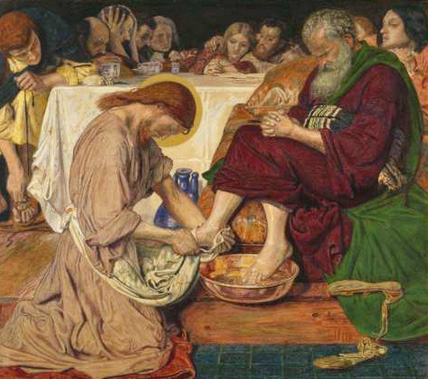
Fig. 4 — The vocabulary of “me first” dies at the basin. “If I then… have washed your feet, you also ought to wash one another’s feet” (John 13:14). Ford Madox Brown, Jesus Washing Peter’s Feet (1852–56). Public domain, Wikimedia Commons.
Here is the heart of what Roy asked: how do you change your vocabulary from “mine / me / I”
to something Christ-like? The answer is not to delete the first person — you still have to say “I” to
function — but to re-aim it, with drills specific enough to actually practice. There is a real reason this works:
language is a handle on attention. When you change the word, you tug the spotlight; do it enough and the spotlight
learns a new resting place.
DRILL SET ARe-word the three culprits
Keep this table where you’ll see it. The left column is the native speech of the self on the throne; the
right column is the same reality re-spoken from a dethroned heart. Each swap trains a specific truth.
Instead of…
Say / think…
The truth it trains (Scripture)
“This is MINE.”
“This is the Lord’s, entrusted to me to steward.”
“The earth is the Lord’s, and everything in it” — Ps 24:1; 1 Cor 4:7
“I did this / I’m good at this.”
“By grace I was able to…” / “God gave the increase.”
“By the grace of God I am what I am” — 1 Cor 15:10; 3:7
“I want…”
“Lord, what would You have me do here?”
“Not my will, but yours, be done” — Luke 22:42
“What about ME?”
“How can I serve what’s needed here?”
“Count others more significant than yourselves” — Phil 2:3–4
“I’m so anxious about my…”
“I cast this on You — it’s Yours to carry.”
“Casting all your anxieties on him” — 1 Pet 5:7
“My plan / my future.”
“If the Lord wills, we will live and do this.”
“If the Lord wills, we will…” — James 4:15
“I deserve…”
“I have received…” / “God, be merciful to me.”
“What do you have that you did not receive?” — 1 Cor 4:7; Luke 18:13
“Look what I did.”
(silence) — let the deed be seen by the Father in secret.
“Do not let your left hand know…” — Matt 6:1–4
Table 1 — The vocabulary swap. The goal is not to abolish “I” but to re-aim it: from source to steward, from owner to receiver, from self-will to God’s will.
D1The Pronoun Fastdaily · 1 hr → 1 day
What. Pick a window — one hour, then a mealtime, then a whole day — and deliberately drop first-person-singular
bragging and complaining from your speech, replacing it with the swaps in Table 1. Not legalism about the letter
“I”; a fast from self-reference as the reflex topic.
How, concretely: (1) For one hour, before you speak, ask silently, “Is this about me, or about them / the
task / God?” (2) When you catch a “mine” or a “look what I did,” don’t scold yourself — just
re-say it with a swap. (3) End with one sentence of thanks to move the spotlight fully off self.
Scripture — Psalm 141:3: “Set a guard, O Lord, over my mouth.”
Rationale: speech both reflects and shapes attention (Tackman 2019); fasting from a reflex weakens it.
D2The If–Then Trigger (implementation intention)strongest single tool
What. Pre-decide a tiny script so the new word fires automatically instead of relying on in-the-moment willpower. This is
the best-evidenced behavior-change technique in psychology, and it fits heart-training perfectly.
How, concretely: write two or three “if X, then Y” rules and rehearse them until they’re
automatic — e.g. “If I catch myself saying ‘mine,’ then I silently pray ‘Yours, Lord.’”
· “If I feel the urge to say ‘look what I did,’ then I thank God in secret and stay quiet.” ·
“If I start a sentence with ‘I want,’ then I finish it with ‘…but Your will be done.’”
Scripture — Proverbs 16:3: “Commit your work to the Lord, and your plans will be established.”
Gollwitzer PM (1999), American Psychologist 54:493–503; meta-analysis Gollwitzer & Sheeran (2006), d ≈ 0.65 across 94 studies. Strong
D3Distanced self-talk (the “name, not I” trick)for stress & temptation
What. Under stress, address yourself by name or as “you” instead of “I.” It sounds odd, but in
controlled studies this small linguistic shift measurably improves emotion regulation — it gives you the tiny distance
needed to choose the Christ-like response instead of the reflexive self-protective one.
How, concretely: when anger or anxiety spikes, think not “Why am I so upset?” but
“Roy, what does love require here?” or “You can entrust this to God.” The third-person framing
loosens the self’s grip just enough to act well — a secular echo of counseling your own soul: “Why are you cast
down, O my soul?” (Psalm 42:5).
Scripture — Psalm 42:5, 11; 103:1: the psalmist talks to his own soul rather than simply from it.
Kross E, et al. (2014), JPSP 106(2):304–324; Moser JS, et al. (2017), Scientific Reports 7:4519. Moderate
D4Gratitude & hidden giving — the self-forgetting disciplinesweekly
What. Two practices that drain the “mine” reflex at the root: a running gratitude list (which re-codes life
from owned to received) and acts of service no one sees (which re-aim love outward). Both are among the
best-evidenced well-being interventions in psychology, and both are commanded.
How, concretely: (1) Each night, write three specific things received today — naming them as
gifts, not achievements, kills entitlement. (2) Once this week, do a genuine good turn in secret — and tell no one. The
secrecy is the training: it starves the “look what I did” reflex and gives the deed to God alone.
Scripture — 1 Thess 5:18 (“give thanks in all circumstances”); Matt 6:3–4 (giving in secret).
One honest caution on the vocabulary swapDo not let this become a new performance — a smug “I don’t say
‘mine’ anymore” is just the Pharisee’s prayer in recycled packaging. The words are training wheels for the
heart; if the heart isn’t softening (more peace, more patience, less need to be seen), the vocabulary is theater. The
tell that it’s working is not cleaner speech — it’s that you stop noticing whether anyone noticed.
The single most important place this re-wording happens is in prayer — and that raises the question Roy named directly: can you pray to be happy, and still mean “Thy will be done”?
5Praying to be happy and fulfilled, within His will
Yes, you may pray to be happy — Scripture commands joy — but happiness is relocated from circumstance to communion. “Delight in the Lord” reorders what you desire, so “give me the desires of my heart” and “Thy will be done” converge.
Joy is commanded, not selfish.Phil 4:4; Ps 16:11 “fullness of joy”
Delight reorders desire.Ps 37:4 — the key that dissolves the tension
Relational prayer > transactional.for well-being, how you pray matters
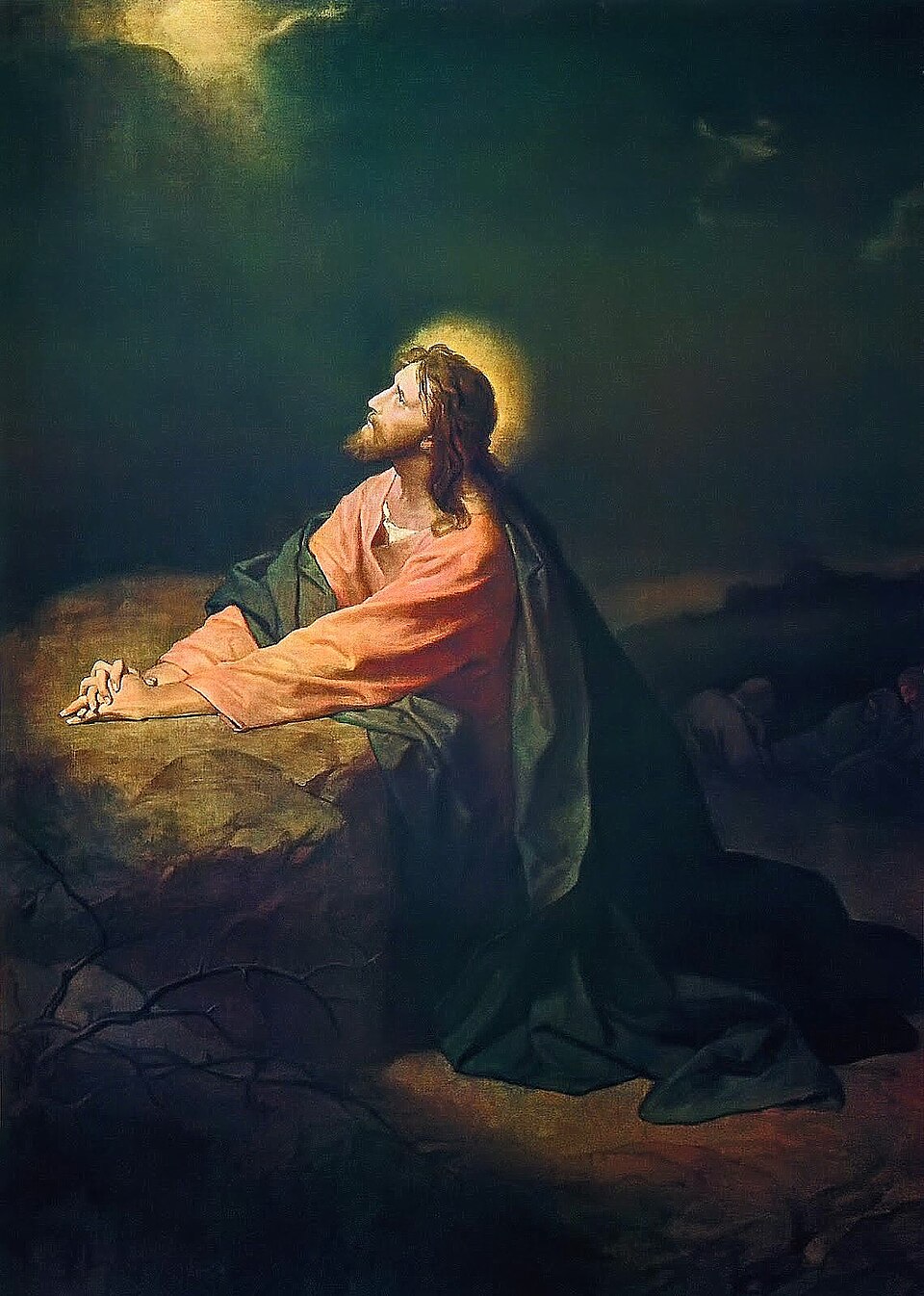
Fig. 5 — The deepest prayer in Scripture holds both halves at once: “Father, if you are willing, remove this cup… nevertheless, not my will, but yours, be done” (Luke 22:42). Heinrich Hofmann, Christ in Gethsemane (1890). Public domain, Wikimedia Commons.
Roy’s instinct here is exactly right and slightly in tension, and the tension is the whole lesson: he
wants to pray to be happy and fulfilled, and he wants it to be within God’s will. Those can sound opposed
— isn’t asking for my happiness just more “me”? Scripture’s answer is a beautiful resolution, not a
compromise.
First, settle it: praying to be happy is not selfish — joy is commanded, and God is its source. Scripture
does not frown on the desire for happiness; it redirects it. “Rejoice in the Lord always; again I will say,
rejoice” (Philippians 4:4) is an imperative. “In your presence there is fullness of joy; at your right hand are
pleasures forevermore” (Psalm 16:11) locates the deepest happiness in God himself. The problem the Bible has is never
with wanting joy — it is with seeking it in the wrong place, where it cannot last. So the first move in this prayer is
not to apologize for wanting to be happy, but to bring that honest want to the only well that never runs dry.
The key that dissolves the tension is Psalm 37:4 — and it has to be read carefully. “Delight yourself
in the Lord, and he will give you the desires of your heart.” The shallow reading makes God a vending machine: delight a
little, get what you already wanted. The true reading runs the other way: when you delight in the Lord — when He
becomes your actual joy — He reshapes what you desire, so that the “desires of your heart” He then
grants are the ones He planted there. The mechanism is not that God surrenders to your wish-list; it is that delighting in Him
slowly re-writes the wish-list until your wanting and His willing point the same way. This is the exact solution to
Roy’s tension: you don’t have to choose between “make me happy” and “Your will be done,”
because delight in God is the place where the two become one request.
The model prayer holds both halves together without flinching — Gethsemane. “Father, if you are
willing, remove this cup from me. Nevertheless, not my will, but yours, be done” (Luke 22:42; Matthew 26:39).
Watch the structure, because it is the template for every hard prayer: Jesus (1) names his real desire plainly and without
pretense — he genuinely does not want the cup; (2) submits it to the Father’s will with the hinge-word
“nevertheless”; and (3) receives not the removal of the cup but the strength to drink it (an angel strengthens
him, v.43). This is how you pray to be happy within His will: you tell God exactly what you want — honesty is not
irreverence — and then you lay it down, trusting that His will is not the enemy of your joy but its true
home. “Your will be done” (Matthew 6:10) is in the model prayer Jesus taught for daily use.
How you pray, not just that you pray, shapes whether it lifts you — and the research is pointed. Poloma and
Pendleton’s (1991) survey work found that the type of prayer matters: meditative prayer (quietly being
with God) and colloquial prayer (talking to God as a friend), together with the sense of a real experience of
God in prayer, were positively associated with well-being — while rote ritual prayer and bare
petitionary (give-me) prayer were weakly or even negatively related. The lesson lines up precisely with
§4’s vocabulary work: transactional, give-me-X prayer keeps the self on the throne (it is “mine” wearing
a halo), whereas relational, with-God prayer quietly dethrones it. Pray to and with God more than you pray
at Him for things.
So the honest anatomy of a prayer to be happy within His will has four movements. Put together, the texts give a
repeatable shape: (1) Adore & thank — start by delighting in who God is and naming gifts received (Psalm
100:4; Philippians 4:6), which relocates joy to its source; (2) Ask honestly — “let your requests be made
known to God” (Philippians 4:6); He invites real desire, so bring the real thing, including “make me happy”;
(3) Surrender the outcome — the Gethsemane “nevertheless,” handing the result to a good Father;
(4) Seek first the Kingdom — “seek first the kingdom of God… and all these things will be added”
(Matthew 6:33), anchoring your fulfillment where circumstance cannot reach it. The promised result is not that you always get
the cup removed, but “the peace of God, which surpasses all understanding” guarding your heart (Philippians 4:7)
— which is a truer form of the happiness you were asking for.
Fig. 6 — Albrecht Dürer, Praying Hands (1508). Public domain, Wikimedia Commons.
5.1The kind of prayer predicts its effect on well-beingModerate
Relational prayer (being with God) outperforms transactional prayer (asking for things) on well-being.
Fits §4 exactly: give-me prayer keeps the self central; with-God prayer dethrones it.
Limits: survey / cross-sectional, self-report, older US sample — directional, not a clinical prescription.
Scripture — Matthew 6:7–8: “do not heap up empty phrases… your Father knows what you need” — relationship over transaction.
Poloma MM, Pendleton BF (1991). Journal of Psychology and Theology 19(1):71–83.
And the thanksgiving that opens the prayer isn’t just etiquette — it is itself one of the most reliable happiness levers we know of:
5.2Gratitude — the first movement of prayer — measurably raises well-beingStrong
Weekly gratitude journaling → higher well-being & optimism and ~1.5 more hours of exercise/week vs hassles/neutral controls (RCT)
Replicated across many later trials; among the most robust positive-psychology interventions.
Theological fit: gratitude re-codes life from owned (“mine”) to received (“given”) — dethroning the self.
So “adore & thank” as prayer’s opening move is both commanded and, independently, a happiness lever.
Scripture — Philippians 4:6–7: “with thanksgiving let your requests be made known… and the peace of God… will guard your hearts.”
Emmons RA, McCullough ME (2003). J. Personality & Social Psychology 84(2):377–389.
“Isn’t praying to be happy just selfish — more ‘me’?”
No — if you seek the happiness in God rather than in getting your way.
The desire for joy is not the problem; C.S. Lewis’s famous line is that our desires are not too strong but too weak
— we settle for mud-pies when a holiday at the sea is offered. Scripture never tells you to want less joy; it tells
you to seek it where it is infinite and safe: in God himself (Psalm 16:11; 37:4). Praying “make me happy in
You” is not selfishness — it is the single desire God most wants to grant, because it is a desire for
Him. The selfishness to repent of is not wanting joy; it is demanding joy on your terms, which is the self back
on the throne. Delight in the Lord, and the wanting itself gets healed.
Logic — why the two halves stop fighting(1) You were made for joy, and God is joy’s true source (Ps
16:11). (2) Delighting in God reshapes what you desire (Ps 37:4). (3) Therefore, as you delight in Him, “the desires of
your heart” increasingly are His will — so “make me happy” and “Thy will be done”
converge on one request. The convergence isn’t forced; it is grown, by delight.
Everything so far — posture, the self-loop, dying to self, the vocabulary, the prayer — only becomes real as a rhythm. Here is the daily program that makes it a life and not a mood.
6The daily training program
A concrete rhythm: a morning offering, a breath prayer through the day, the pronoun fast, a nightly examen, and a six-week ladder — with honest, checkable markers of whether the heart is actually moving.
Bookend the day with surrender.morning offering + nightly examen
Carry a breath prayer through it.“Jesus… have mercy on me”
Climb a 6-week ladder.add one rung at a time — don’t sprint
Fig. 7 — The training’s charter: “Blessed are the poor in spirit… Blessed are the pure in heart, for they shall see God” (Matthew 5:3, 8). Carl Bloch, The Sermon on the Mount (19th c.). Public domain, Wikimedia Commons.
Posture is trained by repetition, not by insight. You will not think your way off the throne; you step
down a hundred small times until stepping down is the reflex. Here is a day, and a six-week on-ramp. Start smaller than you
think you should.
When
Practice
What you actually do
Trains / Scripture
On waking
The Morning Offering (surrender first)
Before the phone: “This day is Yours, and I am Yours. Not my will but Yours in it. Make me happy in You.” 60 seconds.
Hands the throne over before the self claims it — Luke 9:23; Ps 143:8
Morning
Relational prayer + 3 thanks
5–10 min: adore & thank (name 3 gifts), ask honestly, surrender the outcome, seek the Kingdom (the §5 four movements).
Relocates joy to its source — Phil 4:4–7; Matt 6:33
Through the day
Breath prayer + if–then triggers
On repeat under the breath: “Lord Jesus Christ, have mercy on me” / “He must increase, I must decrease.” Fire the D2 swaps on cue.
Keeps the spotlight off self in real time — 1 Thess 5:17; John 3:30
One window
The Pronoun Fast (D1)
One hour (or a meal): no bragging/complaining first-person; re-say with Table 1 swaps; serve or listen instead.
Weakens self-reference as the reflex topic — Ps 141:3; Phil 2:3–4
Once this week
Hidden service
A real good turn no one sees, told to no one. Give something away. Let God alone see it.
Starves “look what I did” — Matt 6:3–4; Acts 20:35
At night
The Examen (2 questions)
Look back: “Where did self take the throne today? Where did I let Christ have it?” Thank God for the second; confess the first; sleep.
Trains honest self-awareness without self-obsession — Ps 139:23–24; 4:4
Table 2 — One day of heart-posture training. The two bookends (morning offering, nightly examen) matter most; add the middle rungs over weeks.
THE LADDERSix weeks — add one rung at a time
Weeks 1–2 — the bookends only. Do just the 60-second Morning Offering and the two-question nightly Examen.
Nothing else. The temptation is to start with the whole program and quit in nine days; resist it. You are not trying to
impress God or yourself — you are laying one small, keepable habit at each end of the day so that surrender becomes the
frame the day hangs in. If you miss a day, simply begin again the next; the examen itself will teach you not to make even your
consistency into a new “look what I did.”
Weeks 3–4 — add the breath prayer and one if–then trigger. Now carry one short prayer through the day
(“Lord Jesus Christ, have mercy on me” is the ancient one; use any true short line), and install a single D2 trigger
— the strongest is “If I catch a ‘mine,’ then ‘Yours, Lord.’” One trigger, rehearsed
until automatic, beats ten you forget. This is the phase where the vocabulary work from §4 actually enters the
bloodstream, because it is now attached to a cue you meet dozens of times a day rather than to a resolution you made once.
Weeks 5–6 — add the Pronoun Fast and weekly hidden service. Add one daily window of the Pronoun Fast (start
with a single meal) and one secret good turn a week. By now the earlier rungs should feel less effortful — that easing is
the gray-matter point from §1 made experiential: the path is getting worn. Do not add more than this. A sustainable
half-program practiced for a year will re-posture a heart far more than a heroic full program abandoned in a month. “The
one who endures to the end” is the operative virtue (Matthew 24:13).
Honest markers — how to tell it’s actually workingDon’t measure by how spiritual you feel. Measure by
these, over weeks: (1) you less often need other people to notice what you did; (2) thwarted plans sting less —
the “nevertheless” comes faster; (3) you catch the “mine/me/I” reflex sooner, and the catching feels
less like scolding and more like a smile; (4) you are, quietly, more available to the person in front of you. If instead you
find yourself prouder of your progress, that is the self re-taking the throne through the back door — name it in the
examen and keep walking. The fruit to watch for is Galatians 5:22–23 (love, joy, peace, patience…), not a feeling of
achievement.
One thing remains: to say plainly what this program can and cannot claim — where the science ends and the Scripture carries the weight.
7Honest limits & synthesis
Small effect sizes, confounded prayer-health data, correlational brain findings — the science corroborates the shape; Scripture carries the doctrine. Convergence, not proof. The one-breath recap.
The science is corroboration, not proof.Scripture carries the authority
The effects are real but modest.r≈.10, confounded cohorts — honestly flagged
The two records converge on the self.dethrone it → freedom & joy
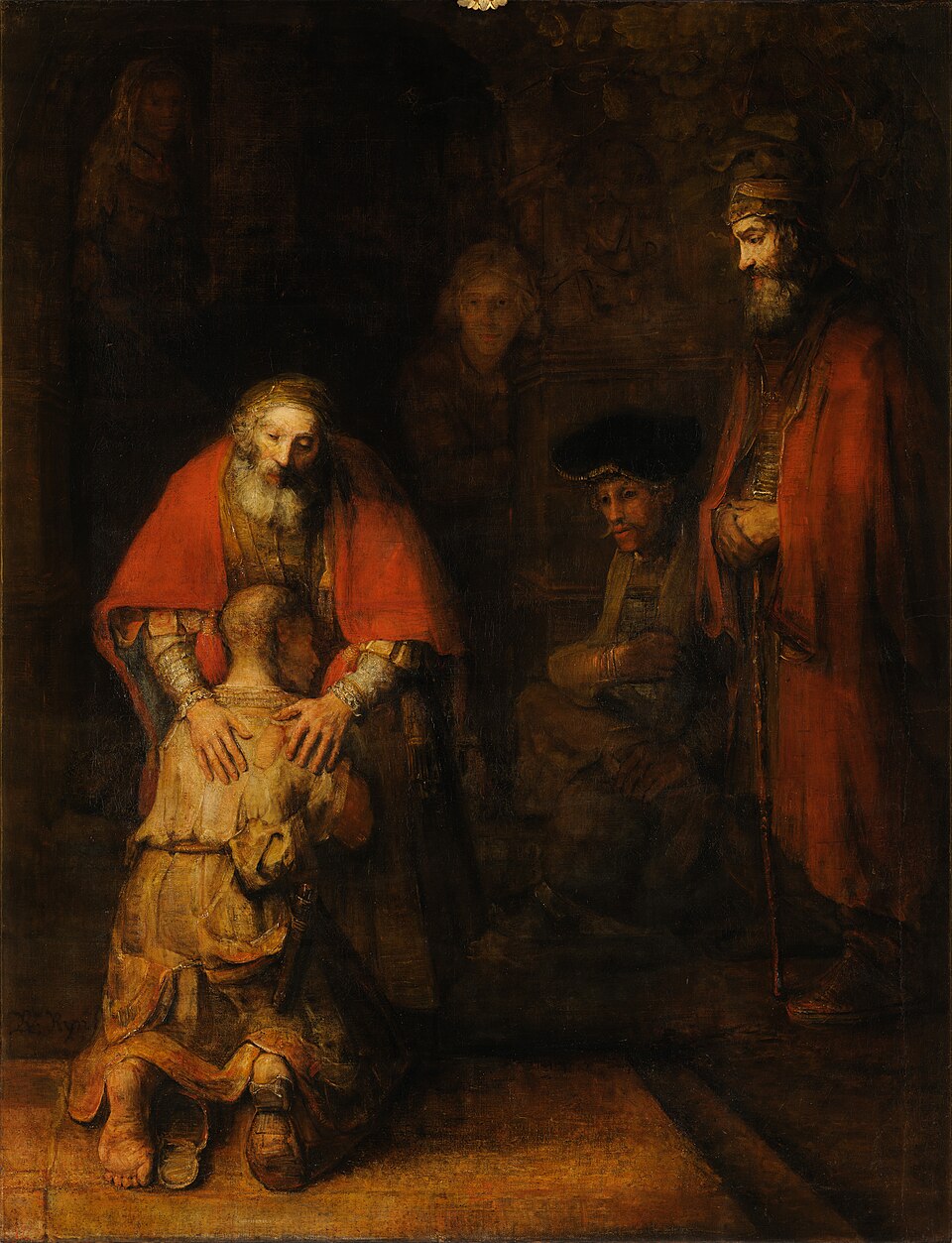
Fig. 8 — The end of the whole road: the self that stopped grasping is received, not erased. Rembrandt, The Return of the Prodigal Son (c.1668). Public domain, Wikimedia Commons.
A paper that graded everyone else honestly has to grade itself. Here is exactly what this can and cannot
claim.
The effect sizes are real but modest — this is training, not magic. The I-talk correlation is small
(r ≈ .10); distanced self-talk and gray-matter-from-practice are Moderate, drawn in part from small samples; the
prayer-and-well-being data are survey-based and cross-sectional. None of these is a miracle lever, and anyone who sells them
as one is lying. What they establish, soberly, is that the direction Scripture points — off the self, toward God
and neighbor — is the direction the best available human data also points, and that the practices are genuinely
trainable. That is a strong and useful convergence; it is not a proof, and it is not a shortcut.
The “religion is good for you” literature is badly confounded — and leaning on it would be dishonest.
There is a large body of observational work (reviewed by Koenig, 2012, among others) associating religious involvement with
better mental health. But people who pray and attend worship differ from those who don’t in a hundred uncontrolled ways
— social support, temperance, marriage rates, personality. That evidence is graded Emerging here for a reason: it is
suggestive, not load-bearing, and it absolutely cannot be used to argue “therefore Christianity is true.”
Christianity’s truth rests on the resurrection and the person of Christ, not on wellness statistics. The health findings
are a footnote, not a foundation.
The brain findings describe a how, never a why, and never the doctrine. That self-reference lives in
the default-mode network, and that trained attention quiets it, is a fascinating mechanistic picture — but it is
Model/Moderate evidence about how a re-postured heart might show up in tissue, not evidence that God exists or that the
self ought to be dethroned. The ought comes entirely from Scripture. Reverse the order — let a brain scan tell you
what to worship — and you have simply enthroned neuroscience in the seat the self just vacated.
With the limits stated, the convergence is genuinely striking — and it is the useful thing. Two independent
records, written millennia apart with no shared agenda, point at the same hinge of human flourishing: the overgrown,
self-referential self is the problem, and the cure is to get it off the throne — by attention moved to God (prayer),
by words re-aimed (the vocabulary), by surrender (“not my will”), and by love turned outward (hidden service).
Scripture says this is because you were made by God and for God and are restless until you rest in Him; the data can only say
that people built this way do better when they live this way. The believer is unsurprised that the Maker’s instructions
and the creature’s wiring agree.
The whole thing in one breathYour heart is always leaning somewhere, and by default it leans
on the self — a self that grasps, compares, and talks endlessly about itself, measurably to its own harm. The cure is not
to hate the self but to dethrone it: let Christ increase so the self can decrease; re-word “mine” into
“entrusted” and “I want” into “Your will”; pray to be happy, but seek the happiness in God,
where “delight in the Lord” and “Thy will be done” turn out to be one request; and give yourself away in
small hidden ways, daily, until self-forgetfulness is the reflex. Do it as a rhythm, not a mood. The promise is not that every
cup is removed, but that the one who loses his life this way is the one who finally finds it — received, like the prodigal,
into an embrace he could never have earned and no longer needs to.
Not clinical adviceThis is a discipleship study, not therapy. The self-reference and
mood research describes populations, not your diagnosis. If you are carrying real depression, anxiety, trauma, or scrupulosity,
“try harder to die to self” can do harm — please pair this with a pastor and a qualified clinician. Grace, not
performance, is the engine throughout (2 Cor 3:18); if the practices start feeling like a treadmill you must run to earn love,
stop and re-read §3.
RReferences
Peer-reviewed sources, each tied to the finding it supports above. Scripture quotations are locating anchors
(ESV/KJV public-domain wording); the doctrine rests on the text, not on these studies.
1. Tackman AM, Sbarra DA, Carey AL, Donnellan MB, Horn AB, Holtzman NS, Edwards T, Pennebaker JW, Mehl MR. Depression, negative emotionality, and self-referential language: a multi-lab, multi-measure, and multi-language-task research synthesis. J Pers Soc Psychol. 2019;116(5):817–834.
2. Edwards T, Holtzman NS. A meta-analysis of correlations between depression and first person singular pronoun use. J Res Pers. 2017;68:63–68.
3. Rude SS, Gortner EM, Pennebaker JW. Language use of depressed and depression-vulnerable college students. Cogn Emot. 2004;18(8):1121–1133.
4. Raichle ME, MacLeod AM, Snyder AZ, Powers WJ, Gusnard DA, Shulman GL. A default mode of brain function. Proc Natl Acad Sci USA. 2001;98(2):676–682.
5. Brewer JA, Worhunsky PD, Gray JR, Tang YY, Weber J, Kober H. Meditation experience is associated with differences in default mode network activity and connectivity. Proc Natl Acad Sci USA. 2011;108(50):20254–20259.
6. Northoff G, Heinzel A, de Greck M, Bermpohl F, Dobrowolny H, Panksepp J. Self-referential processing in our brain — a meta-analysis of imaging studies on the self. NeuroImage. 2006;31(1):440–457.
7. Hölzel BK, Carmody J, Vangel M, Congleton C, Yerramsetti SM, Gard T, Lazar SW. Mindfulness practice leads to increases in regional brain gray matter density. Psychiatry Res Neuroimaging. 2011;191(1):36–43.
8. Emmons RA, McCullough ME. Counting blessings versus burdens: an experimental investigation of gratitude and subjective well-being in daily life. J Pers Soc Psychol. 2003;84(2):377–389.
9. Poloma MM, Pendleton BF. The effects of prayer and prayer experiences on measures of general well-being. J Psychol Theol. 1991;19(1):71–83.
10. Gollwitzer PM. Implementation intentions: strong effects of simple plans. Am Psychol. 1999;54(7):493–503.
11. Gollwitzer PM, Sheeran P. Implementation intentions and goal achievement: a meta-analysis of effects and processes. Adv Exp Soc Psychol. 2006;38:69–119.
12. Kross E, Bruehlman-Senecal E, Park J, Burson A, Dougherty A, Shablack H, Bremner R, Moser J, Ayduk O. Self-talk as a regulatory mechanism: how you do it matters. J Pers Soc Psychol. 2014;106(2):304–324.
13. Moser JS, Dougherty A, Mattson WI, et al. Third-person self-talk facilitates emotion regulation without engaging cognitive control. Sci Rep. 2017;7:4519.
14. Dunn EW, Aknin LB, Norton MI. Spending money on others promotes happiness. Science. 2008;319(5870):1687–1688.
15. Crocker J, Canevello A. Creating and undermining social support in communal relationships: the role of compassionate and self-image goals. J Pers Soc Psychol. 2008;95(3):555–575.
16. Yaden DB, Haidt J, Hood RW, Vago DR, Newberg AB. The varieties of self-transcendent experience. Rev Gen Psychol. 2017;21(2):143–160.
17. Kruse E, Chancellor J, Ruberton PM, Lyubomirsky S. An upward spiral between gratitude and humility. Soc Psychol Personal Sci. 2014;5(7):805–814.
18. Koenig HG. Religion, spirituality, and health: the research and clinical implications. ISRN Psychiatry. 2012;2012:278730. (observational literature — graded Emerging; confounded.)
19. The Holy Bible — English Standard Version & Authorized (King James) Version (public domain). Principal texts: Prov 4:23; 23:7; Ps 16:11; 37:4; 51:10; 139:23–24; Ezek 36:26; Matt 5:3–8; 6:1–10,33; 22:37; Luke 9:23–24; 18:9–14; 22:42; John 3:30; 13:14; Rom 12:2; 1 Cor 4:7; 15:10; 2 Cor 3:18; Gal 2:20; 5:22–23; Phil 2:5–9; 4:4–7; Col 3:1–3,17; James 4:6,15; 1 Pet 5:6–7.
GodExamined · Training the Heart: Dying to Self, Praying in His Will · compiled 2026-10-30 · local research document.
Every claim graded (Established / Strong / Moderate / Model / Emerging). Scripture states the why and carries the doctrine;
the studies describe a how and carry none of it. Convergence is corroboration, not proof. Artworks are genuine
public-domain works (Wikimedia Commons), credited per figure. Not clinical advice — see §7.