GOD EXAMINEDBible← Back to The Proof

The Great Reversal

Every wound the Old Testament opens, the New Testament heals — often with the very thing that caused it, turned inside out. The whole catalogue as one table: each row a one-line BEFORE (OT) → AFTER (NT) comparison, side by side. Click any row to expand it in place.

Read every row two ways at once — prophecy and reversal The Bible does not present these as lucky parallels noticed after the fact. It presents them as prophecy by design: God wrote the pattern into real history first, then fulfilled it in person.
  1. Prophetic by design. God deliberately laid these patterns and promises into actual Old-Testament history and story — the serpent-crusher (Gen 3:15), the Passover lamb, the bronze serpent, Jonah's three days, the thirty pieces of silver (Zech 11:12–13) — pointing forward like a sealed envelope.
  2. Prophetically fulfilled in real life by Jesus. Those God-authored patterns came true in the real, historical life, death, and resurrection of Christ — the envelope opened, in events His followers lived through and died testifying to.
  3. Reversed inside the story. And the fulfilment does not merely repeat the old wound — it undoes it: death becomes life, curse becomes blessing, the very thing that killed becomes the thing that heals.
One Author, one story — written in advance by God, then lived out by Jesus.

What you're looking at Typology · Recapitulation · Protoevangelium

Your instinct — Eve's hand takes the fruit that brings death; a woman's voice (Mary Magdalene) first carries the news of life — is the Bible's signature move, named three ways: typology (an OT "type" answered by a NT "antitype"), recapitulation (Christ retraces Adam's path and reverses each defeat — Irenaeus), and the protoevangelium (Gen 3:15 — the first gospel, spoken inside the curse). Promised at the fall, paid out across the canon.

The grade on each row = how firmly the link stands: NT-Explicit the New Testament draws the link in so many words. Patristic held by the earliest Church; strong tradition. Devotional an edifying resonance — not load-bearing doctrine.
↓ Skim the whole argument as one chain

Skim it in one chain

Scripture opens with a wound and closes with its healing. → A woman's hand took the fruit that brought death, so a woman's voice is first to carry the news of life (§1). → Death came through one man, so life comes through one Man, the Last Adam (§2). → Death entered at a tree, so it is undone on a tree, and a Tree of Life waits at the end (§3). → The fall happened in a garden, so the surrender and the rising happen in gardens too (§4). → A serpent's lie poisoned us, so the serpent is crushed — and even its image, lifted on a pole, heals (§5). → The ground was cursed with thorns, so the King wears thorns and the flaming sword becomes a torn veil (§6). → Pride scattered the tongues at Babel, so the Spirit gathers them at Pentecost (§7). → Waters of judgment drowned the world, so the water of baptism saves it (§8). → A brother's blood cried for vengeance, so a better Brother's blood speaks mercy (§9). → A father was asked for his only son and given a ram, so the Father gives His only Son as the Lamb (§10). → A beloved son was betrayed for silver and raised up to save his betrayers (§11). → A lamb's blood spared the firstborn, so the Lamb of God becomes our Passover (§12). → The Law at Sinai killed three thousand; the Spirit at Pentecost saved three thousand (§13). → Jonah lay three days in the deep and rose to a city of enemies, so the Son lay three days in the earth (§14). → And a dozen smaller mirrors say the same thing (§15) — read honestly, knowing which links the Bible draws itself (§16).

16 rows · one-line OT → NT side by side · click any row to expand it in place
§PatternBefore — Old Testament (the wound) After — New Testament (the healing)
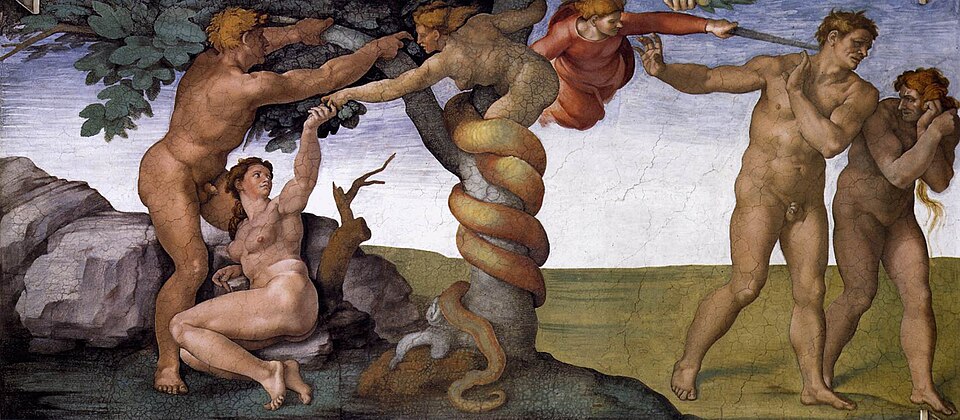
§1 The Womandeath-bringer → life-bringerPatristic NT Eve is deceived, takes the forbidden fruit, and hands death to the world. Mary's "yes" undoes Eve's "no"; Mary Magdalene is first to see the risen Christ and carry the news of life — in a garden, both times.
Michelangelo, Fall and Expulsion from the Garden of Eden
Fig. 1 — Michelangelo, Fall and Expulsion from the Garden of Eden (Sistine Chapel, 1509–10). One fresco holds both halves: Eve reaching for the fruit, the pair driven out. Public domain, Wikimedia Commons.
The wound · Genesis 3

A woman is deceived by the serpent, takes the fruit, and gives it to the man; through her act death enters. Named "mother of all living," she becomes the mother of all dying.

Gen 3:1–6, 20 · Rom 5:12 · 1 Tim 2:14

The healing · Luke 1 & John 20

A woman's "Let it be to me according to your word" lets Life enter; and a woman is first to see the risen Christ and first sent to tell the men the news of life.

Luke 1:38 · John 20:11–18

  • Your observation is the hinge of the whole pattern, and the Church saw it by the second century. Irenaeus wrote that "the knot of Eve's disobedience was loosed by the obedience of Mary; what the virgin Eve bound by unbelief, the Virgin Mary loosed by faith" (Against Heresies III.22.4; V.19.1). The logic is exact: the fall came through a woman's word to a fallen angel, so the rescue comes through a woman's word to a holy one. Eve believed the serpent and distrusted God; Mary believed Gabriel and trusted God. Same role, same stakes, opposite choice, opposite result for the race.
  • Mary Magdalene completes the mirror, and here the New Testament draws the line itself. In Genesis a woman takes hold of fruit and spreads death by her report; in John 20 a woman takes hold of the risen Christ and spreads life by her report: "I have seen the Lord." All four Gospels make women the first witnesses — John names Magdalene — which is itself a quiet argument for honesty: no first-century forger would stake the central claim on female testimony, discounted in court. The early Church called her apostola apostolorum, "apostle to the apostles," because she was sent with the news.
  • The scene is staged in a garden on purpose, so the two women stand in the same place. The fall is in Eden; the resurrection appearance is in a garden by the tomb (John 19:41). Mary even takes Jesus for "the gardener" (John 20:15) — and Adam was precisely the gardener (Gen 2:15). The second woman meets the true Gardener and is told to go and speak; the first met the serpent and spoke death. The setting signals that the earlier scene is being re-run with the outcome reversed.
Honesty flag Eve→Mary is patristic typology — ancient and faithful to the text, but a pattern the Church perceived, not a sentence the NT writes. Magdalene as first commissioned witness, by contrast, is stated plainly in all four Gospels — NT-explicit.
In one breath: the first woman spoke and death spread; the obedient woman answered Eve's "no," and the first risen-witness spoke and life spread — same role, same garden, opposite result.
§2 The Manfirst Adam → Last AdamNT Adam grasps at being like God, disobeys at the tree, and his death passes to all. The last Adam refuses to grasp (Phil 2), obeys unto death, and His life passes to all in Him.
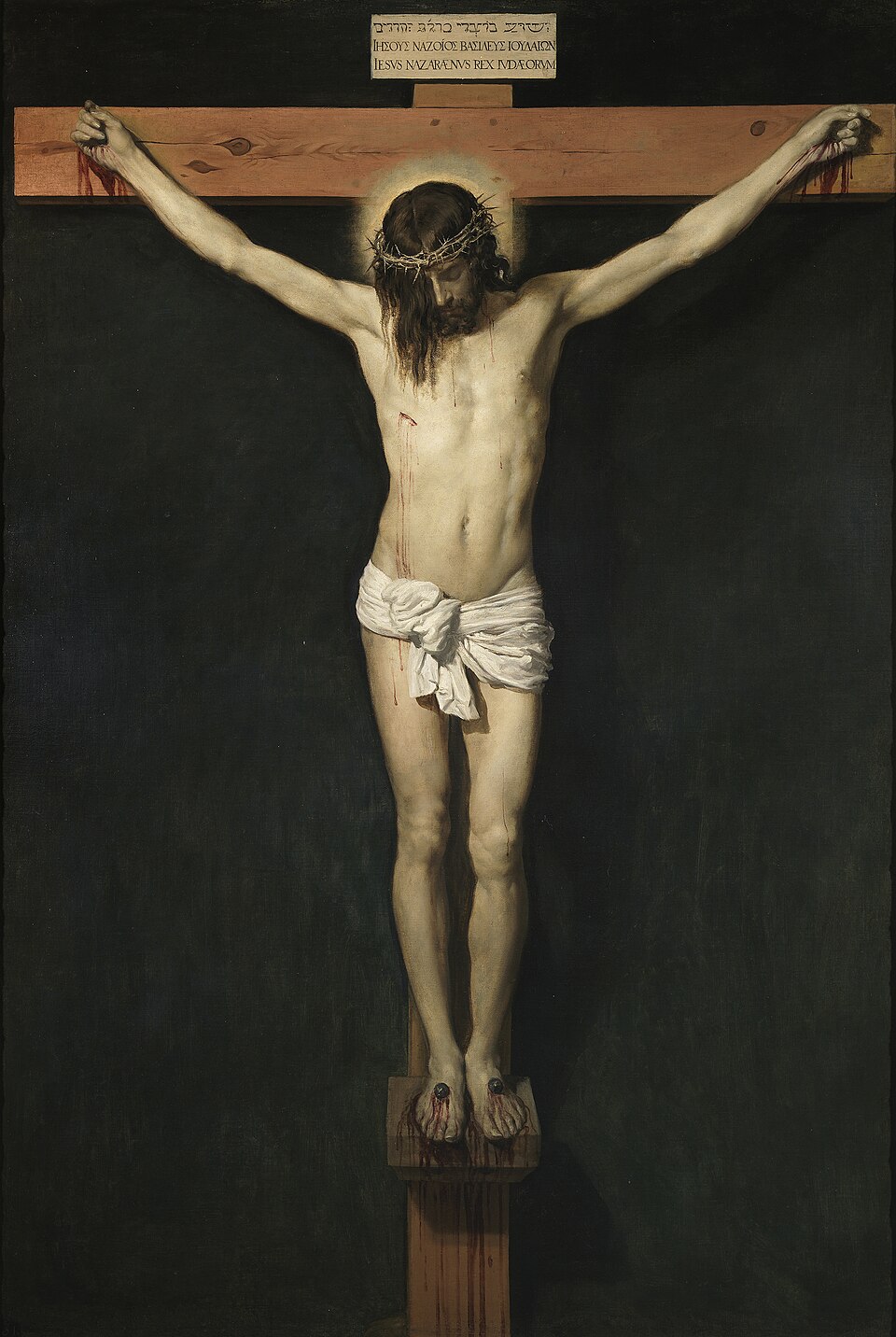
Velázquez, Christ Crucified
Fig. 2 — Diego Velázquez, Cristo crucificado (c. 1632, Prado). Obedience on a tree answering disobedience at a tree. Public domain, Wikimedia Commons.
The wound · Adam

The first man grasps at being "like God," disobeys at the tree, and falls — and as head of the race his death passes to all. "The first man Adam became a living being."

Gen 2:17; 3:5–6, 19 · Rom 5:12

The healing · Christ

The second man refuses equality with God as a thing to grasp, obeys unto death, and rises — and as new head His life passes to all in Him. "The last Adam became a life-giving spirit."

Phil 2:6–8 · 1 Cor 15:22, 45 · Rom 5:19

  • This is the one reversal the NT spells out as a formal argument, twice. Romans 5:12–21 runs the parallel line by line: "as by one man's disobedience the many were made sinners, so by one man's obedience the many will be made righteous." 1 Corinthians 15:21–22 compresses it: "as in Adam all die, so also in Christ shall all be made alive." Paul even supplies the vocabulary, calling Adam "a type (typos) of the one who was to come" (Rom 5:14). Every other reversal on this page is a variation on one head's defeat answered by a new Head's victory.
  • Christ reverses Adam's exact failure — He un-grasps what Adam grasped. The serpent's lure was "you will be like God" (Gen 3:5); Philippians 2:6–8 says Christ "did not count equality with God a thing to be grasped, but emptied himself... and became obedient to the point of death, even death on a cross." The second Adam descends by self-emptying where the first ascended by self-seizing. Irenaeus called this recapitulation: Christ retraces Adam's steps and wins at each point Adam lost.
  • Even the side-wound carries the pattern: from the first Adam's side came a bride, and from the last Adam's side comes His. God put Adam to sleep and formed Eve from his opened side (Gen 2:21–22); on the cross "one of the soldiers pierced his side, and at once there came out blood and water" (John 19:34) — the Church, the Bride, born from the opened side of the sleeping second Adam (Eph 5:25–32). The bride who shared the first man's fall is reconstituted from the second Man's sacrifice.
Scripture "As one trespass led to condemnation for all men, so one act of righteousness leads to justification and life for all men." — Romans 5:18
In one breath: one man's grab for godhood sentenced the race to death; one Man's refusal to grab, obeying unto death, raised it to life.
§3 The Treetree of death → Tree of LifeNT Patristic Death comes by eating from a tree; the Tree of Life is fenced off by cherubim. The cross is called "the tree" (Gal 3:13); Scripture ends with the Tree of Life open again, healing the nations.
The wound · the tree of knowledge

"In the day that you eat of it you shall surely die." A tree is the instrument of the fall, and the way to the tree of life is barred.

Gen 2:17; 3:22–24

The healing · the cross & Tree of Life

Life comes by a death on a tree; the NT repeatedly calls the cross "the tree," and the canon closes with the tree of life restored.

Gal 3:13 · Acts 5:30; 10:39 · Rev 2:7; 22:2

  • The NT deliberately calls the cross a "tree," so the reader cannot miss the rhyme with Eden. Peter preaches that they killed Jesus "by hanging him on a tree" (Acts 5:30; 10:39); Paul quotes Deuteronomy — "cursed is everyone who is hanged on a tree" — to say Christ "became a curse for us" (Gal 3:13). The Greek word xylon ("wood/tree") is the same word the Greek OT uses for the garden tree. The disease came through a tree, so the antidote is given through a tree.
  • The arc is a full circle: a tree lost at the start is a tree regained at the end. Humanity is driven out "lest he reach out his hand and take also of the tree of life" (Gen 3:22–24); the risen Christ promises, "To the one who conquers I will grant to eat of the tree of life" (Rev 2:7), and in Revelation 22:2 the tree stands again, "the leaves of the tree were for the healing of the nations." The Bible is bookended by the same tree — forbidden on page three, freely given on the last page.
  • The early Church read this so strongly that "the tree" became a title for the cross in its hymns. Melito of Sardis, Irenaeus, and the Good Friday hymn Pange lingua ("the faithful cross, the one noble tree") treat Eden's tree and Calvary's as a matched pair. This is typology, but it is anchored by the hard fact that the apostles chose the loaded word xylon on purpose.
In one breath: a tree in Eden dealt death and the Tree of Life was fenced off; the cross — "the tree" — bore the curse, and Scripture ends with the Tree of Life open again.
§4 The GardenEden → Gethsemane & the tombPatristic Devotional In a garden Adam says "my will" and hides from God among the trees. In a garden Jesus says "not my will but yours"; risen in a garden, He is found — taken for the gardener.
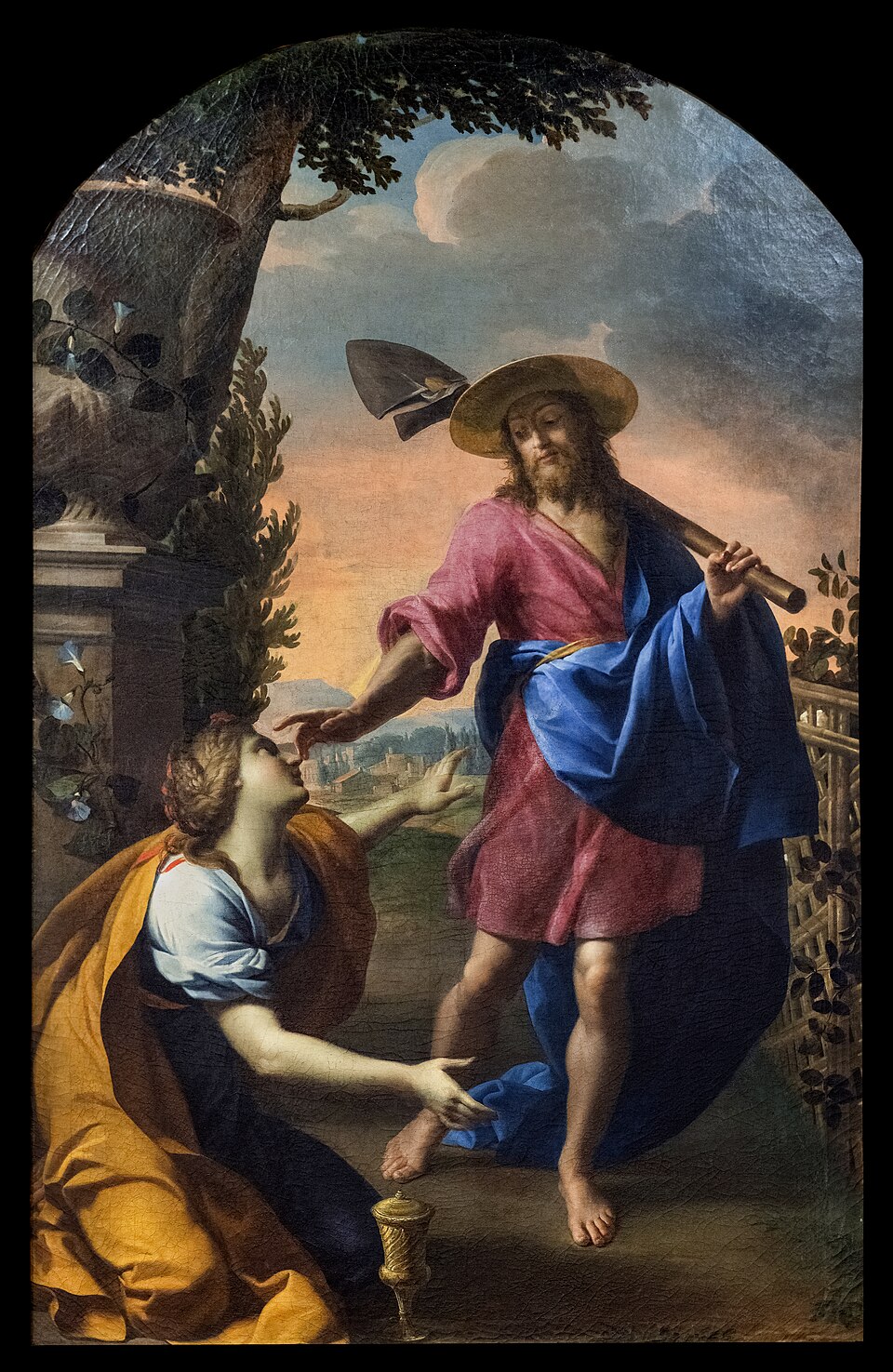
Noli me tangere — Christ appearing to Mary Magdalene in the garden
Fig. 3 — Antoine Rivalz, Noli me tangere (Musée Ingres-Bourdelle). The risen Christ in the garden of the tomb; Mary takes Him for the gardener (John 20:15). Public domain, Wikimedia Commons.
The wound · Eden

In a garden the man seizes his own will against God, then hides among the trees. The garden becomes a place of disobedience, shame, and hiding.

Gen 2:15–17; 3:8–10

The healing · Gethsemane & the tomb

In a garden Jesus surrenders His will; in a garden He is found alive — sought rather than hiding, taken for the gardener.

Luke 22:39–44 · John 18:1; 19:41; 20:15

  • The decisive word of the fall and of the rescue are opposites, spoken in the same kind of place. Adam's catastrophe is a declaration of independent will. In Gethsemane, "going a little farther he fell on his face and prayed, 'My Father... not as I will, but as you will'" (Matt 26:39; Luke 22:42), His sweat "like great drops of blood" (22:44). The whole reversal turns on two sentences in two gardens: "I will" and "not my will but yours."
  • Adam hides in the garden; the risen Christ is sought in the garden — the relationship is flipped. "The man and his wife hid themselves from the presence of the LORD God among the trees" (Gen 3:8), and God comes asking, "Where are you?" At the tomb the human comes seeking — "where have you laid him?" — and God, in Christ, is found and speaks her name (John 20:15–16). The garden of hiding becomes the garden of being found.
  • "She supposed him to be the gardener" is a deliberate echo — though the most devotional link here. Adam was placed "to work it and keep it" (Gen 2:15): the original gardener, who let it fall to thorns. When Mary mistakes the risen Jesus for "the gardener" (John 20:15), the second Adam stands in a garden at the dawn of a new creation, and the mistake is, at a deeper level, exactly right. This is edifying resonance; the garden-settings themselves are hard features of the text.
Honesty flag That the fall, the agony, and the resurrection all occur in gardens is textual fact. That John intends "the gardener" as an Adam-echo is a strong but devotional inference.
In one breath: in a garden a man grasped his own will and hid; in a garden the Son surrendered His will, and in a garden He rose — found, and taken for the gardener of a new creation.
§5 The Serpentdeceiver crushed; venom healsNT A serpent's lie poisons the world; venomous snakes kill in the wilderness. The serpent's head is crushed (Gen 3:15); its image, lifted on a pole, heals — as the Son is "lifted up" (John 3:14).
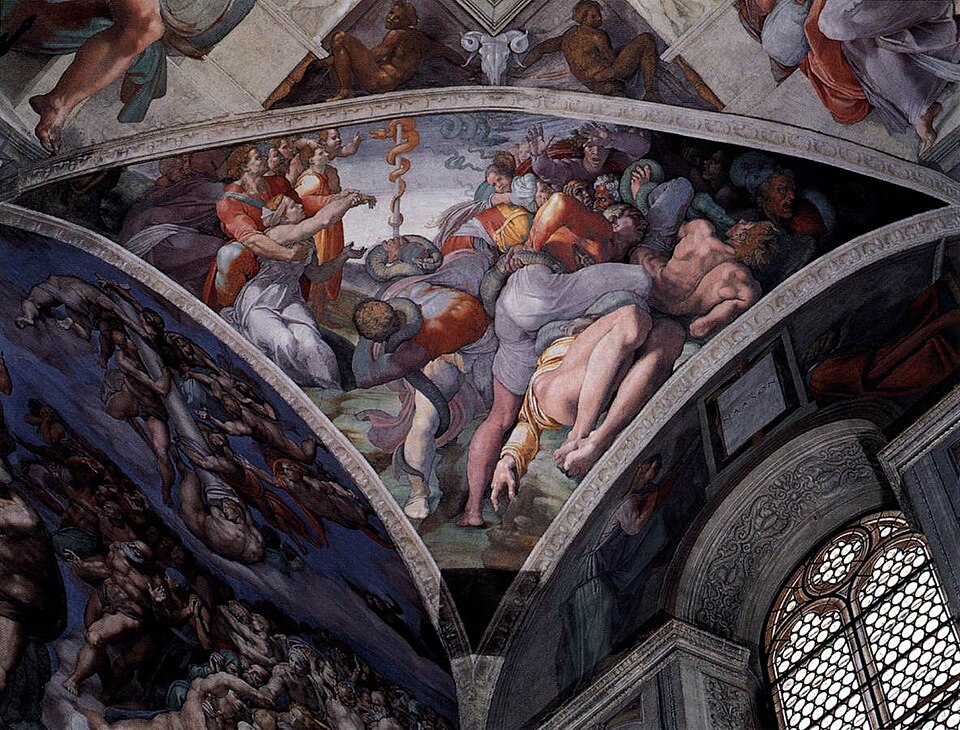
Michelangelo, The Brazen Serpent
Fig. 4 — Michelangelo, The Brazen Serpent (Sistine Chapel). The dying look to the bronze serpent and live (Num 21) — the sign Jesus applies to His own lifting up. Public domain, Wikimedia Commons.
The wound · the serpent & the venom

The serpent deceives and poisons; venomous snakes kill the complaining Israelites. Yet in Eden God already promises the serpent's head will be crushed by the woman's seed.

Gen 3:1–5, 15 · Num 21:4–9

The healing · lifted up

Moses lifts a bronze serpent on a pole; all who look live. Jesus says He will be "lifted up" the same way — and the ancient serpent is finally crushed.

John 3:14–15 · Rom 16:20 · Rev 12:9; 20:2, 10

  • The first promise of reversal is spoken to the serpent, inside the curse — the protoevangelium. "He shall bruise your head, and you shall bruise his heel" (Gen 3:15): the woman's seed takes a survivable wound to the heel (the crucifixion) while delivering a mortal wound to the head (the devil's defeat). Paul applies it to the Church — "The God of peace will soon crush Satan under your feet" (Rom 16:20) — and Revelation shows "that ancient serpent" thrown down and destroyed (Rev 12:9; 20:2, 10).
  • Jesus turns the bronze-serpent episode into the clearest "venom becomes cure" reversal in Scripture. In Numbers 21 the remedy is counter-intuitive: make an image of the very thing that is killing you, lift it on a pole, and whoever looks lives. "As Moses lifted up the serpent in the wilderness, so must the Son of Man be lifted up, that whoever believes in him may have eternal life" (John 3:14–15). The instrument of death, raised up, becomes the instrument of healing — exactly as the tree that killed becomes the tree that saves (§3).
  • The reversal is total: the deceiver who seemed to win in Eden is stripped of every victory. In Genesis the serpent appears to triumph; by Revelation the dragon is unmasked, defeated, and cast out forever. The cross is the decisive blow: "he disarmed the rulers and authorities and put them to open shame, by triumphing over them" (Col 2:15). The head-crushing promised in Eden is paid in full at Golgotha.
Scripture "As Moses lifted up the serpent in the wilderness, so must the Son of Man be lifted up, that whoever believes in him may have eternal life." — John 3:14–15
In one breath: the serpent poisoned the world and seemed to win, but God promised its head crushed; the venom lifted on a pole healed those who looked, and Christ "lifted up" crushes it for good.
§6 The Cursethorns, sweat, dust, barred gateNT Patristic Thorns curse the ground, man sweats and returns to dust; a flaming sword bars the way to God. A crown of thorns, bloody sweat, resurrection, and the temple veil torn open top to bottom.
Caravaggio, The Crowning with Thorns
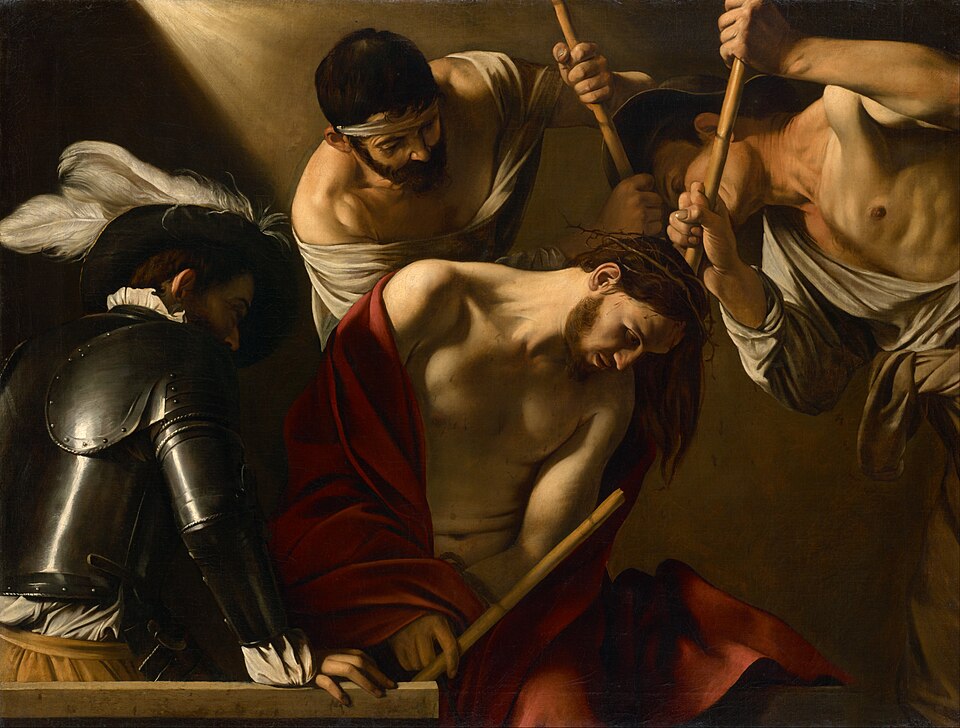
Fig. 5 — Caravaggio, The Crowning with Thorns (c. 1603). The King wears the thorns that cursed the ground (Gen 3:18; Matt 27:29). Public domain, Wikimedia Commons.
  • Thorns: the ground was cursed to grow thorns, so the King wears a crown of thorns and absorbs the curse on His head. "Cursed is the ground because of you... thorns and thistles it shall bring forth for you" (Gen 3:17–18). At the Passion, "twisting together a crown of thorns, they put it on his head" (Matt 27:29). The clearest emblem of the cursed earth is pressed onto the brow of the One bearing the curse — "Christ redeemed us from the curse... by becoming a curse for us" (Gal 3:13). The curse, worn.
  • Sweat: "by the sweat of your face" became the mark of fallen labour, and in Gethsemane that sweat turns to blood. "By the sweat of your face you shall eat bread, till you return to the ground" (Gen 3:19); in the garden the second Adam's "sweat became like great drops of blood falling down to the ground" (Luke 22:44). The toil-sweat of the fall is answered by the agony-sweat of redemption, poured onto the same cursed ground.
  • Dust and death: "to dust you shall return" is the last clause of the curse, and the resurrection is its reversal. "You are dust, and to dust you shall return" (Gen 3:19) is contradicted by "Death is swallowed up in victory" (1 Cor 15:54–55). Christ, "the firstborn from the dead" (Col 1:18), guarantees all who are in Him are raised imperishable. The curse's last word, "dust," is overruled by the gospel's last word, "life."
  • The barred gate: cherubim with a flaming sword shut the way, and at the cross the veil — woven with cherubim — is torn open. God "placed the cherubim and a flaming sword... to guard the way to the tree of life" (Gen 3:24); the temple veil, embroidered with cherubim (Ex 26:31), re-enacted that closed way. At Jesus' death "the curtain of the temple was torn in two, from top to bottom" (Matt 27:51) — from above, by God. Hebrews: we now have "confidence to enter the holy places by the blood of Jesus, by the new and living way that he opened for us through the curtain, that is, through his flesh" (Heb 10:19–20). The guarded way back to God is thrown open.
Scripture "The curtain of the temple was torn in two, from top to bottom." — Matthew 27:51  ·  "Cursed is everyone who is hanged on a tree." — Galatians 3:13
In one breath: thorns, sweat, dust, and a barred gate were the curse; the thorn-crowned King sweats blood, defeats the dust in rising, and tears the veil so the shut way back to God stands open.
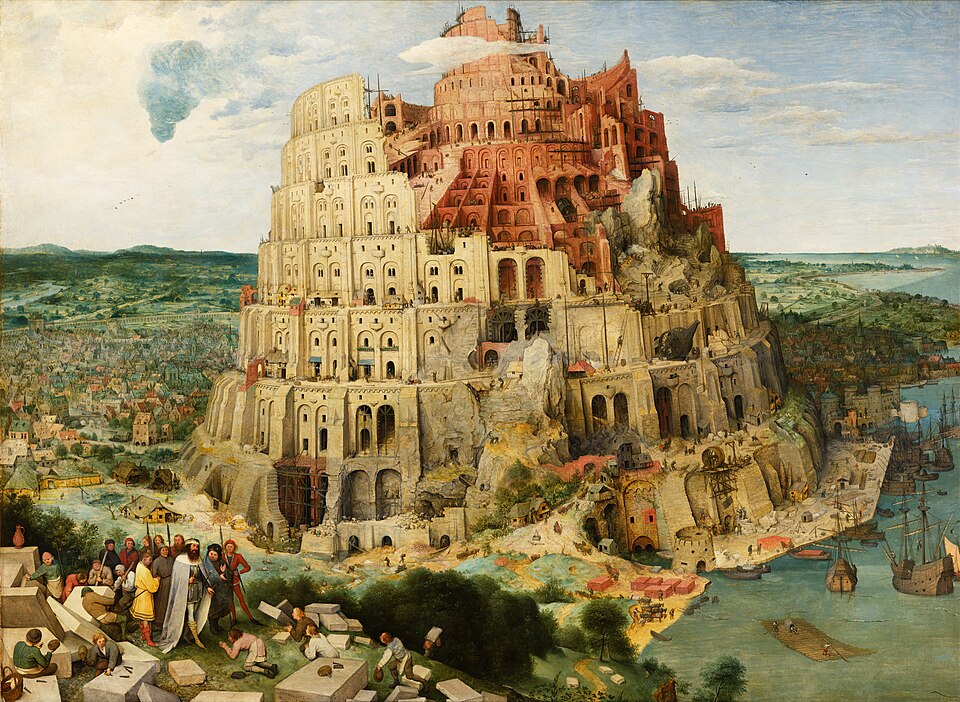
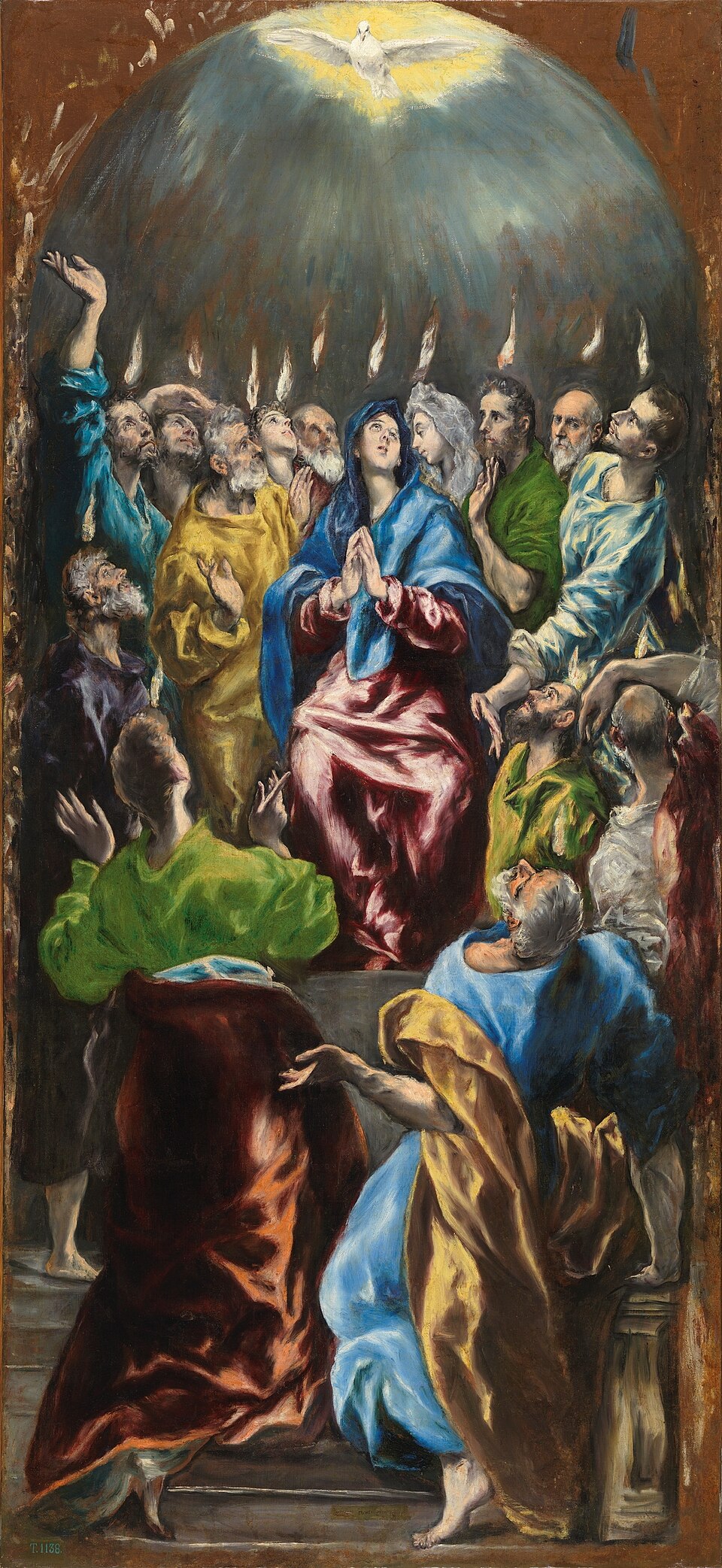
§7 Babel → Pentecostscattered → gathered tonguesPatristic Pride builds a tower to heaven; God confuses the languages and scatters the nations. The Spirit descends from heaven; every nation hears as one — scattering becomes ingathering.
Bruegel, The Tower of Babel
Fig. 6 — Pieter Bruegel the Elder, The Tower of Babel (1563, Vienna). Pride climbing toward heaven; the confusion of tongues scatters the builders. Public domain, Wikimedia Commons.
El Greco, Pentecost
Fig. 7 — El Greco, Pentecost (c. 1600, Prado). The Spirit descends as tongues of fire; the nations hear in their own languages. Public domain, Wikimedia Commons.
The wound · Babel

Humanity, proud and unified in rebellion, builds a tower "with its top in the heavens." God confuses their language and scatters them over the earth.

Genesis 11:1–9

The healing · Pentecost

The Spirit descends on the believers; men "from every nation under heaven" each hear the mighty works of God "in his own language." Scattering becomes mission.

Acts 2:1–11

  • The two scenes are built from the same parts, reflected. At Babel humanity reaches up in pride, and God comes down to confuse and scatter (Gen 11:5–8); at Pentecost God comes down in the Spirit on those waiting in humility, and many languages are drawn together in understanding (Acts 2:5–11). Babel's confusion of tongues is answered by Pentecost's gift of tongues: the curse made one people into many who could not hear each other; the cure makes many peoples one who can.
  • The deepest reversal is the motive: Babel makes a name for ourselves; Pentecost proclaims the name of God. "Let us make a name for ourselves, lest we be dispersed" (Gen 11:4) versus the crowd hearing "the mighty works of God" (Acts 2:11). And the very dispersion Babel feared becomes, redeemed, the engine of the Great Commission (Acts 1:8). What pride broke apart, grace gathers — not by erasing the languages but by making each a vessel for one message.
  • The Church has read this as a matched pair since antiquity, and it frames the book of Acts. Luke lists the nations present (Acts 2:9–11) as a deliberate "table of nations," echoing Genesis 10–11. Revelation shows the destination — "a great multitude... from every nation, from all tribes and peoples and languages" before the throne (Rev 7:9). The scattering of Babel ends in the gathered, multilingual worship of heaven.
In one breath: at Babel pride reached for heaven and God scattered the tongues; at Pentecost the Spirit came from heaven and every nation heard as one.
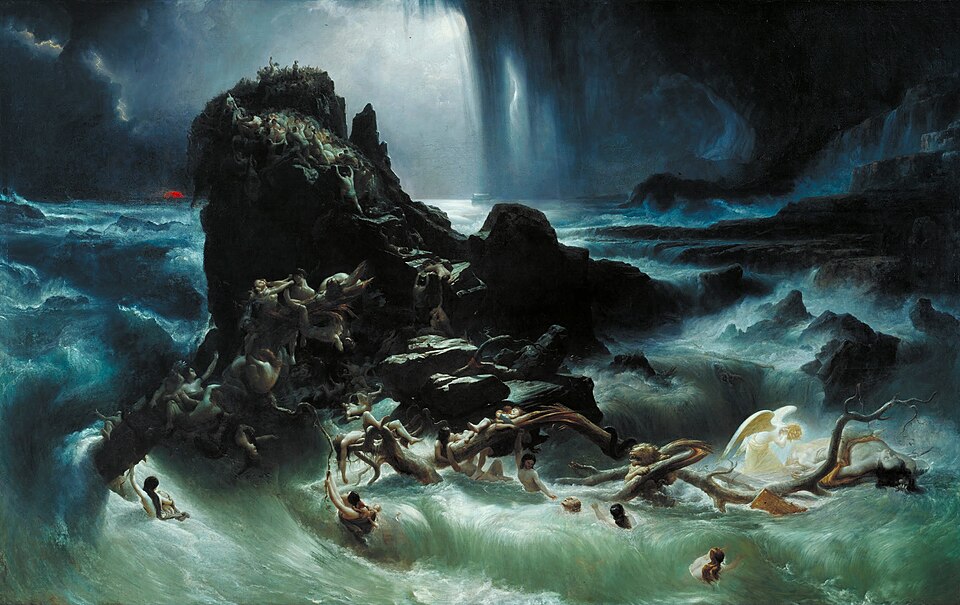
§8 Flood → Baptismwaters of death → of lifeNT Water drowns a guilty world in judgment. Water now saves — baptism, the flood's "antitype" (1 Pet 3:21); the dove rests on Christ.
Francis Danby, The Deluge
Fig. 8 — Francis Danby, The Deluge (c. 1840). The waters of judgment; Peter calls baptism the antitypos that "now saves you." Public domain, Wikimedia Commons.
The wound · the Flood

Water becomes the instrument of judgment; the flood destroys a corrupt world. Yet the same water bears the ark to a cleansed earth, and a dove returns with an olive leaf.

Gen 6:5–8; 7:17–24; 8:8–11

The healing · Baptism

Peter names baptism the antitype of the flood — water that "now saves you... through the resurrection of Jesus Christ." The Spirit descends "like a dove" at Jesus' baptism.

1 Peter 3:20–21 · Matthew 3:16

  • The NT hands you this typology fully formed, with the technical word. "Eight persons, were brought safely through water. Baptism, which corresponds to this (Greek antitypon), now saves you... through the resurrection of Jesus Christ" (1 Pet 3:20–21). The flood is water that drowns the guilty world; baptism is water that saves the one who passes through it, because in baptism the believer passes through death with Christ into new life (Rom 6:3–4).
  • The dove ties the scenes together and points to a new creation. Noah's dove returns with an olive leaf — judgment over, peace come (Gen 8:11); at Jesus' baptism "he saw the Spirit of God descending like a dove and coming to rest on him" (Matt 3:16). Both scenes open with the Spirit over the waters (Gen 1:2), framing baptism as the start of a new creation.
  • The ark is a type of being "in Christ": salvation through the judgment, not around it. Noah's family is carried through the flood in the ark; the believer is brought through death in Christ, who went through the waters of death and out in resurrection. The early Church read the ark as a figure of the Church — the vessel carrying a remnant across the waters into a cleansed new earth.
Scripture "Baptism, which corresponds to this, now saves you... through the resurrection of Jesus Christ." — 1 Peter 3:21
In one breath: the flood was water that drowned a guilty world; baptism — its named antitype — is water that saves, as the dove of peace rests on the One who begins the new creation.
§9 Cain & Abelblood of vengeance → of mercyNT A murdered brother's blood cries from the ground for vengeance. Jesus' blood "speaks a better word than Abel's" — mercy for the guilty (Heb 12:24).
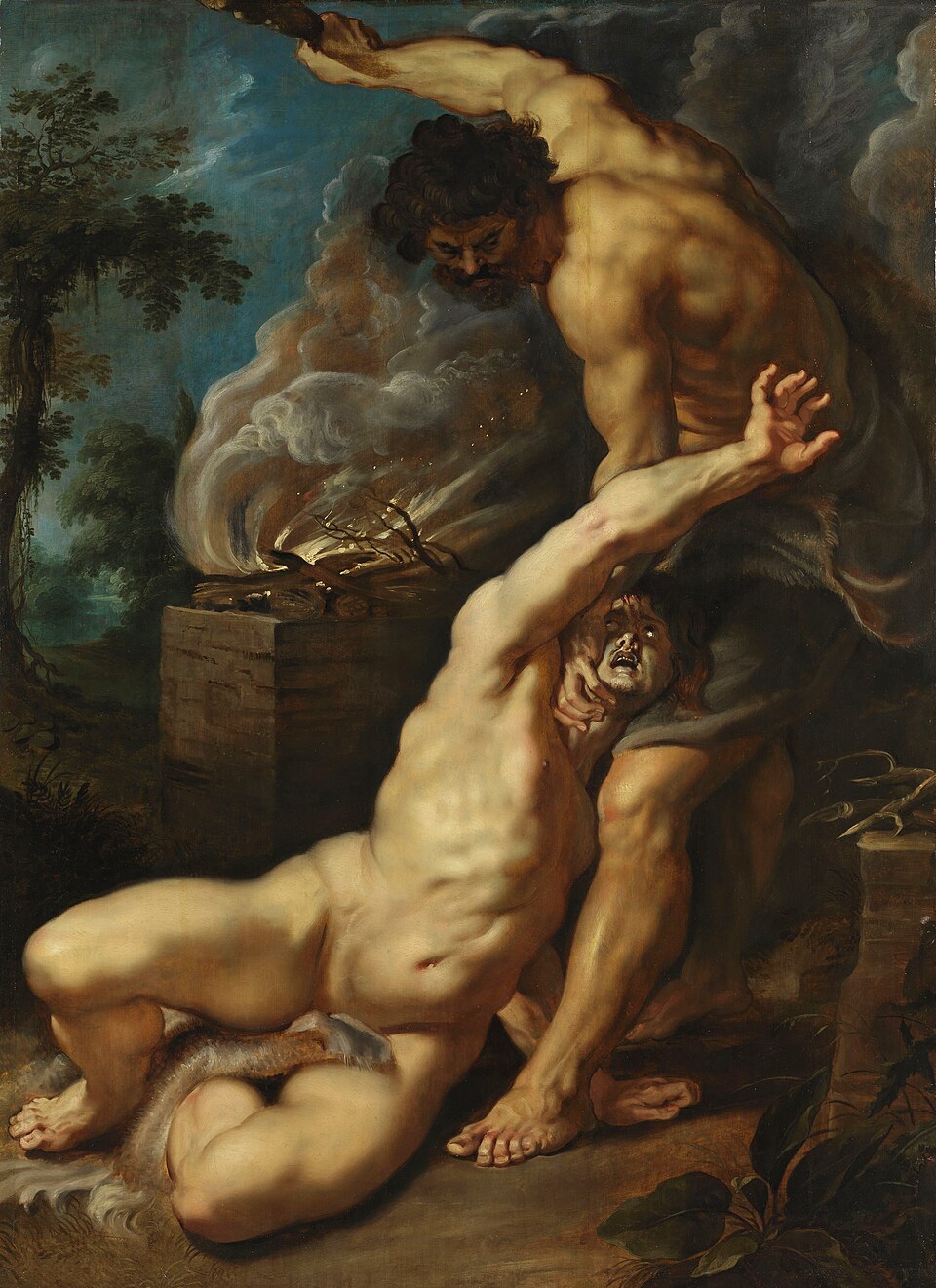
Rubens, Cain slaying Abel
Fig. 9 — Peter Paul Rubens, Cain slaying Abel (c. 1608–09, Courtauld). The first murder; Abel's blood "cries out from the ground." Public domain, Wikimedia Commons.
The wound · Cain & Abel

The first death is a murder: Cain kills his righteous brother from envy, and "the voice of your brother's blood is crying to me from the ground." Spilled blood demands justice.

Gen 4:3–10 · Heb 11:4

The healing · the blood of Jesus

Jesus, the righteous Brother, is killed by His own — but His "sprinkled blood speaks a better word than the blood of Abel": not vengeance on the guilty but mercy for them.

Heb 12:24 · Luke 23:34

  • Hebrews draws this reversal in a single, deliberate comparison. Believers have come "to the sprinkled blood that speaks a better word than the blood of Abel" (Heb 12:24). Both are the blood of a righteous man murdered unjustly; both "speak." But Abel's blood cries for justice against the murderer (Gen 4:10), while Jesus' blood asks pardon for the murderers. The first innocent blood indicts; the last redeems — the gospel in miniature: the thing that should condemn us becomes the thing that saves us.
  • The parallel runs deeper: a righteous shepherd killed by his brother out of envy — the Gospels' diagnosis of the crucifixion. Abel was a keeper of sheep whose offering God accepted; Cain killed him from jealousy (1 John 3:12). Pilate "perceived that it was out of envy that the chief priests had delivered him up" (Mark 15:10). Where Cain asked, "Am I my brother's keeper?" (Gen 4:9), the second Abel lays down His life to keep His brothers.
  • The reversal turns the whole logic of bloodshed inside out. Under the old order, blood guilt demands payment — "whoever sheds the blood of man, by man shall his blood be shed" (Gen 9:6). Jesus' blood breaks the chain by absorbing the demand: "Father, forgive them, for they know not what they do" (Luke 23:34). Justice is not ignored but satisfied in Him, so the voice crying "vengeance" over every life is answered, once, by a louder voice crying "mercy."
Scripture "...and to the sprinkled blood that speaks a better word than the blood of Abel." — Hebrews 12:24
In one breath: the first brother's blood cried for vengeance; the last Brother's blood, from the mercy seat, speaks a better word — forgiveness for the very ones who shed it.
§10 Abraham & Isaacthe son spared → the Son givenPatristic NT The only beloved son is spared when a ram is substituted on Mount Moriah. The Father's only Son is not spared — He is the Lamb God provides (John 3:16; Rom 8:32).
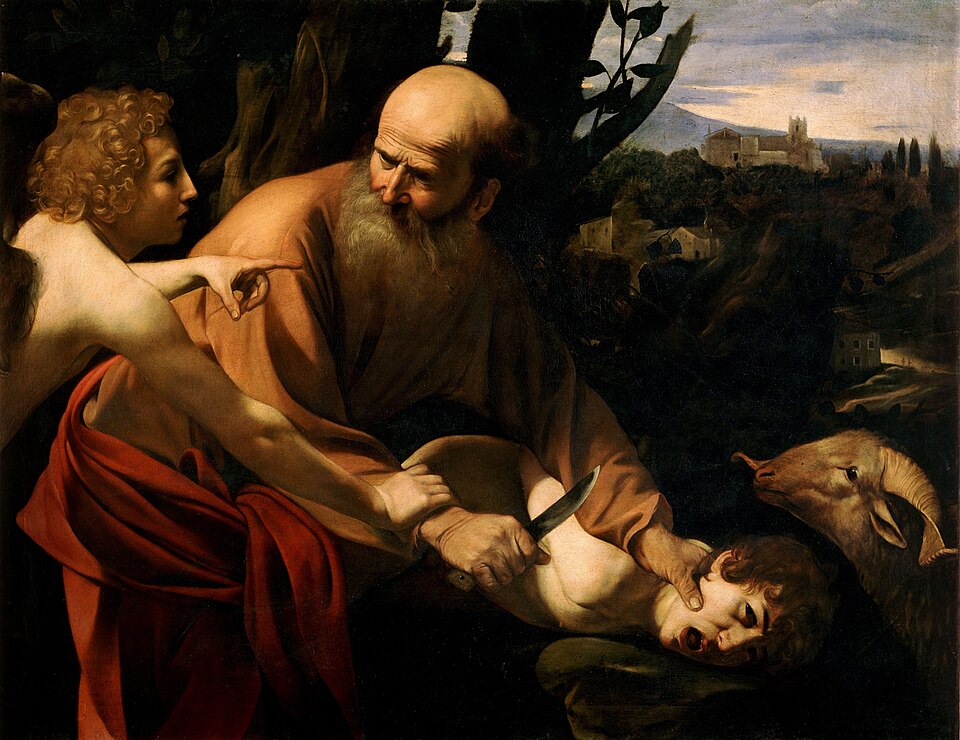
Caravaggio, Sacrifice of Isaac
Fig. 10 — Caravaggio, Sacrifice of Isaac (c. 1603, Uffizi). The knife stayed, the ram provided; "God will provide for himself the lamb." Public domain, Wikimedia Commons.
The type · Moriah

God tests Abraham: offer "your son, your only son Isaac, whom you love." Isaac carries the wood up the hill; at the last moment a ram is offered instead. "The LORD will provide."

Genesis 22:1–14

The fulfilment · Calvary

The Father offers "his only Son" — and the knife is not stayed. Jesus carries His own wood up the hill; He is the Lamb God provides. "He... did not spare his own Son."

John 3:16; 1:29 · Rom 8:32 · Heb 11:17–19

  • The language of Genesis 22 is echoed so precisely in John 3:16 and Romans 8:32 that the NT is clearly reading the cross through Moriah. "Your son, your only son... whom you love" (Gen 22:2) ↔ "God so loved the world, that he gave his only Son" (John 3:16); "you have not withheld your son" (Gen 22:12, 16) ↔ God "did not spare his own Son but gave him up for us all" (Rom 8:32). Jewish tradition even locates Moriah at the temple mount (2 Chron 3:1) — the same ridge where Jesus died.
  • The reversal is in the ending: Isaac is spared because a substitute is provided; the Son is the substitute, so He is not spared. Abraham says, "God will provide for himself the lamb" (Gen 22:8); the Lamb God ultimately provides is His own Son — "Behold, the Lamb of God, who takes away the sin of the world!" (John 1:29). On Moriah the ram dies in Isaac's place; at Calvary nothing is substituted, because the Son is taking our place. The pattern completes by refusing the substitution it once allowed.
  • Hebrews 11 confirms the typology with the word "resurrection." "He considered that God was able even to raise him from the dead, from which, figuratively speaking, he did receive him back" (Heb 11:17–19). "Figuratively speaking" (Greek en parabolē) tells us outright the episode is a parable of resurrection: Isaac "as good as dead" three days, received back alive. And Isaac carried the wood for his own sacrifice (Gen 22:6), as Jesus "went out, bearing his own cross" (John 19:17).
In one breath: Abraham's only son was spared when a ram was provided; the Father's only Son was not spared, because the Son is the Lamb God provides.
§11 Joseph → Jesusbetrayed → raised to save themPatristic Devotional The beloved son is betrayed by his brothers for silver and thrown into a pit. Raised to a throne, he saves the very brothers who sold him — "you meant evil, God meant good."
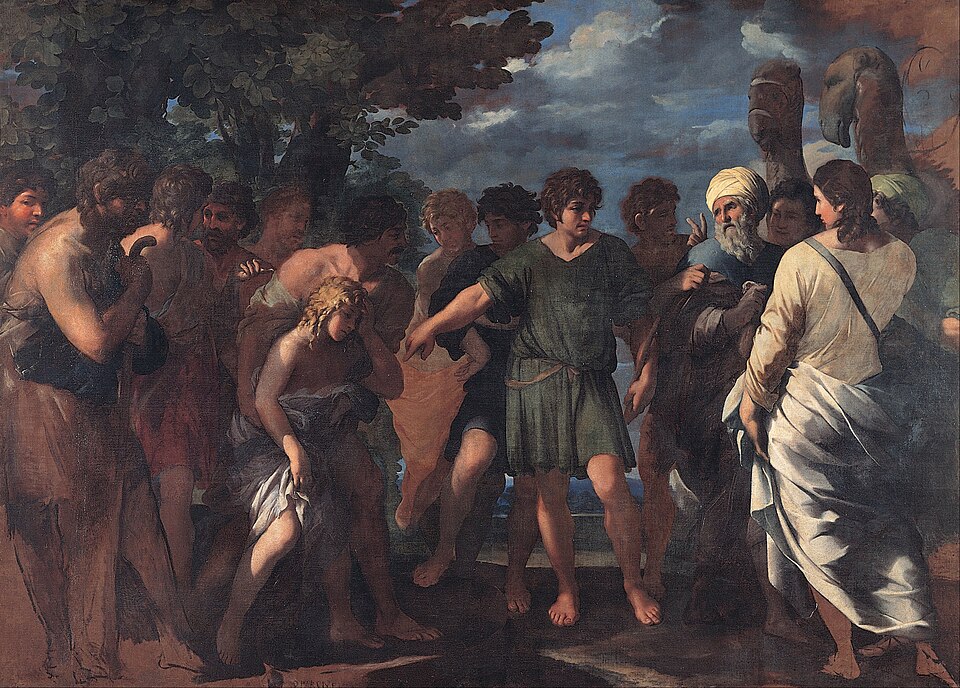
Bottala, Joseph sold by his brothers
Fig. 11 — Giovanni Maria Bottala, Joseph Sold by His Brothers. Betrayed and sold for silver — then raised up to save them. Public domain, Wikimedia Commons.
  • Joseph is the richest extended foreshadowing of Christ in the OT, matching the gospel point for point. Beloved son sent to his brothers and rejected (Gen 37:3–14); betrayed and sold for pieces of silver (Gen 37:28 — twenty, as Jesus for thirty, Matt 26:15); stripped of his robe, cast into a pit, reckoned dead (Gen 37:23–33); falsely accused though innocent (Gen 39:11–20); and numbered between two condemned men, one saved and one lost (Gen 40 — as Jesus between two thieves, Luke 23:39–43). No verse says "Joseph is a type of Christ," yet the accumulation is so dense the Church has read him this way for centuries.
  • The reversal climaxes where the gospel does: the betrayed one is raised to a throne and saves his betrayers. Joseph is lifted from prison to Pharaoh's right hand (Gen 41:40–44), and in the famine the brothers who sold him come begging for bread — and he feeds and saves them (Gen 42–45). The crucified Jesus is "exalted at the right hand of God" (Acts 2:33) and, from that throne, offers bread and life to the people who delivered Him to death. Identical structure: rejection, descent into death, exaltation, salvation extended to the guilty.
  • Joseph states the theology of the whole pattern in one sentence. "You meant evil against me, but God meant it for good, to bring it about that many people should be kept alive" (Gen 50:20) — exactly how the NT reads the cross: "this Jesus, delivered up according to the definite plan... of God, you crucified... but God raised him up" (Acts 2:23–24). The evil intended becomes the means of rescue — the oldest clear statement in Scripture that God turns the worst human wrong into the greatest good.
Scripture "You meant evil against me, but God meant it for good... that many people should be kept alive." — Genesis 50:20
In one breath: the beloved son, betrayed for silver and left for dead, rose to a throne and saved the brothers who sold him — the gospel told in advance.
§12 Passover → Christthe lamb → the Lamb of GodNT A lamb's blood on the doorposts spares the firstborn from the destroyer. "Christ our Passover"; His bones unbroken (John 19:36), He shields all marked by His blood.
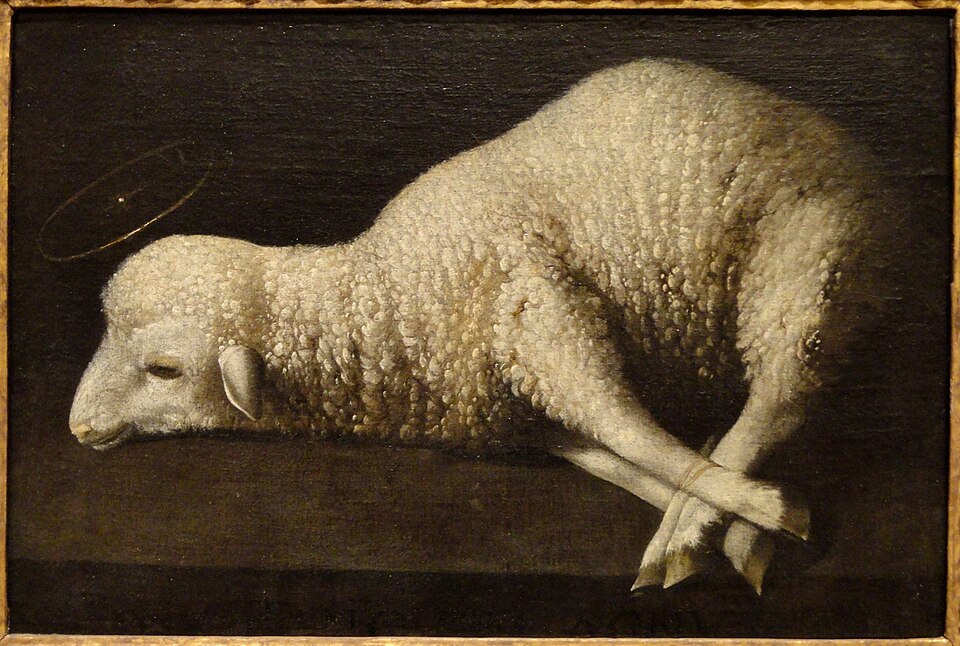
Zurbarán, Agnus Dei
Fig. 12 — Francisco de Zurbarán, Agnus Dei (c. 1635–40). "Behold the Lamb of God" (John 1:29); "Christ, our Passover lamb, has been sacrificed." Public domain, Wikimedia Commons.
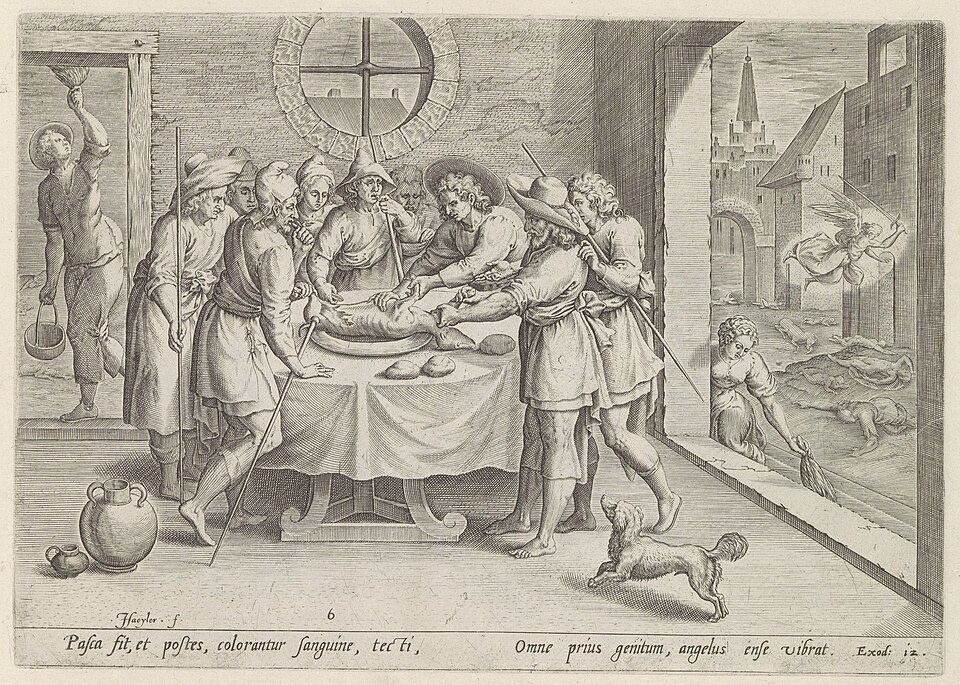
The Passover and the tenth plague of Egypt
Fig. 13 — The Passover & the death of the firstborn (Rijksmuseum engraving). Blood on the doorposts turns the destroyer aside. CC0, Rijksmuseum / Wikimedia Commons.
  • The NT calls Jesus "our Passover" outright — the most densely confirmed type in Scripture. "Christ, our Passover lamb, has been sacrificed" (1 Cor 5:7); "Behold, the Lamb of God, who takes away the sin of the world" (John 1:29); and John has Jesus die at the hour the Passover lambs were slaughtered (John 19:14). The original Passover (Ex 12) spares Israel's firstborn when the destroyer sees the lamb's blood and "passes over"; the true Lamb's blood now shields everyone marked by it from the second death.
  • Even the fine print is fulfilled — the unbroken bones. "You shall not break any of its bones" (Ex 12:46; Num 9:12). At the crucifixion the soldiers break the two criminals' legs "but when they came to Jesus and saw that he was already dead, they did not break his legs" (John 19:33). John points to the law: "that the Scripture might be fulfilled: 'Not one of his bones will be broken'" (John 19:36). A ritual detail written centuries earlier is satisfied, against the soldiers' normal practice, in the body of the Lamb.
  • The whole Exodus becomes a layered picture: the sea is baptism, the manna His body, the rock Christ. "Our fathers... all passed through the sea, and all were baptized into Moses" (1 Cor 10:1–2); the manna becomes "the true bread from heaven... the bread that I will give for the life of the world is my flesh" (John 6:32–51); and "they drank from the spiritual Rock that followed them, and the Rock was Christ" (1 Cor 10:4). The exodus from slavery to the land is the exodus from sin to life, written in advance in stone, water, and bread.
Scripture "For Christ, our Passover lamb, has been sacrificed." — 1 Corinthians 5:7  ·  "Not one of his bones will be broken." — John 19:36
In one breath: the lamb's blood on the door turned death aside from the firstborn; Christ our Passover, His bones unbroken, turns the second death aside from all who are marked by His blood.
§13 Sinai → PentecostLaw kills 3,000 → Spirit saves 3,000NT Devotional The Law given at Sinai → 3,000 die for the golden calf. The letter kills. The Spirit given at Pentecost → 3,000 are saved. The Spirit gives life.
The wound · Sinai

Fifty days after the exodus, the Law is given at Sinai. Israel makes the golden calf; that day "about three thousand men" fall under judgment.

Ex 19:1; 32:28 · 2 Cor 3:6–7

The healing · Pentecost

Fifty days after Christ's Passover, the Spirit is given. Peter preaches, and "about three thousand souls" are baptized and added.

Acts 2:1, 41 · 2 Cor 3:6

  • The calendar lines up: Pentecost is literally "the fiftieth day," and tradition tied it to Sinai. Pentecost (pentēkostē, "fiftieth") is Shavuot, fifty days after Passover (Lev 23:15–16); by the first century Jewish tradition associated it with the covenant at Sinai (Ex 19:1). The Spirit falls on the feast commemorating the Law — God writing His law this time "on tablets of human hearts" (2 Cor 3:3; Jer 31:33). The timing frames Pentecost as the new Sinai.
  • The number is the same and the verdict reversed — 3,000 fall at Sinai, 3,000 are saved at Pentecost. "About three thousand men" die for the golden calf (Ex 32:28); "about three thousand souls" are added at Pentecost (Acts 2:41). Same figure, opposite outcome: death under the broken Law, life under the poured-out Spirit. Paul states the principle: "the letter kills, but the Spirit gives life" (2 Cor 3:6), calling the Law's ministry a "ministry of death, carved in letters on stone" (2 Cor 3:7).
  • This is where to be most careful — and the honesty is part of the strength. The letter-versus-Spirit contrast is Paul's own (2 Cor 3), so that half is NT-explicit. But the "3,000/3,000" mirror rests on the rabbinic dating of Shavuot to Sinai (not stated in the OT) and a numerical correspondence Luke never flags. It is a genuine, arresting resonance — offer it as a devotional pattern, not a proof. Saying so openly is the discipline the whole catalogue runs on.
Honesty flag The 3,000/3,000 parallel is a devotional resonance, not a claim the NT makes. The letter-kills/Spirit-gives-life contrast beneath it, however, is Paul's own argument in 2 Corinthians 3.
In one breath: the Law at Sinai left three thousand dead for the golden calf; the Spirit at Pentecost added three thousand souls — the letter kills, the Spirit gives life.
§14 Jonah → Christthree days; mercy to enemiesNT Jonah: three days in the deep; he resents God's mercy to enemy Nineveh. The Son: three days in the earth; He dies for enemies and is sent to all nations (Matt 12:40).
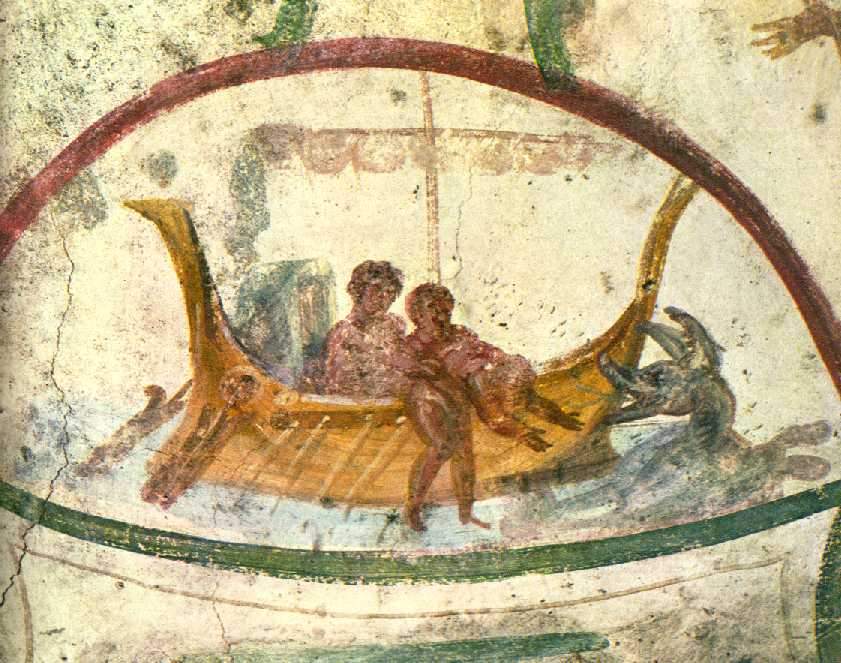
Jonah thrown into the sea
Fig. 14 — Jonah Thrown into the Sea. Three days in the deep and a return to preach — "the sign of Jonah." Public domain, Wikimedia Commons.
The type · Jonah

Jonah flees God's call to enemy Nineveh. Swallowed by a great fish, he spends three days in the deep, is vomited out alive, preaches — and is angry that God shows the city mercy.

Jonah 1:1–3; 1:17; 3:1–10; 4:1–11

The fulfilment · Christ

Jesus claims "the sign of Jonah": three days "in the heart of the earth." Where Jonah resented mercy to enemies, Christ dies for His enemies and sends the gospel to all nations.

Matt 12:38–41; 16:4 · Luke 24:46–47 · Rom 5:8, 10

  • Jesus names Jonah as the one sign He would give — the three-day death-and-resurrection. "No sign will be given... except the sign of the prophet Jonah. For as Jonah was three days and three nights in the belly of the great fish, so will the Son of Man be three days and three nights in the heart of the earth" (Matt 12:39–40). Jonah even prays from inside the fish as from the grave: "out of the belly of Sheol I cried... you brought up my life from the pit" (Jonah 2:2, 6).
  • The reversal is in the heart of the prophet: Jonah resents mercy to enemies; Christ gives His life for enemies. Jonah runs because he fears God will forgive Nineveh — "I knew that you are a gracious God... relenting from disaster" (Jonah 4:2) — and sulks when they repent (Jonah 4:9–11). Christ is the anti-Jonah: He weeps over the city that rejects Him (Luke 19:41), prays for His executioners (Luke 23:34), and "while we were enemies we were reconciled to God by the death of his Son" (Rom 5:10). God's closing question — "should I not pity Nineveh?" — is answered by the cross.
  • Jonah's mission to pagan Nineveh foreshadows the gospel going to all nations. "The men of Nineveh will rise up at the judgment... for they repented at the preaching of Jonah, and behold, something greater than Jonah is here" (Matt 12:41). After the resurrection: "repentance and forgiveness of sins should be proclaimed in his name to all nations" (Luke 24:47). The grudging Gentile mission becomes the joyful Great Commission.
Scripture "As Jonah was three days and three nights in the belly of the great fish, so will the Son of Man be three days and three nights in the heart of the earth." — Matthew 12:40
In one breath: Jonah went three days into the deep and rose to preach to enemies he despised; the Son went three days into the earth and rose — the willing Savior who dies for His enemies.
§15 Shorter mirrorsfirstborn · scapegoat · ladder · wombs · redeemerNT Devotional Dying firstborn · scapegoat driven out · no ladder to heaven · barren wombs · lost inheritance. Risen Firstborn · Christ "outside the gate" · He is the ladder · the virgin womb · the kinsman-redeemer.
  • The firstborn: the firstborn of Egypt die, but Christ the Firstborn dies so the many are raised. NT-Explicit At Passover the firstborn of Egypt are struck down and Israel's firstborn redeemed by the lamb (Ex 12:29; 13:15). The NT calls Christ "the firstborn of all creation," "the firstborn from the dead" (Col 1:15, 18), "the firstborn among many brothers" (Rom 8:29). In Egypt the firstborn die under judgment; in the gospel the Firstborn dies willingly so a whole family of brothers is raised.
  • The scapegoat: on the Day of Atonement two goats bear sin away, fulfilled when Christ suffers "outside the camp." NT-Explicit One goat is slain, one sent away carrying sin into the wilderness, and the sin-offering burned "outside the camp" (Lev 16:10, 27). "Jesus also suffered outside the gate in order to sanctify the people through his own blood" (Heb 13:11–12) — both the slain goat and the one who bears sin away.
  • Jacob's ladder: the stairway between heaven and earth turns out to be a person. NT-Explicit Jacob dreams of a ladder "and the angels of God were ascending and descending on it" (Gen 28:12). Jesus: "you will see heaven opened, and the angels of God ascending and descending on the Son of Man" (John 1:51). Where Babel's tower failed to reach heaven by effort (§7), the ladder descends as a gift — and it is Christ Himself.
  • Barren wombs: the miracle of life from a dead womb climaxes in life from a virgin's womb. Devotional The covenant line repeatedly hangs on a barren woman God opens — Sarah, Rebekah, Rachel, Hannah, Samson's mother, Elizabeth "who was called barren" (Gen 18; 25:21; 30:22; 1 Sam 1; Judg 13; Luke 1:7, 36). Each birth is a small resurrection; the pattern crests not in a barren womb opened but a virgin womb — life where there is no possibility at all (Luke 1:34–35), mirroring creation itself.
  • The kinsman-redeemer: Boaz foreshadows the Redeemer who buys back what was lost. Patristic/Devotional In Ruth, the destitute foreign widow is rescued by Boaz, a near kinsman (Hebrew goʾel, "redeemer") who buys back the forfeited inheritance and takes her as bride (Ruth 3–4). Christ is the true kinsman-redeemer: He takes our flesh (Heb 2:11, 14), pays the price to buy back what sin forfeited (1 Pet 1:18–19), and takes a Gentile-inclusive Bride (Eph 5:25–32). Ruth, a Moabite outsider, ends up in the genealogy of the Redeemer (Matt 1:5).
In one breath: the dying firstborn, the scapegoat, the ladder, the opened wombs, and the kinsman-redeemer all run the same way — loss in the Old answered by restoration in the New.
§16 How to read this honestlythe guardrailsMeta Why the pattern is real and not pattern-matching after the fact — the three firmness tiers, and the discipline that keeps typology faithful rather than fanciful.
  • The strongest evidence the pattern is designed is that the NT authors draw most of these links themselves. Paul calls Adam a "type" (Rom 5:14) and Christ "our Passover" (1 Cor 5:7); Peter calls baptism the "antitype" of the flood (1 Pet 3:21); Hebrews contrasts Jesus' blood with Abel's (Heb 12:24) and sends Him "outside the camp" (Heb 13:11–12); John ties the unbroken bones to the Passover statute (John 19:36); and Jesus applies the bronze serpent (John 3:14), the sign of Jonah (Matt 12:40), and Jacob's ladder (John 1:51) to Himself. When the authors who wrote the antitype point back to the type on purpose, the correspondence is authorial intent, not coincidence. Those are the NT-Explicit rows — they carry the weight.
  • The second tier is patristic typology — read by the earliest Church, faithful to the text, a step beyond a bare proof-text. Eve/Mary (Irenaeus), Babel/Pentecost, Isaac/Christ, the tree arc. Not NT sentences, but ancient, widely held, and grounded in hard textual features (the gardens really are gardens; the cross really is called "the tree"). Treat them as illuminating and trustworthy — strong enough to preach — while acknowledging they are the Church's reading.
  • The third tier is devotional resonance — true to the shape of the story, edifying, but not doctrine. The "gardener" echo, the 3,000/3,000 mirror, the barren-to-virgin trajectory. Real and worth meditating on, but resting on inference or tradition the text does not state. Marking these devotional is not weakness; it is what makes the whole case credible — so a reader can trust that "NT-explicit" really means it.
  • The guardrail against fanciful typology is the one the NT models: let the text set the links, read forward from promise to fulfilment, never build doctrine on a resonance. Typology goes wrong when readers force every detail to "mean" Christ; it stays sound when it follows the direction Scripture already runs — a wound announced (Gen 3:15), then healed. Read this way, the sheer number of independent reversals converging on one Person, across sixty-six books and roughly fifteen centuries of writing, is itself a cumulative argument.
The cumulative point No single reversal proves the design by itself. But a wound announced in Genesis 3 and answered, detail by detail, across the whole canon — tree, garden, serpent, curse, blood, firstborn, lamb, three days — by writers separated by centuries who keep pointing back to the same earlier scenes on purpose, is very hard to explain as accident or after-the-fact invention. That is the Great Reversal: the Bible tells one story, and it is the story of a wound healed by the very things that caused it, turned inside out.

Sources & honesty. Scripture is ESV unless noted; verse references are locating anchors, not interpretive proof in themselves. Patristic reference: Irenaeus, Against Heresies III.22.4, V.19.1 (Eve/Mary). The grading tiers are this document's honest classification of how firmly each link stands; where a pattern depends on extra-biblical tradition (the Shavuot–Sinai dating behind §13) or on inference (the "gardener" echo in §4), that is flagged in the text. Images are genuine public-domain artworks pulled from Wikimedia Commons (credits in each caption); none are fabricated.

Published on the GodExamined.com Resources shelf (Featured studies). Part of the God-server deep-proofs corpus.