 GOD EXAMINEDBible← Back to The Proof
We can honestly claim that Markan authorship is among the best-attested in the New Testament and that the Gospel carries genuine eyewitness testimony one step removed — Peter's preaching, filtered through his interpreter. It is a documented chain to a witness, not a fabrication. We cannot claim that Mark himself watched Jesus' ministry (he did not), nor that the longer ending (16:9-20) is his. Graded Solid for the attribution, with full honesty that this earliest Gospel is primary-adjacent testimony, not a firsthand memoir.
Film stills are copyrighted, so these are listed as references rather than reproduced here.

Click any ▸ Scripture reference to expand the verse (World English Bible).
| The point | The telling detail | Reference |
|---|---|---|
| The Gospel is Peter's remembered testimony, taken down by his interpreter | Papias (c.125), citing 'the Elder' (John), states: 'Mark, having become Peter's interpreter (hermēneutēs), wrote down accurately, though not in order, whatever he remembered of the things said and done by the Lord. For he neither heard the Lord nor followed him, but afterward followed Peter, who used to adapt his teaching to the needs of the moment.' The chain is explicit and early: Mark is the pen; Peter the eyewitness voice. | Papias via Eusebius, HE 3.39.15And the presbyter said this: Mark, having become the interpreter of Peter, wrote down accurately whatsoever he remembered. It was not, however, in exact order that he related the sayings or deeds of Christ. For he neither heard the Lord nor accompanied him; but afterwards, as I said, he accompanied Peter, who adapted his teaching to the needs of his hearers, but with no intention of giving a regular narrative of the Lord's sayings. Wherefore Mark made no mistake in thus writing some things as he remembered them. Papias of Hierapolis, quoted in Eusebius, *Church History* (Historia Ecclesiastica) 3.39.15 — tr. NPNF2 (McGiffert, public domain). |
| The narrative is anchored in Peter's own household | The first healing in a home occurs at 'the house of Simon and Andrew,' where Jesus raises up Peter's mother-in-law by the hand (Mark 1:29-31). Setting the story inside Peter's family home is exactly the domestic detail Peter himself would supply. | Mark 1:29-31Immediately, when they had come out of the synagogue, they came into the house of Simon and Andrew, with James and John. Now Simon’s wife’s mother lay sick with a fever, and immediately they told him about her. He came and took her by the hand, and raised her up. The fever left her, and she served them. (WEB) |
| Vivid, functionless incidental details survive from the eyewitness | In the storm Jesus is 'in the stern, asleep on the cushion (proskephalaion)' — Mark alone keeps the cushion (4:38); at the feeding Mark alone notes the crowd sat on 'the green grass (chlōros chortos),' a springtime/Passover-season detail (6:39). Such useless-but-specific touches are the fingerprints of memory, not invention. | Mark 4:38He himself was in the stern, asleep on the cushion, and they woke him up, and told him, “Teacher, don’t you care that we are dying?” (WEB) |
| Jesus' actual Aramaic words (ipsissima verba) are preserved | Mark retains Jesus' original Aramaic and then translates it for readers: 'Talitha koum' (5:41) and 'Ephphatha' (7:34). Keeping the very syllables Jesus spoke is the kind of thing a hearer treasures and repeats. | Mark 5:41Taking the child by the hand, he said to her, “Talitha cumi!” which means, being interpreted, “Girl, I tell you, get up!” (WEB) |
| Bauckham's 'inclusio of eyewitnesses' frames the book with Peter | Peter is the first named disciple in the Gospel (Simon, 1:16) and the last named at its close ('tell his disciples and Peter,' 16:7), forming a literary bracket that signals him as the principal eyewitness source. Peter is also the most frequently named individual in Mark (roughly 25 references), denser per length than in any other Gospel. | Mark 1:16Passing along by the sea of Galilee, he saw Simon and Andrew the brother of Simon casting a net into the sea, for they were fishermen. (WEB) ▸ source textRichard Bauckham, *Jesus and the Eyewitnesses: The Gospels as Eyewitness Testimony* (2006): argues the Gospels preserve named eyewitness testimony, and that Mark brackets its narrative with an 'inclusio of eyewitness testimony' — Peter named first and last — marking him as the Gospel's principal source. |
| The unflattering portrait of Peter and the Twelve (criterion of embarrassment) | Mark repeatedly shows the disciples as dull and fearful (8:17-21), records Jesus rebuking Peter as 'Satan' (8:33), narrates Peter's threefold denial in full (14:66-72), and omits the flattering 'You are Peter, and on this rock' saying that Matthew includes. A source protecting Peter would not do this; a self-critical Peter preaching his own failures would. | Mark 8:33But he, turning around, and seeing his disciples, rebuked Peter, and said, “Get behind me, Satan! For you have in mind not the things of God, but the things of men.” (WEB) |
| The young man who flees naked reads as the author's own quiet signature | At the arrest 'a young man (neaniskos) followed him, with nothing but a linen cloth about his body, and they seized him, but he left the linen cloth and ran away naked' (14:51-52). The detail has no narrative function and is unique to Mark; many scholars read it as the author discreetly placing himself at the scene — a single firsthand cameo. | Mark 14:51-52A certain young man followed him, having a linen cloth thrown around himself over his naked body. The young men grabbed him, but he left the linen cloth, and fled from them naked. (WEB) |
| Find / site | What it confirms | Reference |
|---|---|---|
| The House of Peter, Capernaum | Franciscan excavations (V. Corbo and S. Loffreda, from 1968) uncovered a first-century courtyard house venerated as a domus-ecclesia from the first century onward, later enclosed by a fifth-century octagonal church. It matches Mark's setting of Jesus' Capernaum ministry 'at home' in Peter's house (Mark 1:29; 2:1). | Capernaum insula sacra, Corbo & Loffreda excavations, from 1968In the 'sacred insula' at Capernaum, next to the synagogue, Franciscan archaeologists Virgilio Corbo and Stanislao Loffreda excavated (from 1968) a modest first-century basalt courtyard house whose central room was plastered and converted to communal religious use (a domus-ecclesia) in the first century, bearing early Christian graffiti, and later enclosed by a fifth-century octagonal church. The site has been venerated as the house of Peter since antiquity. It matches Mark's setting of Jesus' Capernaum ministry 'at home' in Peter's house (Mark 1:29; 2:1). Franciscan excavations at Capernaum (Corbo & Loffreda), begun 1968; Studium Biblicum Franciscanum, Jerusalem. |
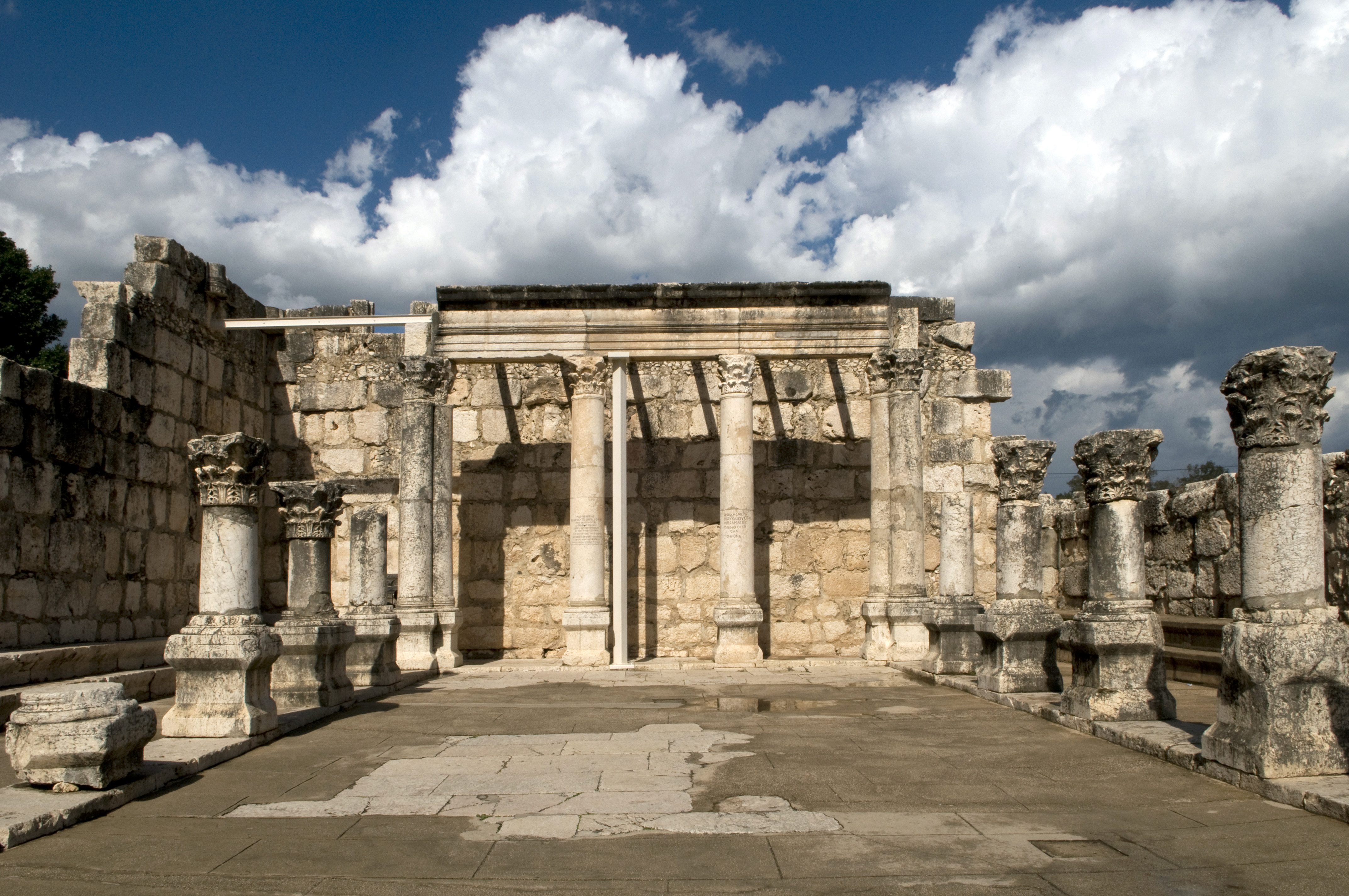
| The Capernaum synagogue | Beneath the later white-limestone synagogue lies a first-century black-basalt foundation — the synagogue stratum of Jesus' day — confirming Mark's very first public scene, teaching in the synagogue at Capernaum (Mark 1:21). | Capernaum synagogue, first-century basalt substratumBeneath the ornate white-limestone synagogue at Capernaum (built c. 4th–5th century AD) excavators found black-basalt walls and a cobbled floor forming an earlier foundation dated to the first century, interpreted as the synagogue of Jesus' day on the same spot. This underlies Mark's very first public scene, Jesus teaching in the synagogue at Capernaum (Mark 1:21). Capernaum synagogue excavations; first-century basalt substratum beneath the later limestone synagogue (Studium Biblicum Franciscanum). |
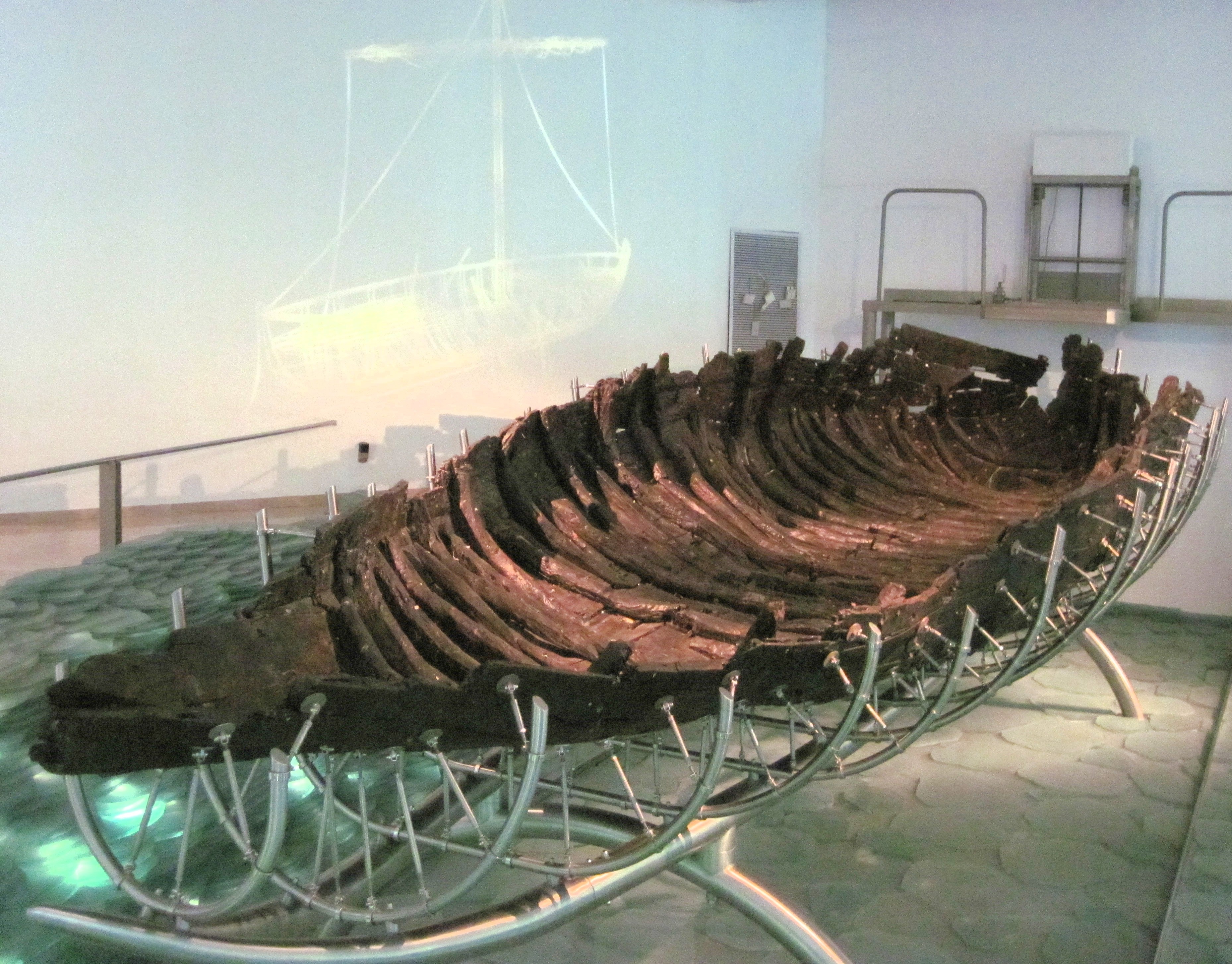
| The Sea of Galilee ('Ginosar') boat | A first-century Galilean fishing boat (~8.2m) recovered from the lakebed in 1986, large enough for a crew and passengers with a raised stern deck — physically matching the boats and the stern-cushion scene of Mark 4:35-41. | Kinneret / Ginosar boat, recovered 1986The 'Sea of Galilee Boat' (popularly the 'Jesus Boat') is a first-century wooden fishing vessel about 8.2 m long and 2.3 m wide, discovered in 1986 in the exposed lakebed mud near Kibbutz Ginosar during a drought; radiocarbon dating and associated pottery place it roughly 50 BC–AD 50. It was large enough for a crew and passengers, with a raised stern deck. It physically illustrates the kind of boat behind Mark's lake crossings and the stern scene of Mark 4:35-41. It is now conserved at the Yigal Allon Museum, Ginosar. Yigal Allon Museum, Kibbutz Ginosar; recovered 1986. |
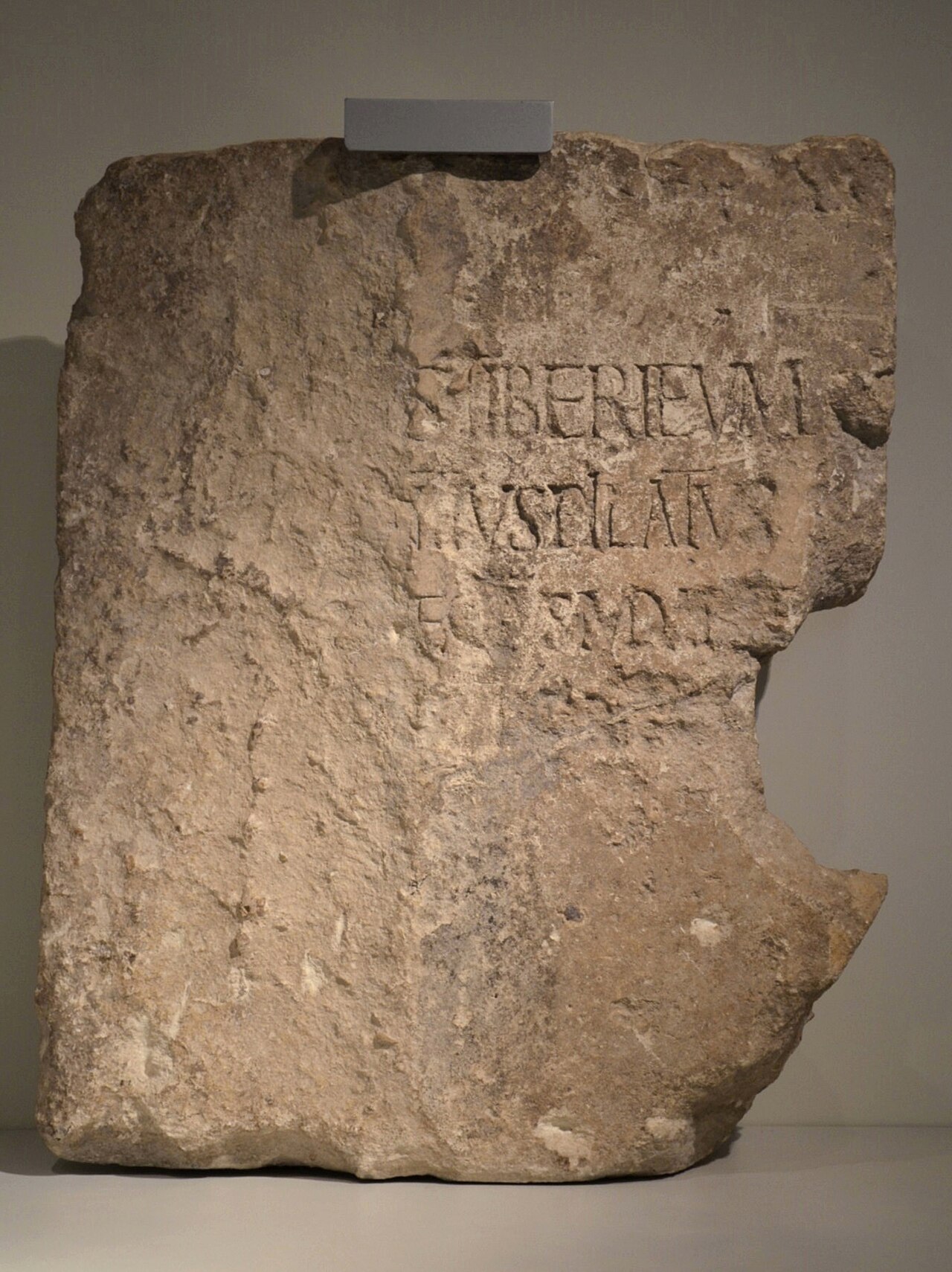
| The Pilate Stone | A dedicatory inscription found at Caesarea Maritima in 1961 (excavations of A. Frova) names '[Pon]tius Pilatus, [Praef]ectus Iuda[ea]e,' confirming the existence, name, and office of the governor who condemns Jesus in Mark's passion narrative (Mark 15). | Pilate Stone, Caesarea Maritima, 1961A limestone dedicatory block discovered in 1961 by Antonio Frova's Italian expedition, reused as a step in the theater at Caesarea Maritima. Its damaged Latin inscription reads in part '[...]S TIBERIEVM / [PON]TIVS PILATVS / [PRAEF]ECTVS IVDA[EA]E' — Pontius Pilate, Prefect of Judea, dedicating a building (a 'Tiberieum') in honor of the emperor Tiberius. It is the only known contemporary inscription naming Pilate and confirms his existence, name, and office — the governor who condemns Jesus in Mark's passion narrative (Mark 15). Pilate Stone, Israel Museum, Jerusalem (replica on site at Caesarea); discovered 1961 (A. Frova expedition). |
| The Decapolis east of the Jordan | Coins and inscriptions attest a real league of Hellenized, largely Gentile cities (Gerasa, Gadara, etc.) east of the lake — a region where pig-herding would be unremarkable, exactly the un-Jewish setting Mark describes for the Gerasene episode and Jesus' movements 'through the region of the Decapolis' (Mark 5:1, 20; 7:31). Honesty note: the precise route of Mark 7:31 and the site of the swine miracle are genuine geographic cruxes discussed under 'challenge.' | Decapolis cities (Gerasa/Gadara), attested by coins and inscriptionsThe Decapolis was a league of ten Hellenized cities — including Gerasa (Jerash) and Gadara (Umm Qais) — lying mostly east and southeast of the Sea of Galilee, attested by Pliny the Elder and Josephus and by the cities' own civic coinage and inscriptions. They were largely Gentile, Greek-speaking centers where pig-keeping would be unremarkable. This confirms the real, un-Jewish regional setting Mark gives for the Gerasene episode and Jesus' movement 'through the region of the Decapolis' (Mark 5:1, 20; 7:31). Civic coins and inscriptions of the Decapolis cities (Gerasa, Gadara); cf. Pliny, *Natural History* 5.16 and Josephus. |
| Ancient witness | What they say | Reference |
|---|---|---|
| Papias of Hierapolis, c.125 (preserved by Eusebius) | Quoting 'the Elder': Mark became Peter's interpreter and accurately wrote down what he remembered of Peter's preaching about the Lord's words and deeds, though not in ordered arrangement, since Mark neither heard nor followed Jesus but followed Peter. This is the earliest surviving statement of Markan authorship and of the Peter connection. | Papias via Eusebius, HE 3.39.15And the presbyter said this: Mark, having become the interpreter of Peter, wrote down accurately whatsoever he remembered. It was not, however, in exact order that he related the sayings or deeds of Christ. For he neither heard the Lord nor accompanied him; but afterwards, as I said, he accompanied Peter, who adapted his teaching to the needs of his hearers, but with no intention of giving a regular narrative of the Lord's sayings. Wherefore Mark made no mistake in thus writing some things as he remembered them. Papias of Hierapolis, quoted in Eusebius, *Church History* (Historia Ecclesiastica) 3.39.15 — tr. NPNF2 (McGiffert, public domain). |
| Irenaeus of Lyons, c.180 | 'After their departure [Peter and Paul], Mark, the disciple and interpreter of Peter, did also hand down to us in writing what had been preached by Peter.' | Adv. Haer. 3.1.1 (also in Eusebius, HE 5.8.2-3)After their departure [the deaths of Peter and Paul at Rome], Mark, the disciple and interpreter of Peter, did also hand down to us in writing what had been preached by Peter. Irenaeus of Lyons, *Against Heresies* (Adversus Haereses) 3.1.1 — tr. ANF (Roberts-Donaldson, public domain); the same passage is quoted in Eusebius, *Church History* 5.8.2–3. |
| Clement of Alexandria, c.180-200 (via Eusebius) | Those who had heard Peter preach in Rome begged Mark, Peter's follower, to write down the teaching; Mark composed his Gospel and gave it to those who asked. Clement reports that Peter, on learning of it, neither actively hindered nor urged it on (elsewhere, that he ratified it for reading in the churches). | Clement, Hypotyposeis, via Eusebius, HE 2.15.1-2 and 6.14.6-7So greatly did the splendor of piety illumine the minds of Peter's hearers that they were not satisfied with the unwritten teaching of the divine Gospel, but with all sorts of entreaties besought Mark, a follower of Peter and the one whose Gospel is extant, that he would leave them a written record of the doctrine which had been orally communicated to them. Nor did they cease until they had prevailed with the man, and had thus become the occasion of the written Gospel which bears the name of Mark. And they say that Peter, when he had learned of what had been done, was pleased with the zeal of the men, and that the work obtained the sanction of his authority for the purpose of being used in the churches. Clement of Alexandria, *Hypotyposeis*, preserved in Eusebius, *Church History* 2.15.1–2 (cf. 6.14.6–7) — tr. NPNF2 (public domain). |
| The Anti-Marcionite Prologue to Mark, traditionally later 2nd c. (date debated) | Describes Mark, nicknamed 'colobodactylus' (stump-fingered), as the interpreter of Peter, who after Peter's death wrote down this Gospel in the regions of Italy. Honesty note: the dating of these prologues is contested; some place them in the 4th century. | Anti-Marcionite Prologue to MarkThe short Latin prologue identifies Mark as 'colobodactylus' (stump-fingered), the interpreter of Peter, who after the death of Peter wrote down this Gospel in the regions of Italy. Anti-Marcionite (Old Latin) Prologue to Mark — faithful factual summary, not a verbatim public-domain quotation; dating contested (some place it 2nd c., others 4th c.). |
| Peter's own letter, 1 Peter (mid-1st c.) | 'She who is at Babylon [i.e. Rome], chosen together with you, sends you greetings, and so does Mark, my son (Markos ho huios mou).' Independent of the later Fathers, this places Mark at Peter's side and names him Peter's 'son,' the exact relationship the tradition presupposes. | 1 Peter 5:13She who is in Babylon, chosen together with you, greets you; and so does Mark, my son. (WEB) |
| Eusebius (c.325) and Jerome (c.393) | Eusebius reports Mark was sent to Egypt and founded the church at Alexandria; Jerome summarizes the whole tradition: 'Mark, disciple and interpreter of Peter,' wrote a short Gospel at the request of the brethren at Rome, which Peter approved and authorized for reading. | Eusebius, HE 2.16.1; Jerome, De Viris Illustribus 8Eusebius: 'And they say that this Mark was the first that was sent to Egypt, and that he proclaimed the Gospel which he had written, and first established churches in Alexandria.' Jerome: 'Mark the disciple and interpreter of Peter wrote a short gospel at the request of the brethren at Rome, embodying what he had heard Peter tell. When Peter had heard this, he approved it and published it to the churches to be read by his authority.' Eusebius, *Church History* 2.16.1 — tr. NPNF2; Jerome, *De Viris Illustribus* (On Illustrious Men) 8 — tr. NPNF2 (both public domain). |
The steelman, following Markan priority (Holtzmann; B. H. Streeter) and form criticism (Bultmann, Dibelius): Mark is the earliest Gospel, which means our earliest narrative source is itself second-hand — the author never once claims to have seen anything, and the Gospel is formally anonymous (the title 'According to Mark' is a second-century addition, not part of the original text). Form critics argue the book is a stitched-together compilation of independent oral units (pericopae) shaped by the needs of the early communities, not a Petrine memoir. Our earliest attribution, Papias, is thin: Eusebius himself calls Papias 'a man of very small intelligence' (HE 3.39.13), and Papias's 'not in order' remark may be an apologetic excuse for Mark's roughness rather than reliable reportage. Bart Ehrman presses the wider point that all four Gospels circulated anonymously and that the Peter connection is a later, pious inference. And the manuscript record proves the text was edited: the 'longer ending' (16:9-20) is absent from the two best manuscripts (Sinaiticus and Vaticanus) and is un-Markan in vocabulary and style — so, the critic asks, if the ending was added, why trust the title?
Concede what is fair. Mark is formally anonymous; the author never claims to have witnessed Jesus' ministry (Papias says as much); and the longer ending (16:9-20) is almost certainly not original — it is missing from the earliest and best manuscripts, Eusebius and Jerome noted its absence, and honest translations bracket it. The genuine Gospel ends at 16:8. Grant, too, that Markan priority makes this the earliest but still a mediated source. Yet the attribution to Mark is one of the strongest in the entire New Testament: it is early (Papias c.125), unanimous (Irenaeus, Clement, the prologue, Origen, Eusebius, Jerome), and has no competing candidate. Decisively, no one fabricating authority for a Gospel would credit it to Mark — a non-apostle, a minor figure who once abandoned Paul mid-mission (Acts 13:13; 15:37-38). The criterion of embarrassment cuts for the tradition, not against it. Bauckham's eyewitness inclusio, the dense Petrine detail, the unflattering Peter, and the retained Aramaic show testimony standing behind the text, not free community invention. Eusebius's jab at Papias targets his millenarian speculation, not his report about Mark, and 'not in order' is a strange thing to invent about a book one is commending. Finally, a disputed ending of twelve verses does not unseat the attribution of the whole.
See also: the directory · the full roster · verified by outsiders · how we verify the NT.