 GOD EXAMINEDBible← Back to The Proof
The MAN James is among the best-attested figures in the New Testament: a non-Christian source (Josephus) independently names him, his brother, and his execution c. AD 62, and multiple independent Christian streams (Hegesippus, Clement, Origen, Eusebius, Jerome) confirm his leadership of the Jerusalem church and his martyrdom — that much is Solid history. The LETTER's authorship is honestly debated: the accomplished Greek and its slow, contested path into the canon are real problems we should not minimize. Yet its primitive Jewish-Christian character, its deep saturation in Jesus' own Sermon-on-the-Mount teaching, and the distinctive 'chairein' link to the Jerusalem decree fit the Lord's brother better than any later pseudonymous author — so the tradition is well-grounded but not certain, which is why the writer, as a whole, grades Mixed.
Film stills are copyrighted, so these are listed as references rather than reproduced here.


Click any ▸ Scripture reference to expand the verse (World English Bible).
| The point | The telling detail | Reference |
|---|---|---|
| He grew up in the same household as Jesus. | The synagogue crowd names the family by memory: 'Is not this the carpenter, the son of Mary and brother of James and Joses and Judas and Simon?' James heads the list of brothers — the kind of village detail an insider or hostile neighbor would know, not a later inventor. | Mark 6:3Isn’t this the carpenter, the son of Mary, and brother of James, Joses, Judah, and Simon? Aren’t his sisters here with us?” They were offended at him. (WEB) Matt 13:55Isn’t this the carpenter’s son? Isn’t his mother called Mary, and his brothers, James, Joses, Simon, and Judas? (WEB) |
| He did not believe in Jesus at first — an embarrassing admission the church preserved anyway. | 'For not even his brothers believed in him' (John 7:5), and his family once went out to seize Jesus, thinking him out of his mind (Mark 3:21). A fabricated hero would not make the future head of the church a former skeptic; the awkwardness marks it as memory, and it makes his later leadership only explicable by something that changed him. | John 7:5For even his brothers didn’t believe in him. (WEB) Mark 3:21When his friends heard it, they went out to seize him: for they said, “He is insane.” (WEB) |
| The risen Jesus appeared to James specifically — the pivot of his conversion. | Paul's pre-Pauline creed lists a resurrection appearance reserved for James alone: 'then he appeared to James' (1 Cor 15:7). This is the historical hinge that turns the unbelieving brother into a 'pillar.' | 1 Cor 15:7Then he appeared to James, then to all the apostles, (WEB) |
| He presided over the Jerusalem Council and rendered its judgment. | After Peter and Paul speak, it is James who says 'my judgment is' and drafts the decisive ruling on Gentile inclusion — the posture of the recognized head of the mother church, not a peer. | Acts 15:13-21After they were silent, James answered, “Brothers, listen to me. Simeon has reported how God first visited the nations, to take out of them a people for his name. This agrees with the words of the prophets. As it is written, ‘After these things I will return. I will again build the tabernacle of David, which has fallen. I will again build its ruins. I will set it up, That the rest of men may seek after the Lord; all the Gentiles who are called by my name, says the Lord, who does all these things. All of God’s works are known to him from eternity.’ “Therefore my judgment is that we don’t trouble those from among the Gentiles who turn to God, but that we write to them that they abstain from the pollution of idols, from sexual immorality, from what is strangled, and from blood. For Moses from generations of old has in every city those who preach him, being read in the synagogues every Sabbath.” (WEB) |
| Paul reported to James on arrival in Jerusalem. | 'Paul went in with us to James, and all the elders were present' — James is the single named authority to whom the returning missionary gives account. | Acts 21:18The day following, Paul went in with us to James; and all the elders were present. (WEB) |
| Paul met him personally and calls him 'the Lord's brother.' | 'But I saw none of the other apostles except James the Lord's brother.' Paul, a firsthand acquaintance writing within ~20 years, uses the plain family term without hedging. | Gal 1:19But of the other apostles I saw no one, except James, the Lord’s brother. (WEB) |
| Paul ranks him among the three 'pillars' of the church. | 'James and Cephas and John, who seemed to be pillars, gave to Barnabas and me the right hand of fellowship' — James is listed first, ahead of Peter, in Jerusalem's inner leadership. | Gal 2:9and when they perceived the grace that was given to me, James and Cephas and John, they who were reputed to be pillars, gave to me and Barnabas the right hand of fellowship, that we should go to the Gentiles, and they to the circumcision. (WEB) |
| He absorbed Jesus' teaching from inside the family before it was ever written down. | The letter's closest parallel to the Gospels is its ban on oaths — 'do not swear... let your yes be yes and your no be no' (James 5:12) — an unusual, distinctive command found otherwise only on Jesus' lips (Matt 5:34-37), and reproduced not as a quotation but as remembered instruction, exactly what a brother raised on the family's oral Jesus tradition would carry. | James 5:12But above all things, my brothers, don’t swear— not by heaven, or by the earth, or by any other oath; but let your “yes” be “yes”, and your “no”, “no”; so that you don’t fall into hypocrisy. (WEB) Matt 5:34-37but I tell you, don’t swear at all: neither by heaven, for it is the throne of God; nor by the earth, for it is the footstool of his feet; nor by Jerusalem, for it is the city of the great King. Neither shall you swear by your head, for you can’t make one hair white or black. But let your ‘Yes’ be ‘Yes’ and your ‘No’ be ‘No.’ Whatever is more than these is of the evil one. (WEB) |
| Find / site | What it confirms | Reference |
|---|---|---|
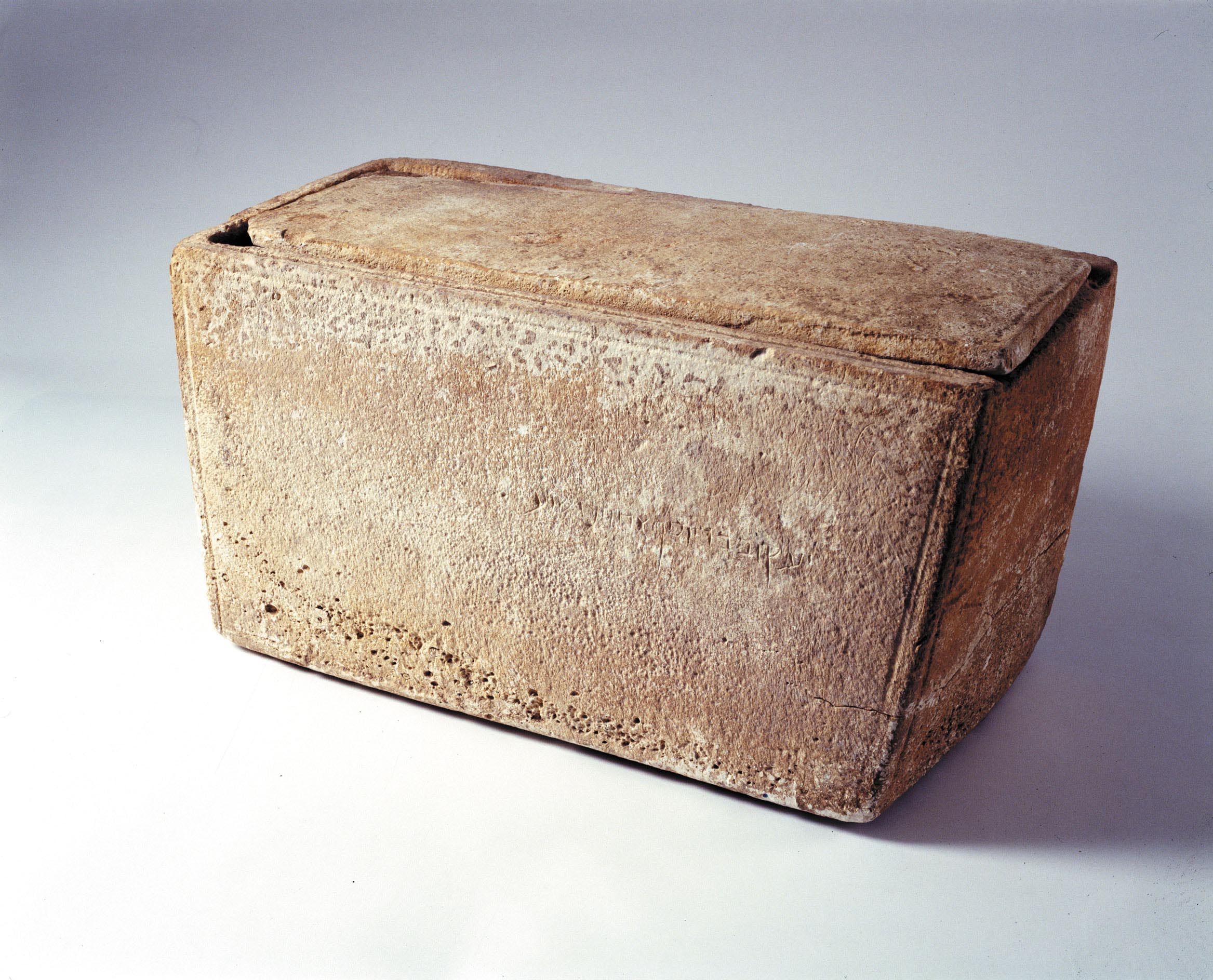
| The James Ossuary — a first-century limestone bone-box inscribed 'James son of Joseph brother of Jesus' (Aramaic). | Presented honestly: it would fit the name, language, period and burial custom of James exactly, but its authenticity is genuinely contested and the inscription (or part of it) may be a modern forgery. The 2012 Israeli court acquittal of the owner on forgery charges was a failure of proof beyond reasonable doubt, NOT a positive authentication. It therefore carries little evidentiary weight and should not be leaned on. | James Ossuary; IAA forgery trial, Jerusalem, verdict 2012 (acquittal ≠ authentication)A first-century limestone ossuary (bone box) that surfaced on the antiquities market and was publicized in 2002 by collector Oded Golan. Its Aramaic inscription reads 'Ya'akov bar Yosef akhui di Yeshua' — 'James son of Joseph brother of Jesus' — which would exactly fit the name, language, period and Jewish secondary-burial custom of James the Just. The Israel Antiquities Authority judged the inscription (at least the 'brother of Jesus' clause) a modern forgery; a long trial ended in 2012 with Golan acquitted of the forgery charges. The court explicitly stated the acquittal did not establish the inscription as authentic, so the object remains genuinely contested and carries little evidentiary weight. James Ossuary; Israel Antiquities Authority forgery case, Jerusalem District Court, acquittal March 2012 (acquittal ≠ authentication). |
| The Theodotus Inscription — a Greek synagogue dedication from pre-70 Jerusalem. | Discovered by R. Weill on the Ophel (City of David) in 1913, it records Theodotos son of Vettenos, a priest and synagogue-ruler, building a synagogue for the reading of the Law. It confirms functioning synagogues in first-century Jerusalem — the setting in which James, uniquely in the NT, calls the Christian assembly a 'synagogue' (James 2:2). | Theodotus Inscription, Ophel, Jerusalem, 1913 (Herodian, pre-AD 70)A Greek limestone dedication plaque discovered by Raymond Weill in 1913 in a cistern on the Ophel (City of David), Jerusalem. It records that Theodotos son of Vettenos, a priest and archisynagogos (synagogue ruler), built the synagogue 'for the reading of the Law and the teaching of the commandments,' together with a guest-house and chambers and water installations for travelers from abroad. Dated to the Herodian period before the AD 70 destruction, it confirms functioning (Greek-speaking) synagogues in first-century Jerusalem — the very setting in which the Epistle of James, uniquely in the NT, calls the Christian assembly a 'synagogue' (James 2:2). Theodotus Inscription, found on the Ophel/City of David, Jerusalem, 1913; now in the Israel Museum (Herodian period, pre-AD 70). |
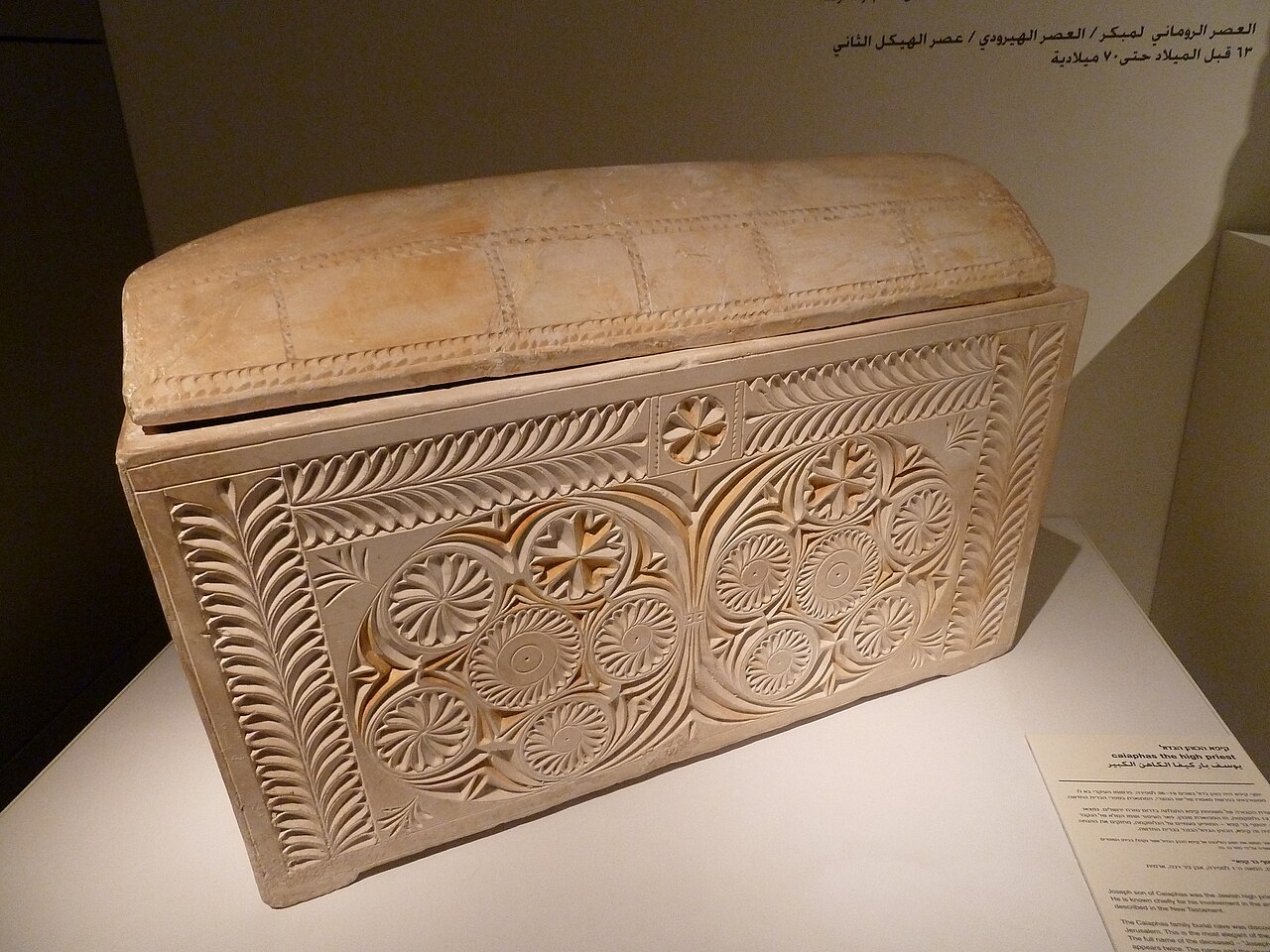
| The Caiaphas ossuary and the high-priestly tombs of Jerusalem. | The 1990 discovery of an ossuary inscribed 'Yehosef bar Qayafa' (Joseph son of Caiaphas) confirms the real existence of the priestly aristocracy that controlled the Sanhedrin. It is this class — specifically the high priest Ananus (of the house of Annas) — that Josephus says convened the court and executed James c. AD 62. It confirms the world of the men who killed him, not James himself. | Caiaphas ossuary, Peace Forest, Jerusalem, 1990An ornately carved first-century limestone ossuary found in 1990 in a disturbed burial cave in the Peace Forest (North Talpiot), Jerusalem. It bears the Aramaic inscription 'Yehosef bar Qayafa' (Joseph son of Caiaphas) and held the bones of several individuals, including an elderly man of about sixty. It is widely identified with the high priest Caiaphas of the Gospels and confirms the real existence of the priestly aristocracy that controlled the Sanhedrin — the same class (specifically the high priest Ananus of the house of Annas) that Josephus says convened the court and executed James c. AD 62. Caiaphas ossuary, discovered Peace Forest / North Talpiot, Jerusalem, 1990; now in the Israel Museum. |
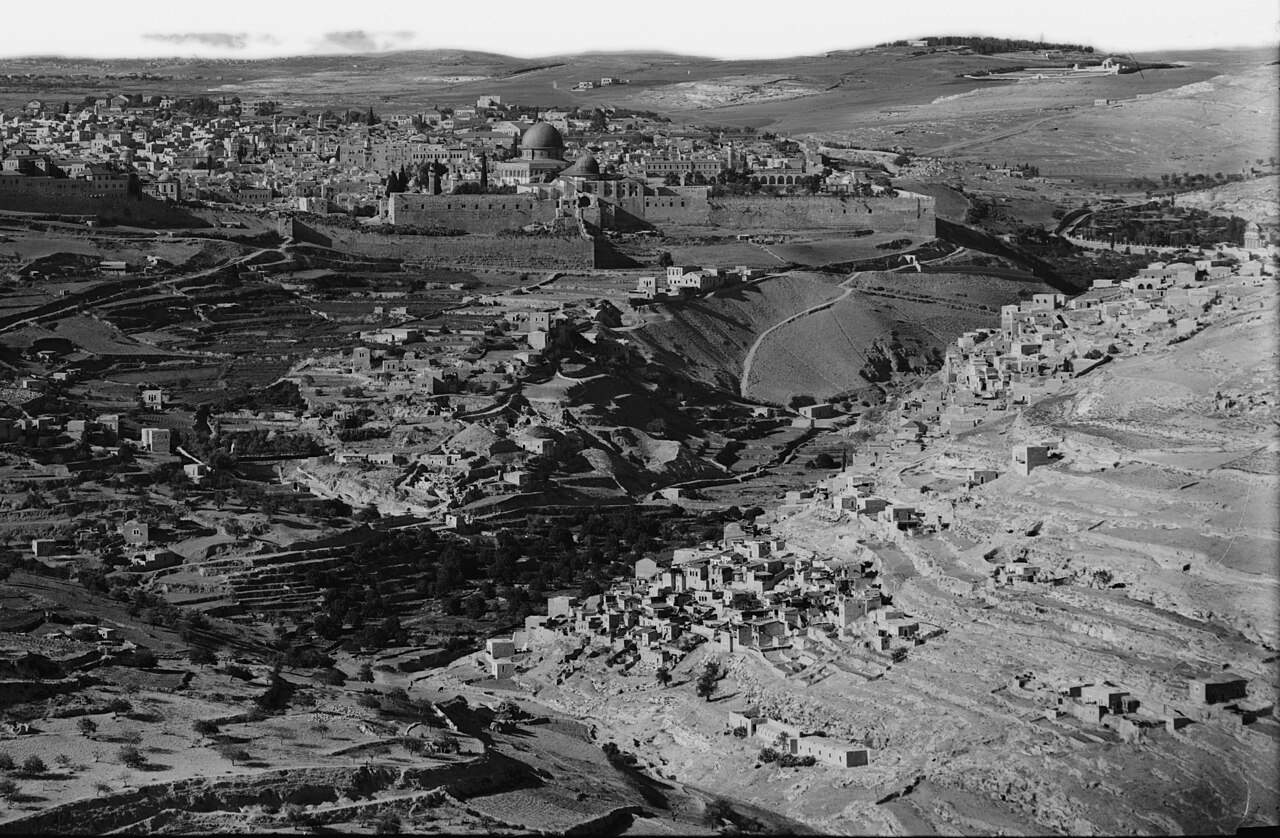
| Herodian Temple Mount and Jerusalem excavations. | The monumental Herodian temple platform, the southern steps, and the Ophel remains reconstruct the physical Jerusalem in which James led the church for roughly three decades and near which Hegesippus places his martyrdom (thrown from the temple pinnacle). Direct archaeology of James is thin; these finds honestly confirm the WORLD of his ministry, not his hand. | Temple Mount / Ophel excavations, Jerusalem (Herodian period)The monumental Herodian temple platform and its retaining walls (including the Western Wall), the great southern staircase, Robinson's Arch, and the adjoining Ophel excavations collectively reconstruct the physical Jerusalem of the first century. This is the city in which James led the mother church for roughly three decades and near whose temple Hegesippus places his martyrdom (cast down from the pinnacle). Direct archaeology of James himself is thin; these remains honestly confirm the world of his ministry rather than his own hand. Temple Mount, Western Wall, southern steps, and Ophel excavations, Jerusalem (Herodian period); principal excavators include Benjamin Mazar and Eilat Mazar. |
| Ancient witness | What they say | Reference |
|---|---|---|
| Josephus, c. 93 (a non-Christian Jewish historian) | Records that the high priest Ananus convened the Sanhedrin and had stoned 'the brother of Jesus who was called Christ, whose name was James,' provoking outrage that cost Ananus his office — dating the death to c. AD 62. This passage is accepted as authentic by virtually all scholars, including skeptics, and is the single strongest external anchor for James: a neutral/hostile source names the man, his brother, and his execution. | Antiquities 20.9.1 (§20.200)'Festus was now dead, and Albinus was but upon the road; so he assembled the sanhedrim of judges, and brought before them the brother of Jesus, who was called Christ, whose name was James, and some others, [or, some of his companions]; and when he had formed an accusation against them as breakers of the law, he delivered them to be stoned.' Josephus adds that this provoked the fair-minded citizens of the city, so that King Agrippa deprived the high priest Ananus of his office — fixing the death to c. AD 62. Josephus, *Antiquities of the Jews* 20.9.1 (§20.200) — tr. William Whiston (1737, public domain). |
| Hegesippus, c. 165-175 (via Eusebius) | Describes James 'the Just,' a lifelong Nazirite of such constant prayer that his knees grew hard 'like a camel's,' and narrates his martyrdom — cast down from the temple, stoned, and clubbed. An early Jewish-Christian tradition independent of Josephus that corroborates the piety, title, and violent death. | Hegesippus, Hypomnemata, in Eusebius, Historia Ecclesiastica 2.23'He was in the habit of entering alone into the temple, and was frequently found upon his knees begging forgiveness for the people, so that his knees became hard like those of a camel, in consequence of his constantly bending them in his worship of God, and asking forgiveness for the people.' The same chapter narrates James 'the Just,' a lifelong Nazirite, being cast down from the temple pinnacle, stoned, and finally clubbed to death. Hegesippus, *Memoirs*, quoted in Eusebius, *Church History (Historia Ecclesiastica)* 2.23 (esp. 2.23.6) — tr. NPNF2 (McGiffert, public domain). |
| Clement of Alexandria, c. 200 (via Eusebius) | Reports that James called 'the Just' was appointed bishop/overseer of the Jerusalem church, preferred even over Peter and John for that seat — confirming his recognized leadership of the mother church. | Clement, Hypotyposes, in Eusebius, Historia Ecclesiastica 2.1.3-4; 2.23.1'For they say that Peter and James and John after the ascension of our Saviour, as if also preferred by our Lord, strove not after honor, but chose James the Just bishop of Jerusalem.' Clement thus reports that James, though the Lord's brother, was given the seat of the Jerusalem church even over the leading apostles. Clement of Alexandria, *Hypotyposes (Outlines)*, quoted in Eusebius, *Church History* 2.1.3-4 (cf. 2.23.1) — tr. NPNF2 (McGiffert, public domain). |
| Origen, c. 248 | Repeatedly cites Josephus on 'James the brother of Jesus who was called Christ' and praises James's reputation for righteousness, showing the Josephan notice was already known and used by the mid-third century. | Origen, Contra Celsum 1.47; Commentary on Matthew 10.17Origen reports that Josephus, 'although not believing in Jesus as the Christ,' says 'nevertheless—being, although against his will, not far from the truth—that these disasters happened to the Jews as a punishment for the death of James the Just, who was a brother of Jesus (called Christ),—the Jews having put him to death, although he was a man most distinguished for his justice.' He repeats the point in his Commentary on Matthew, which likewise cites Josephus on 'James the brother of Jesus who was called Christ.' Origen, *Against Celsus (Contra Celsum)* 1.47; and *Commentary on Matthew* 10.17 — tr. ANF vol. 4 / vol. 9 (Roberts-Donaldson, public domain). |
| Eusebius of Caesarea, c. 325 | Compiles the accounts of Hegesippus, Clement, and Josephus: James, the Lord's brother, was first bishop of Jerusalem and was martyred c. AD 62. Elsewhere he honestly classes the Epistle of James among the 'disputed' books (antilegomena) that were nonetheless widely used. | Eusebius, Historia Ecclesiastica 2.23; 3.25.3In Book 2.23 Eusebius compiles the accounts of Hegesippus, Clement, and Josephus to present James, the Lord's brother, as the first bishop of Jerusalem, martyred c. AD 62. Elsewhere he candidly classes the letter among the disputed books: 'Among the disputed writings, which are nevertheless recognized by many, are extant the so-called epistle of James and that of Jude, also the second epistle of Peter, and those that are called the second and third of John, whether they belong to the evangelist or to another person of the same name.' Eusebius, *Church History (Historia Ecclesiastica)* 2.23 and 3.25.3 — tr. NPNF2 (McGiffert, public domain). |
| Jerome, c. 393 | Names James the Just as author of a single epistle, first bishop of Jerusalem, and martyr — but candidly adds that some hold the letter 'was published by another under his name,' and that it only gradually gained authority. An early witness who both attributes the book and flags the ancient doubt. | Jerome, De Viris Illustribus 2Jerome names James the Just, the Lord's brother, as ordained by the apostles the first bishop of Jerusalem, and reports: 'He wrote a single epistle, which is reckoned among the seven Catholic Epistles, and even this is claimed by some to have been published by some one else under his name, and gradually, as time went on, to have gained authority.' So Jerome both attributes the letter to James and candidly records the ancient doubt about its authorship. Jerome, *On Illustrious Men (De Viris Illustribus)* 2 — tr. NPNF2 vol. 3 (Richardson, public domain). |
The strongest critical case is literary and historical. The Greek of James is polished, rhetorically skilled, and rich in Hellenistic diatribe style and vocabulary — surprising for a Galilean village artisan whose native tongues were Aramaic and Hebrew. Martin Dibelius, in his classic commentary, argued the book is a loosely stitched collection of moral exhortation (paraenesis) with no concrete author-situation, most plausibly pseudonymous. Critics add that James addresses a 'faith and works' debate (James 2:14-26) that looks like a reaction to a distorted Paulinism, implying a date after Paul; and that the letter was slow and contested in reaching the canon — Eusebius lists it among the disputed books, its reception in the Syriac East lagged, and Luther, judging it to undercut justification by faith, called it 'an epistle of straw.'
Concede what is fair: we cannot prove James personally penned the polished Greek, and the letter's authorship is genuinely uncertain. But the difficulties have honest answers. Secretarial composition (an amanuensis) is well attested in the period — Peter wrote 'by Silvanus' (1 Pet 5:12) — and lower Galilee was bilingual, Sepphoris a Greek-speaking city nearby, with James spending decades in cosmopolitan Jerusalem; means and motive are present. The letter's very primitiveness — a Christian 'synagogue,' no developed Christology, no Gentile-controversy machinery, no awareness of Jerusalem's AD 70 fall — argues for an EARLY date that fits the historical James far better than a later forger, who would have left theological fingerprints. The James 2 passage need not be anti-Paul: it may correct a misuse of Paul's slogans or address the question independently, and it uses 'justify/works/faith' in a different register. The 'chairein' link binds the author to the James of Acts 15. On canon, the delay reflects the slow circulation of a Jewish-Christian letter to a Jewish audience, not a verdict against it — the church ultimately received it, Eusebius still counted it in use, and Luther's judgment was theological preference, not historical evidence (he kept it in his Bible).
See also: the directory · the full roster · verified by outsiders · how we verify the NT.