 GOD EXAMINEDBible← Back to The Proof
Paul is the most securely attested human author in the New Testament and the anchor of its chronology. We can say with high confidence that a real man, Paul of Tarsus, wrote at least seven letters roughly two decades after the crucifixion, that he personally interviewed the primary eyewitnesses (Peter, James, John), and that through the creed of 1 Corinthians 15 he transmits testimony traceable to within a few years of the events. We cannot claim with the same confidence that he wrote all thirteen letters — six are genuinely contested and are graded so — but the full weight of the case stands, unshaken, on the undisputed seven.
Film stills are copyrighted, so these are listed as references rather than reproduced here.
Click any ▸ Scripture reference to expand the verse (World English Bible).
| The point | The telling detail | Reference |
|---|---|---|
| He claimed to have seen the risen Jesus himself. | Paul lists his own experience as the last in a chain of resurrection appearances — 'last of all, as to one untimely born, he appeared also to me' — and elsewhere grounds his very apostleship on it: 'Have I not seen Jesus our Lord?' This is a firsthand claim in a signed letter, not a later legend. | 1 Cor 15:8and last of all, as to the child born at the wrong time, he appeared to me also. (WEB) 1 Cor 9:1Am I not free? Am I not an apostle? Haven’t I seen Jesus Christ, our Lord? Aren’t you my work in the Lord? (WEB) Gal 1:16to reveal his Son in me, that I might preach him among the Gentiles, I didn’t immediately confer with flesh and blood, (WEB) |
| He spent fifteen days with Peter and met James the Lord's brother in person. | Three years after his conversion Paul went up to Jerusalem specifically 'to visit Cephas, and remained with him fifteen days,' and adds 'I saw none of the other apostles except James the Lord's brother.' This is the single most important line in the historical case: the church's most productive writer personally interviewed the two men closest to Jesus. | Gal 1:18-19Then after three years I went up to Jerusalem to visit Peter, and stayed with him fifteen days. But of the other apostles I saw no one, except James, the Lord’s brother. (WEB) |
| He met the three 'pillars' — James, Peter, and John — and they endorsed his mission. | Fourteen years later Paul laid his gospel before 'those who seemed to be pillars — James and Cephas and John,' who 'gave to me and Barnabas the right hand of fellowship.' Independent contact with the leadership of the Jerusalem church is documented in Paul's own hand. | Gal 2:1Then after a period of fourteen years I went up again to Jerusalem with Barnabas, taking Titus also with me. (WEB) |
| He passed on a resurrection creed he had 'received' — material older than any Gospel. | 'For I delivered to you as of first importance what I also received: that Christ died for our sins... that he was buried, that he was raised on the third day... and that he appeared to Cephas, then to the twelve... then to more than five hundred... then to James.' The formulaic Greek and named witnesses mark this as a pre-Pauline creed; even the atheist scholar Gerd Lüdemann dated its origin to within a few years of the crucifixion. | 1 Cor 15:3-7For I delivered to you first of all that which I also received: that Christ died for our sins according to the Scriptures, that he was buried, that he was raised on the third day according to the Scriptures, and that he appeared to Cephas, then to the twelve. Then he appeared to over five hundred brothers at once, most of whom remain until now, but some have also fallen asleep. Then he appeared to James, then to all the apostles, (WEB) |
| The Damascus basket escape — an undesigned coincidence with Acts. | Paul recounts being lowered in a basket through a window in the wall to escape 'the governor under King Aretas' who was guarding Damascus to seize him. Acts independently reports the same escape 'through the wall, lowering him in a basket,' but attributes the danger to a Jewish plot. Neither account borrows from the other; together they interlock into one real event — a classic mark of independent testimony. | 2 Cor 11:32-33In Damascus the governor under King Aretas guarded the Damascenes’ city, desiring to arrest me. Through a window I was let down in a basket by the wall, and escaped his hands. (WEB) Acts 9:23-25When many days were fulfilled, the Jews conspired together to kill him, but their plot became known to Saul. They watched the gates both day and night that they might kill him, but his disciples took him by night, and let him down through the wall, lowering him in a basket. (WEB) |
| He worked as a tentmaker to support himself. | Paul repeatedly refers to laboring 'with our own hands' rather than living off the churches. Acts specifies the trade: 'because he was of the same trade he stayed with them and worked, for they were tentmakers (skēnopoioi) by trade.' The two sources agree on an incidental, non-theological biographical fact. | 1 Cor 4:12We toil, working with our own hands. When people curse us, we bless. Being persecuted, we endure. (WEB) 1 Cor 9:6Or have only Barnabas and I no right to not work? (WEB) Acts 18:3and because he practiced the same trade, he lived with them and worked, for by trade they were tent makers. (WEB) |
| He names Priscilla and Aquila, real co-workers, across letters and Acts. | Paul greets 'Prisca and Aquila, my fellow workers in Christ Jesus' and notes they host a church in their house; Acts identifies the same couple as tentmakers Paul met in Corinth who had been expelled from Rome under Claudius. The overlapping named persons anchor Paul in a verifiable social network. | Rom 16:3Greet Prisca and Aquila, my fellow workers in Christ Jesus, (WEB) 1 Cor 16:19The assemblies of Asia greet you. Aquila and Priscilla greet you much in the Lord, together with the assembly that is in their house. (WEB) Acts 18:2-3He found a certain Jew named Aquila, a man of Pontus by race, who had recently come from Italy, with his wife Priscilla, because Claudius had commanded all the Jews to depart from Rome. He came to them, and because he practiced the same trade, he lived with them and worked, for by trade they were tent makers. (WEB) |
| The 'thorn in the flesh' — an intimate, unflattering personal detail. | Paul confesses 'a thorn was given me in the flesh, a messenger of Satan to harass me,' which he prayed three times to have removed and was refused. Such a self-revealing admission of chronic weakness reads as personal correspondence, not composed hagiography. | 2 Cor 12:7-9By reason of the exceeding greatness of the revelations, that I should not be exalted excessively, there was given to me a thorn in the flesh, a messenger of Satan to torment me, that I should not be exalted excessively. Concerning this thing, I begged the Lord three times that it might depart from me. He has said to me, “My grace is sufficient for you, for my power is made perfect in weakness.” Most gladly therefore I will rather glory in my weaknesses, that the power of Christ may rest on me. (WEB) |
| Find / site | What it confirms | Reference |
|---|---|---|
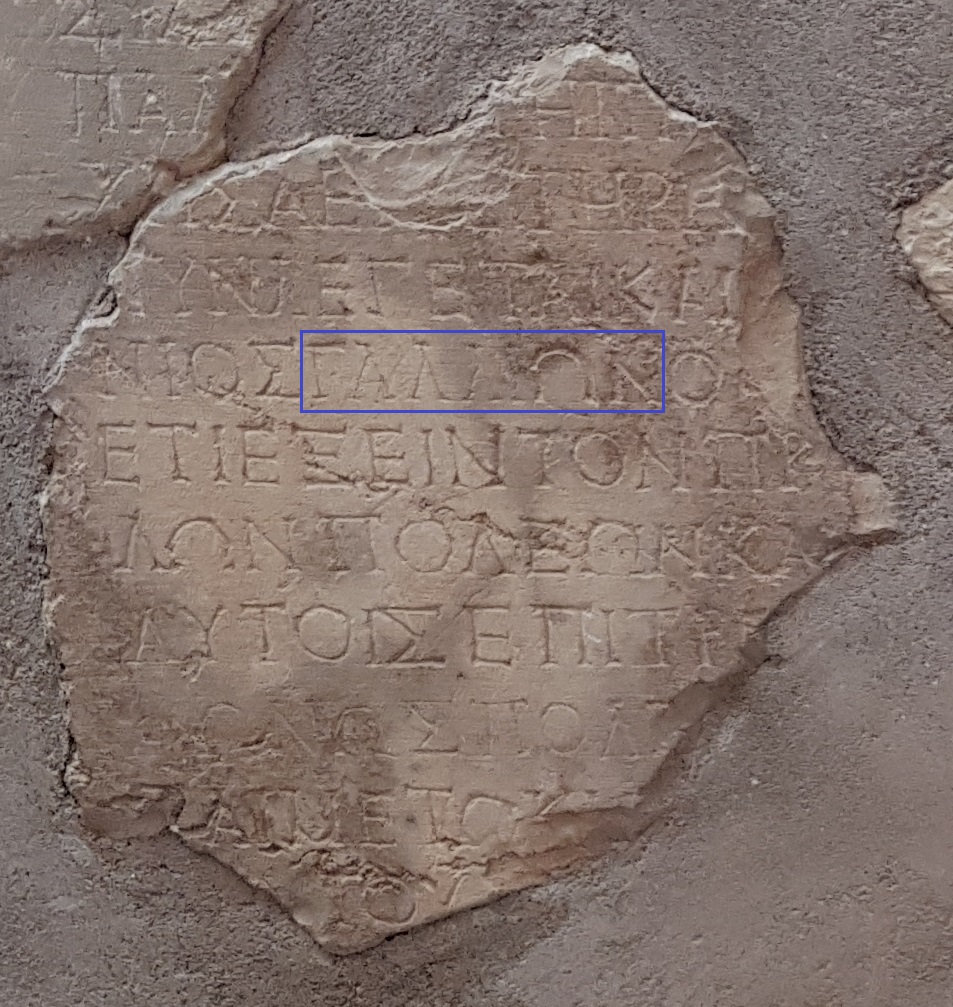
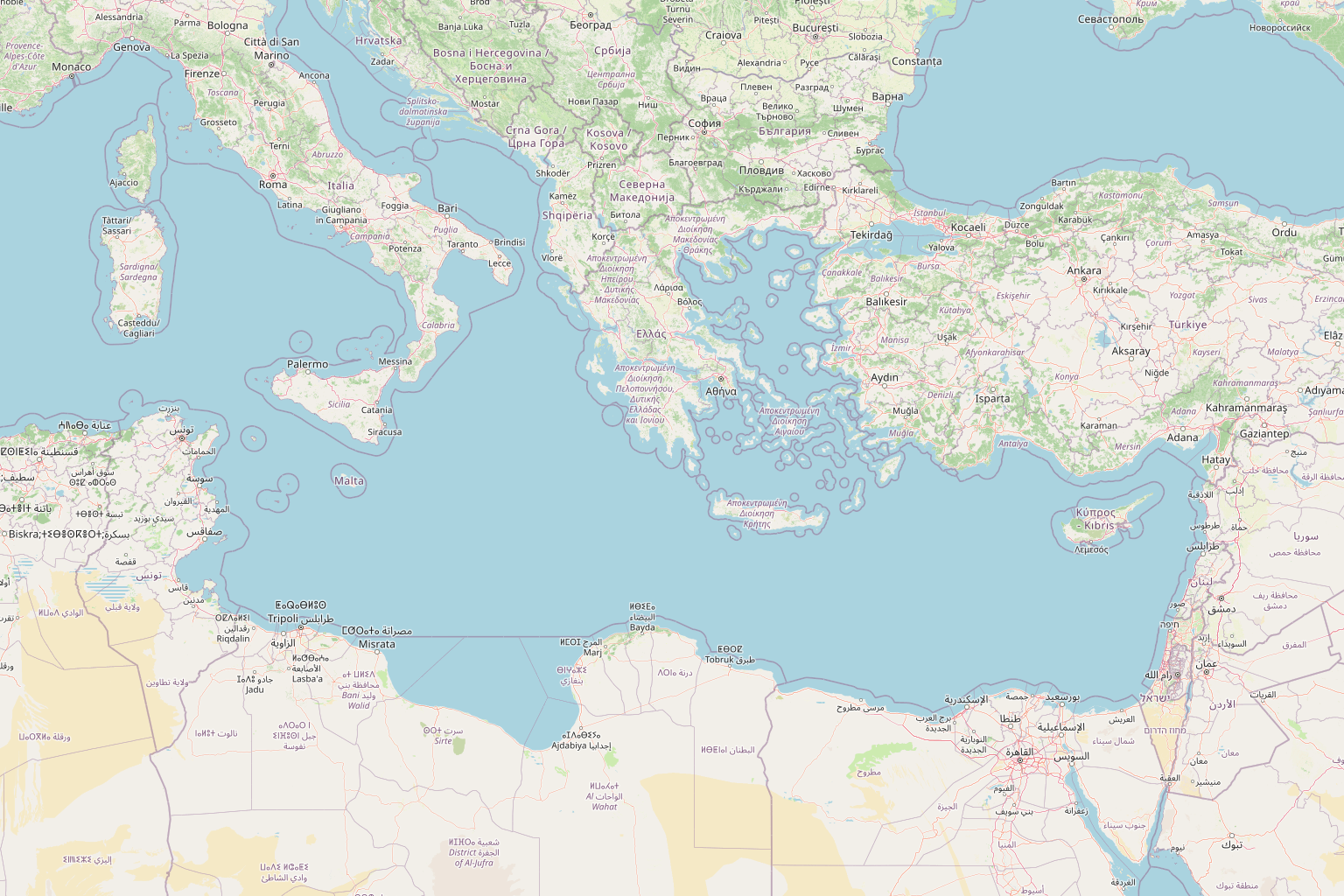
| The Gallio Inscription at Delphi — the linchpin of New Testament chronology. | A stone copy of a letter of the emperor Claudius names Gallio as proconsul of Achaia and dates his term to c. AD 51–52. Acts places Paul before this exact official ('when Gallio was proconsul of Achaia') at Corinth, fixing Paul's Corinthian ministry to AD 50–52. This is the firmest absolute date in the entire New Testament and calibrates the whole Pauline timeline. | Delphi (Gallio) Inscription, SIG³ 801d; Acts 18:12But when Gallio was proconsul of Achaia, the Jews with one accord rose up against Paul and brought him before the judgment seat, (WEB) ▸ source textThe Delphi (Gallio) Inscription is a set of stone fragments of a letter from the emperor Claudius, carved on the wall of the temple of Apollo at Delphi, which names Lucius Junius Gallio as proconsul of Achaia and refers to Claudius's 26th acclamation as imperator, dating it to about AD 51–52. Because Acts 18:12 places Paul before Gallio's tribunal at Corinth, the inscription supplies the firmest absolute date in the New Testament, anchoring Paul's Corinthian ministry to roughly AD 50–52 and calibrating the whole Pauline chronology. Delphi (Gallio) Inscription, SIG³ (Sylloge Inscriptionum Graecarum, 3rd ed.) 801d; fragments in the Delphi Archaeological Museum. |
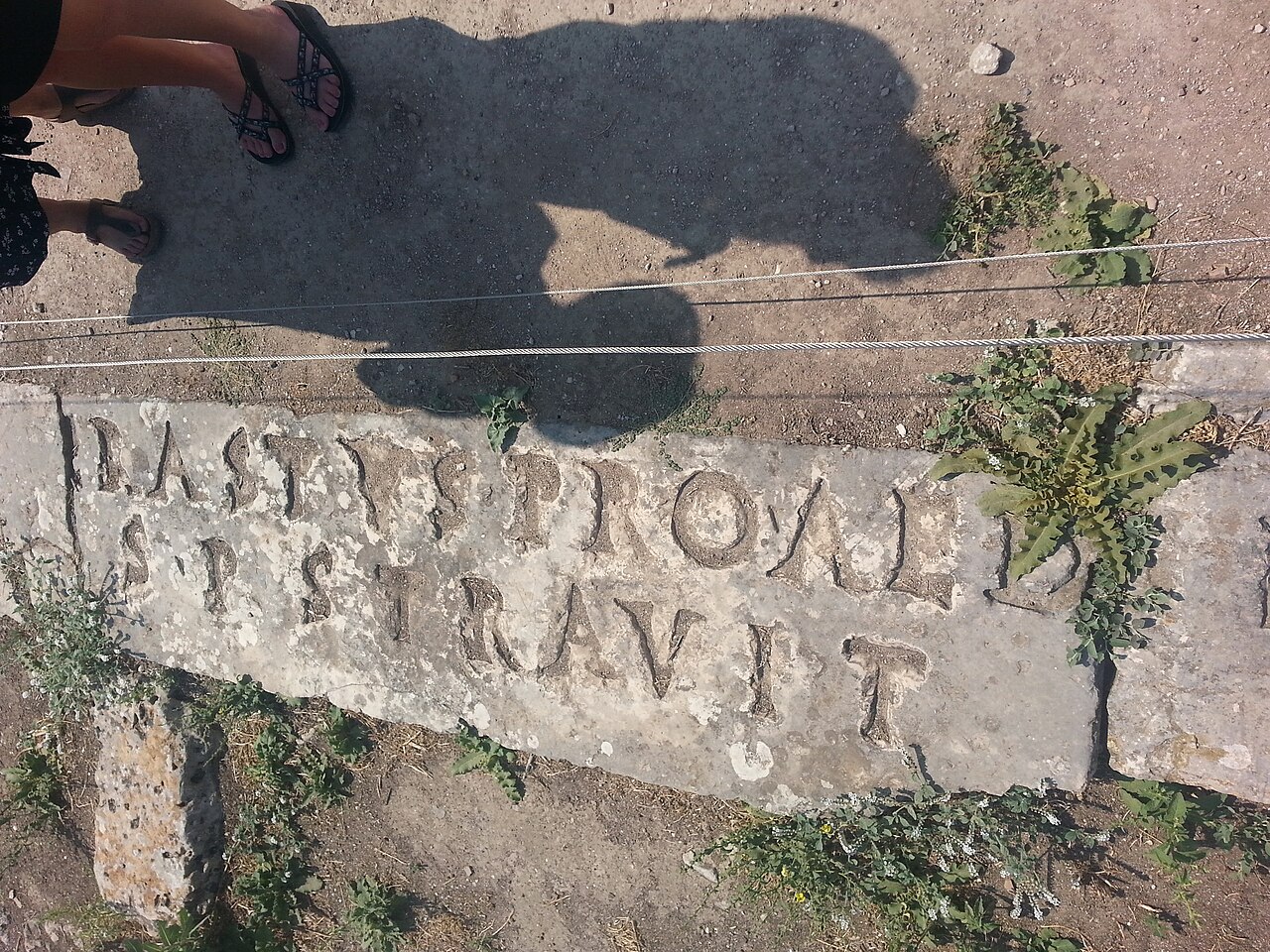
| The Erastus Inscription in the pavement at Corinth. | A first-century Latin inscription near the theatre reads ERASTVS PRO AEDILIT[AT]E S P STRAVIT — 'Erastus, in return for his aedileship, laid this pavement at his own expense.' Paul, writing from Corinth, sends greetings from 'Erastus, the city treasurer (oikonomos).' The name, city, and civic-office profile line up remarkably; even granting scholarly caution about identity, the fit is striking. | Erastus pavement, Corinth (excavated 1929); Rom 16:23Gaius, my host and host of the whole assembly, greets you. Erastus, the treasurer of the city, greets you, as does Quartus, the brother. (WEB) ▸ source textA first-century Latin paving inscription uncovered in 1929 beside the theatre at Corinth reads 'ERASTVS PRO AEDILIT[AT]E S P STRAVIT' — 'Erastus, in return for his aedileship, laid [this pavement] at his own expense.' Paul, writing to Rome from Corinth, sends greetings from 'Erastus, the city treasurer (oikonomos)' (Rom 16:23). Many scholars connect the two men, since the name, city, and civic-office profile align, though some remain cautious because the Greek and Latin titles differ. Erastus pavement, in situ by the theatre at Corinth; excavated by the American School of Classical Studies, 1929. |
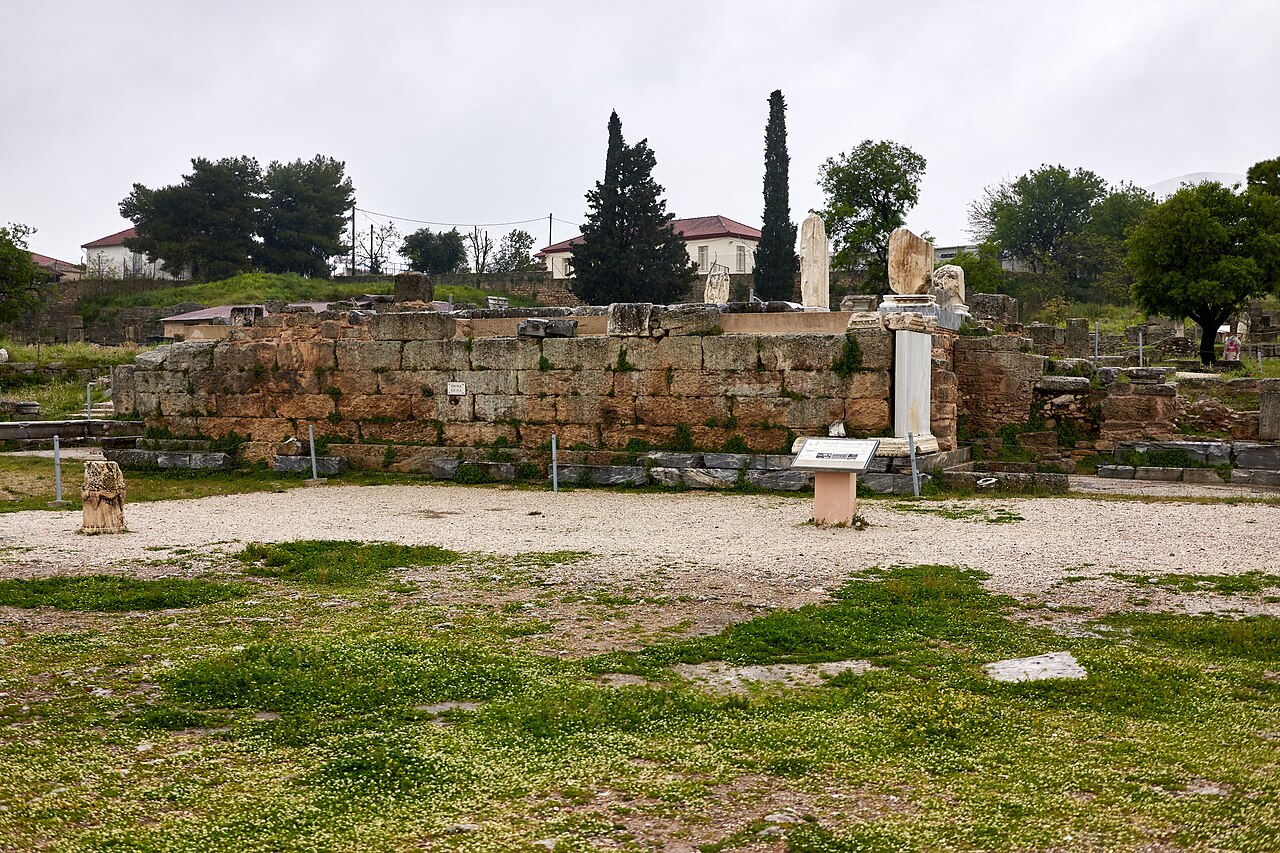
| The Bema (judgment seat) in the Corinthian forum. | The raised public tribunal where Paul was hauled before Gallio has been excavated in the center of the Corinthian agora. Acts' account of Paul 'brought before the judgment seat (bēma)' matches a real, locatable feature of the city. | Bema, Corinth agora; Acts 18:12-17But when Gallio was proconsul of Achaia, the Jews with one accord rose up against Paul and brought him before the judgment seat, saying, “This man persuades men to worship God contrary to the law.” But when Paul was about to open his mouth, Gallio said to the Jews, “If indeed it were a matter of wrong or of wicked crime, you Jews, it would be reasonable that I should bear with you; but if they are questions about words and names and your own law, look to it yourselves. For I don’t want to be a judge of these matters.” So he drove them from the judgment seat. Then all the Greeks laid hold on Sosthenes, the ruler of the synagogue, and beat him before the judgment seat. Gallio didn’t care about any of these things. (WEB) ▸ source textThe bema was the raised stone tribunal, or judgment seat, in the central agora of Corinth from which Roman magistrates heard legal cases and addressed the public. It has been excavated and is clearly identifiable in the center of the Corinthian forum. Acts 18:12-17 describes Paul being dragged before the bema when Gallio was proconsul, matching a real, locatable civic feature of the city. Bema (judgment seat), central agora of Corinth; excavated by the American School of Classical Studies at Athens. |
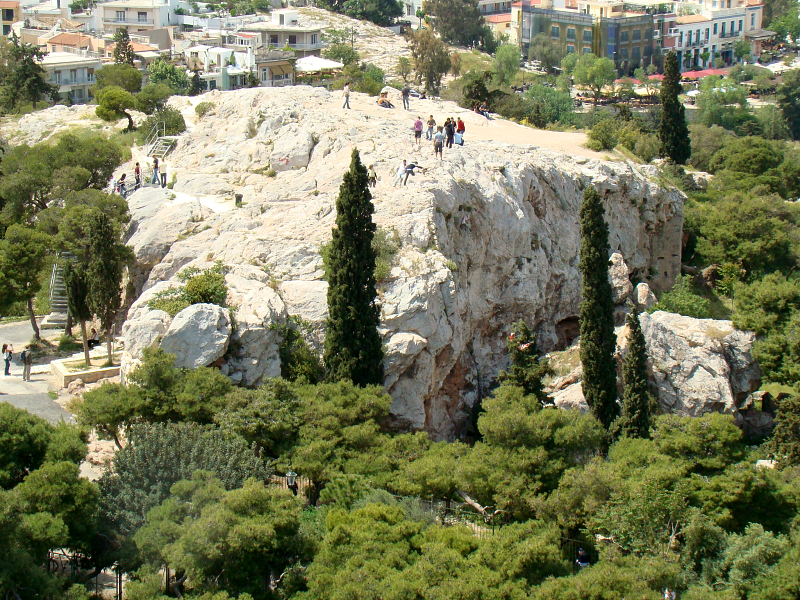
| The Areopagus (Mars Hill) at Athens. | The rocky council-hill where Paul is said to have addressed Athenian philosophers, quoting their own poets, is a fixed and identifiable Athenian landmark below the Acropolis — the correct venue for exactly the kind of learned civic discourse Acts describes. | Areopagus, Athens; Acts 17:19-34They took hold of him, and brought him to the Areopagus, saying, “May we know what this new teaching is, which is spoken by you? For you bring certain strange things to our ears. We want to know therefore what these things mean.” Now all the Athenians and the strangers living there spent their time in nothing else, but either to tell or to hear some new thing. Paul stood in the middle of the Areopagus, and said, “You men of Athens, I perceive that you are very religious in all things. For as I passed along, and observed the objects of your worship, I found also an altar with this inscription: ‘TO AN UNKNOWN GOD.’ What therefore you worship in ignorance, this I announce to you. The God who made the world and all things in it, he, being Lord of heaven and earth, doesn’t dwell in temples made with hands, neither is he served by men’s hands, as though he needed anything, seeing he himself gives to all life and breath, and all things. He made from one blood every nation of men to dwell on all the surface of the earth, having determined appointed seasons, and the boundaries of their dwellings, that they should seek the Lord, if perhaps they might reach out for him and find him, though he is not far from each one of us. ‘For in him we live, and move, and have our being.’ As some of your own poets have said, ‘For we are also his offspring.’ Being then the offspring of God, we ought not to think that the Divine Nature is like gold, or silver, or stone, engraved by art and design of man. The times of ignorance therefore God overlooked. But now he commands that all people everywhere should repent, because he has appointed a day in which he will judge the world in righteousness by the man whom he has ordained; of which he has given assurance to all men, in that he has raised him from the dead.” Now when they heard of the resurrection of the dead, some mocked; but others said, “We want to hear you again concerning this.” Thus Paul went out from among them. But certain men joined with him, and believed, among whom also was Dionysius the Areopagite, and a woman named Damaris, and others with them. (WEB) ▸ source textThe Areopagus ('Hill of Ares,' Latin 'Mars Hill') is a rocky outcrop just northwest of the Athenian Acropolis that gave its name to the ancient Athenian council. It is a fixed, identifiable landmark and the recognized venue for civic and philosophical deliberation in Athens. Acts 17:19-34 places Paul's address to Athenian philosophers here — the fitting setting for the learned discourse the narrative describes. Areopagus, Athens, below the northwest slope of the Acropolis. |
| Nabatean coins and inscriptions of Aretas IV. | Aretas IV Philopatris ruled the Nabatean kingdom until his death c. AD 40, attested by abundant coinage and inscriptions. Paul's mention of 'the governor under King Aretas' guarding Damascus fits a narrow real-world window and even helps date Paul's early movements, since Aretas' authority over the Damascus region ends by AD 40. | Nabatean coinage/inscriptions of Aretas IV; 2 Cor 11:32In Damascus the governor under King Aretas guarded the Damascenes’ city, desiring to arrest me. (WEB) ▸ source textAretas IV Philopatris ('lover of his people') ruled the Nabatean kingdom from Petra c. 9 BC to c. AD 40 and is abundantly attested by coins and inscriptions bearing his name and those of his queens. His reign fixes a real-world window for Paul's statement in 2 Cor 11:32 that 'the governor under King Aretas' was guarding Damascus to seize him, and because Aretas's authority over the region ends by about AD 40, it also helps date Paul's early movements. Nabatean coinage and inscriptions of Aretas IV (r. c. 9 BC – c. AD 40); various museum collections. |
| The Temple 'soreg' warning inscription from Jerusalem. | A Greek inscription (found by Clermont-Ganneau in 1871, with a second fragment in 1935) warned that no foreigner may pass the balustrade around the sanctuary on pain of death. This is precisely the barrier behind the charge that Paul had 'brought Greeks into the temple' — the accusation that triggered his arrest — confirming the exact custom the narrative assumes. | Temple Warning (soreg) Inscription, Istanbul Archaeology Museum; Acts 21:28crying out, “Men of Israel, help! This is the man who teaches all men everywhere against the people, and the law, and this place. Moreover, he also brought Greeks into the temple, and has defiled this holy place!” (WEB) ▸ source textA Greek inscription from the balustrade (soreg) around the inner courts of the Jerusalem Temple warned that no foreigner might pass the barrier on pain of death — in substance: 'No foreigner is to enter within the balustrade and enclosure around the sanctuary; whoever is caught will have himself to blame for the death that follows.' A complete slab was found by Charles Clermont-Ganneau in 1871 and a second fragment in 1935. It confirms the exact barrier behind the charge in Acts 21:28 that Paul had brought Greeks past it into the temple, the accusation that triggered his arrest. Temple Warning (soreg) Inscription; complete slab (1871) in the Istanbul Archaeology Museum; fragment (1935) in the collections at Jerusalem. |
| Ancient witness | What they say | Reference |
|---|---|---|
| Clement of Rome, c. AD 96 | Writing from Rome, Clement calls him 'the blessed Paul the Apostle,' recounts his sufferings and martyrdom, and expressly tells the Corinthians to 'take up the epistle of the blessed Paul' — i.e., 1 Corinthians — as an authoritative letter already circulating within a generation of Paul's death. | 1 Clement 5:5-7; 1 Clement 47:1Writing from Rome c. AD 96, Clement sets the apostles before his readers' eyes: 'Owing to envy, Paul also obtained the reward of patient endurance, after being seven times thrown into captivity, compelled to flee, and stoned. After preaching both in the east and west... he suffered martyrdom under the prefects... and so was removed from the world.' In 47:1 he urges the Corinthians, 'Take up the epistle of the blessed Apostle Paul' — treating 1 Corinthians as an authoritative letter already circulating within a generation of Paul's death. 1 Clement 5; 47:1 — tr. Roberts-Donaldson, Ante-Nicene Fathers vol. 1 (public domain). |
| Polycarp of Smyrna, c. AD 110 (and Ignatius, c. AD 107) | Polycarp praises 'the blessed and glorious Paul,' reminds the Philippians that Paul had written to them, and quotes his letters as authoritative. Ignatius of Antioch, en route to martyrdom, likewise honors Paul and echoes his epistles. Two independent bishops in Asia Minor treat the Pauline corpus as established. | Polycarp, To the Philippians 3:2, 11:2-3; Ignatius, To the Ephesians 12:2Polycarp of Smyrna tells the Philippians that neither he 'nor any other such one, can come up to the wisdom of the blessed and glorious Paul,' who taught among them and 'wrote you a letter' (To the Philippians 3:2), and in chapter 11 (extant only in Latin) he again recalls Paul's labor and correspondence with them. Ignatius of Antioch, en route to martyrdom, calls the Ephesians 'companions in the mysteries of Paul... who in all his Epistles makes mention of you in Christ Jesus' (To the Ephesians 12:2). Two bishops of Asia Minor thus treat Paul's letters as established and authoritative. Polycarp, To the Philippians 3:2 (and 11:2-3, Latin); Ignatius, To the Ephesians 12:2 — tr. Roberts-Donaldson, Ante-Nicene Fathers vol. 1 (public domain). |
| 2 Peter 3:15-16 (first century / early second) | This letter already speaks of 'our beloved brother Paul' who wrote 'in all his letters,' and puts those letters on the level of Scripture — the untaught twist them 'as they do the other Scriptures.' Paul's writings were being read as a recognized, quasi-canonical collection extremely early. | 2 Peter 3:15-16Regard the patience of our Lord as salvation; even as our beloved brother Paul also, according to the wisdom given to him, wrote to you; as also in all of his letters, speaking in them of these things. In those, there are some things that are hard to understand, which the ignorant and unsettled twist, as they also do to the other Scriptures, to their own destruction. (WEB) |
| Marcion of Sinope, c. AD 140 | The heretic Marcion built his canon around a ten-letter Pauline collection (the Apostolikon), omitting the Pastorals. Even a hostile, selective editor presupposes that a fixed body of Paul's letters already existed and carried supreme authority by the 130s–140s. | Marcion's Apostolikon (reconstructed via Tertullian, Adv. Marcionem)Around AD 140 Marcion of Sinope compiled the earliest known fixed collection of Pauline letters, the 'Apostolikon,' comprising ten epistles (Galatians, 1–2 Corinthians, Romans, 1–2 Thessalonians, 'Laodiceans' [= Ephesians], Colossians, Philippians, and Philemon) while omitting the Pastorals. The collection survives only through refutations, chiefly Tertullian's five-book 'Against Marcion' (Adversus Marcionem), which quotes and rebuts Marcion's edited text. Even this hostile, selective editor presupposes that an authoritative body of Paul's letters already existed by the 130s–140s. Reconstructed from Tertullian, Adversus Marcionem (c. AD 207) — factual summary, not a direct quotation. |
| The Muratorian Fragment, c. AD 170–200 | The oldest known list of New Testament books enumerates Paul's letters to churches and individuals by name, treating them as the accepted writings of the apostle to the Gentiles. | Muratorian Canon, lines 39–68The Muratorian Fragment is an 8th-century Latin manuscript (discovered by L.A. Muratori and published in 1740) preserving a canon list usually dated c. AD 170–200 — the oldest known list of New Testament books. Lines 39–68 enumerate Paul's letters, noting that he wrote 'by name to only seven churches' (the Corinthians, Ephesians, Philippians, Colossians, Galatians, Thessalonians, and Romans) plus one letter each to Philemon and Titus and two to Timothy, while rejecting forged letters to the Laodiceans and Alexandrians. It thus treats the Pauline corpus as the accepted writings of the apostle to the Gentiles. Muratorian Canon, lines 39–68 (Ambrosian Library manuscript, Milan); facts/paraphrase following the Tregelles public-domain translation (1867). |
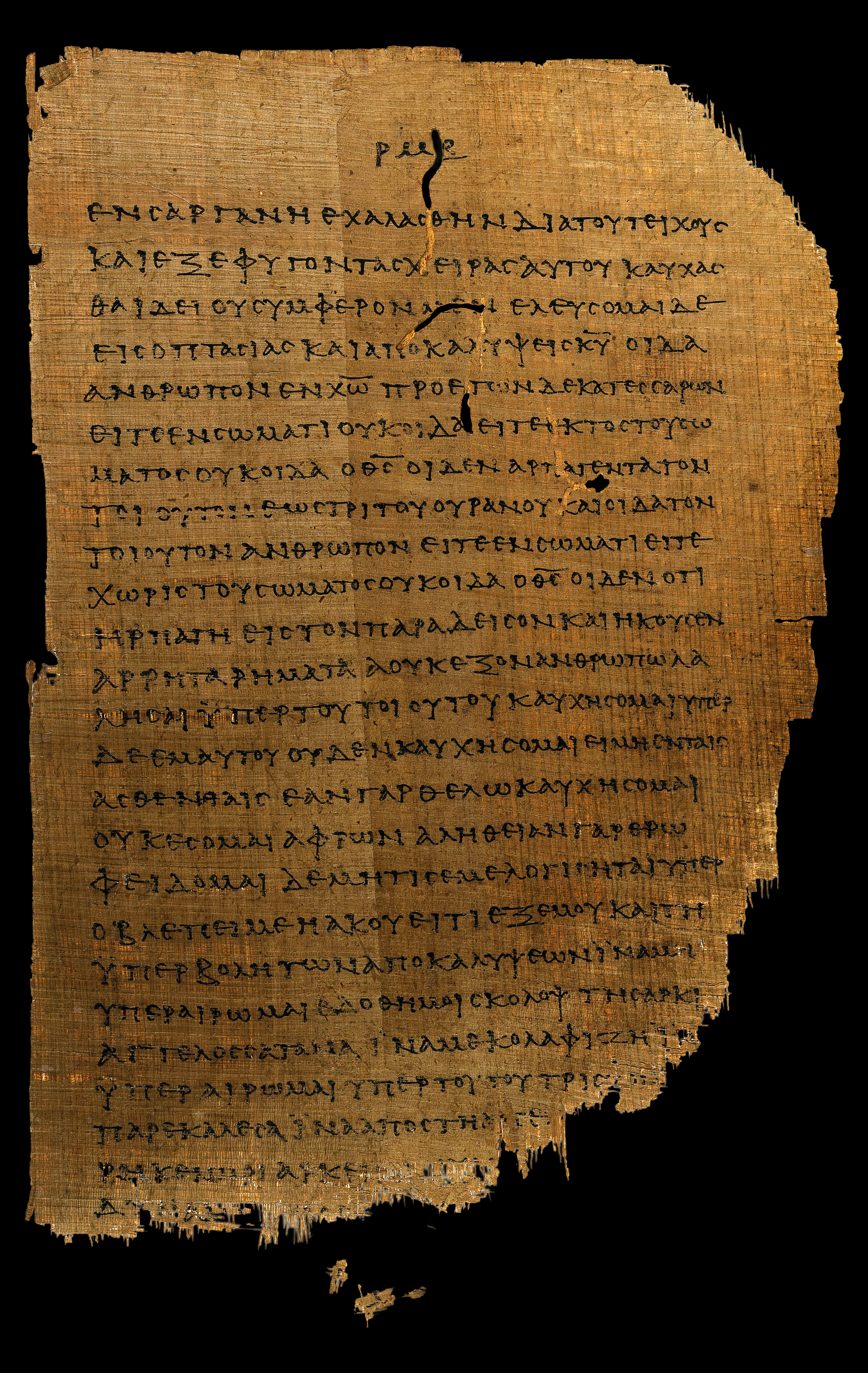
| Irenaeus, c. AD 180 (with Tertullian and the manuscript P46, c. AD 200) | Irenaeus quotes Paul's letters by name hundreds of times as authoritative apostolic Scripture, and Tertullian defends the full corpus against Marcion. The physical evidence keeps pace: P46 (Chester Beatty II), a codex of Paul's letters dated c. AD 175–225, is the earliest surviving collection of his epistles. | Irenaeus, Adv. Haer. (passim); Tertullian, Adv. Marcionem; P46 (Chester Beatty Papyrus II)Irenaeus of Lyons (Against Heresies, c. AD 180) quotes Paul's letters by name hundreds of times as authoritative apostolic Scripture, and Tertullian (Against Marcion, c. AD 207) defends the full Pauline corpus against Marcion's abridgment. The physical evidence keeps pace: P46 (Chester Beatty Papyrus II), a papyrus codex of Paul's letters dated c. AD 175–225, is the earliest surviving collection of his epistles, preserving large portions of Romans, Hebrews, 1–2 Corinthians, Ephesians, Galatians, Philippians, Colossians, and 1 Thessalonians. Irenaeus, Adversus Haereses (passim); Tertullian, Adversus Marcionem; P46 = Chester Beatty Papyrus II / P. Mich. inv. 6238 (c. AD 175–225). Mixed ancient works plus a manuscript; description is factual, not a quotation. |
Two lines of critique deserve a fair hearing. First, on authorship: critical scholars (notably Bart Ehrman, Forged) hold that six of the thirteen letters are pseudonymous — Ephesians, Colossians, and 2 Thessalonians on grounds of divergent vocabulary and style, and the Pastorals (1–2 Timothy, Titus) most strongly of all, because their advanced church structure (bishops, elders, deacons as settled offices), later vocabulary, and theology look like a second-generation situation Paul did not live to see. Second, on history: the mythicist Richard Carrier argues that Paul's Christ was a purely celestial being — crucified by demonic powers in a supra-lunar realm, never a man who walked Galilee — pointing to Paul's near-silence on Jesus' earthly life and teaching.
Both concessions can be made without weakening the core. On authorship, the entire historical case for Paul rests on the seven undisputed letters (Romans, 1–2 Corinthians, Galatians, Philippians, 1 Thessalonians, Philemon), whose authenticity is granted even by skeptics like Ehrman — so nothing essential rides on the six contested ones, and we grade them honestly as disputed rather than defend them as certain. On the celestial-Jesus reading, Paul repeatedly plants Jesus in real history within those very undisputed letters: he was 'born of a woman, born under the law' (Gal 4:4), 'descended from David according to the flesh' (Rom 1:3), instituted the Lord's Supper 'on the night when he was betrayed' (1 Cor 11:23-25), had brothers, one of whom — James the Lord's brother — Paul personally met (Gal 1:19; 1 Cor 9:5). Carrier's view is a minority position rejected across the field; even the agnostic Ehrman wrote a whole book (Did Jesus Exist?) refuting it.
See also: the directory · the full roster · verified by outsiders · how we verify the NT.